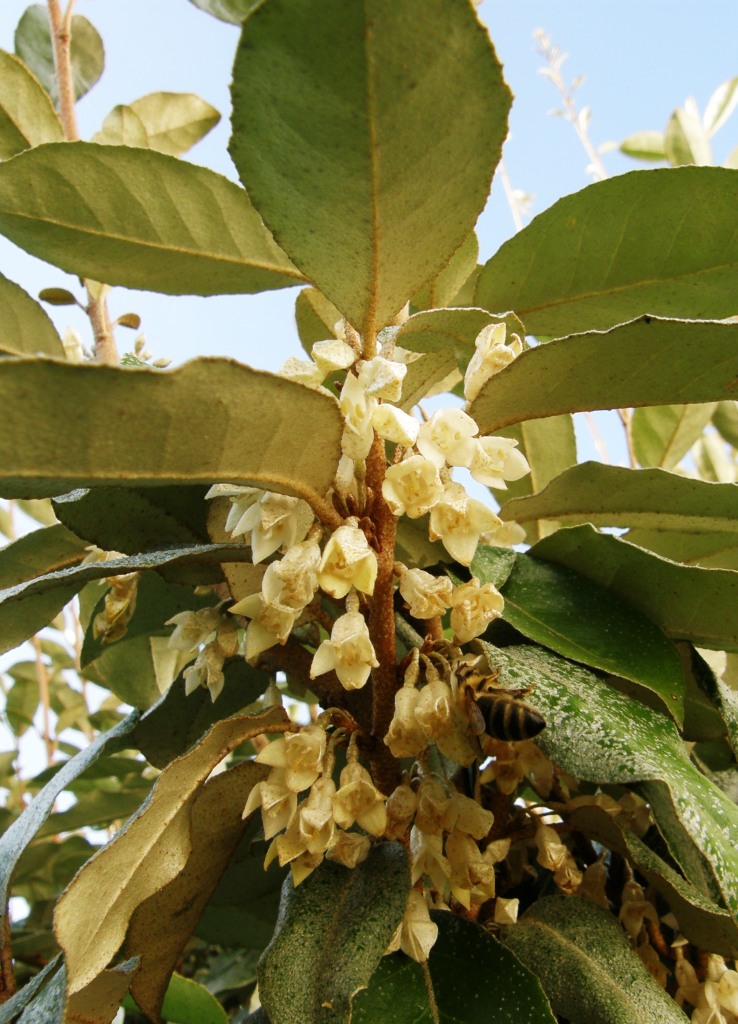
Photo: VoDeTan2Dericks-Tan, CC BY-SA 3.0 · source

Shrub · Elaeagnaceae
Ebbinge’s silverberry
Elaeagnus × ebbingei
In other languages: Olijfwilg (Nederlands) · Chalef d’Ebbinge (Français)
Ebbinge’s silverberry is an evergreen shrub raised in the Netherlands around 1930 as a cross between two Asian species. It grows into a dense shrub about 3 m high and wide, with leathery leaves that are dark green above and silvery white beneath. In October and November small, creamy white flowers appear among the leaves, with a surprisingly strong, sweet scent. Gardeners mainly choose it as a tough hedging plant that copes with wind, sea air and drought. Well-known variegated cultivars are ‘Limelight’, with a yellow centre to the leaf, and ‘Gilt Edge’, with a golden margin.
Light
Sun to shade
not fussy
Moisture
Dry to normal
no wet feet
Legal basis
Sand, loam or clay
any pH
Hardiness
down to -18 °C
protect young plants
Size
3 m
tall, 3 m wide
Flowering
October–November
| Pruning months | May and August |
|---|---|
| Height | 3 m |
| Native to Belgium | No, planted |
| Good for bees, butterflies and birds | Yes, for bees |
| Poisonous to people and pets | Not known to be poisonous |
| Flowering | October–November |
Identify
Ebbinge’s silverberry: how do you recognise it?
- Habit
- A dense, broadly upright shrub 3 m high and wide; as a hedge easily kept at 1.5–2 m.
- Leaves
- Oval, leathery, 5–10 cm; glossy dark green above, silvery white beneath with fine scales.
- Shoots
- Young shoots are covered in brownish-silver scales; the shrub is almost thornless.
- Flowers
- Small, tubular, creamy white flowers in the leaf axils, in October–November, with a strong, sweet scent.
- Fruit
- Sometimes small, orange-red berries speckled with silver in April–May.
- Roots
- With nodules containing bacteria that fix nitrogen from the air.
Flowering: October–November · Harvest and fruit: April–May · Plants: April–May and September–October · Pruning: May and August
In your garden
Why grow it?
- A fast-growing evergreen hedge that gives privacy and shelter all year.
- Tolerates wind, sea air and drought: ideal on the coast and in dry spots.
- Fragrant flowers in October and November, when little else is in bloom; bees still visit them.
- Grows in sun, partial shade and shade, on almost any soil.
- The silvery foliage makes it lighter and fresher than many other evergreens.
Ebbinge’s silverberry: where does it grow best?
- Sun, partial shade or shade; it grows densest in sun.
- Any well-drained soil: sand, loam or clay, acid to chalky.
- Dry to moist; it dislikes wet, waterlogged soil.
- Resistant to wind and sea air, but young plants prefer shelter from cold east winds.
- For a hedge 2–3 plants per metre; as a free-standing shrub allow 2.5–3 m.
- Light
- Sun, partial shade and shade
- Soil type
- Sand, loam or clay
- Acidity
- Not fussy
- Moisture
- Dry or normal
- Size
- 3 m tall, 3 m wide
- Hardiness
- Hardy (to -18 °C)
Goes well with
- Escallonia: Another wind-resistant hedging plant, with pink or white flowers in summer.
- Lavender: A low, silver-grey edging in sun in front of the hedge.
- Fountain grass: Soft plumes in late summer in front of the dark hedge.
- Elephant’s ears: Evergreen leaves at the base, even in shade.
Maintenance
Ebbinge’s silverberry: when and how to plant it?
Plant in April–May and September–October.
- Plant in April–May or September–October.
- Dig a hole or, for a hedge, a trench 40 cm deep and twice as wide as the root ball.
- Set the plant at the same depth as it was in the pot and firm the soil well.
- Leave 35–50 cm between hedging plants, or 2.5–3 m around a single shrub.
- Water generously straight away, then weekly in dry weather during the first year.
- Mulch with wood chips or compost to prevent drying out and suppress weeds.
Care
- Watering
- Water faithfully in dry spells during the first year. After that it is very drought-tolerant.
- Feeding
- Rarely needed: it takes nitrogen from the air itself. On poor sandy soil perhaps a little compost in spring.
- Mulching
- A layer of wood chips around young plants holds moisture and keeps weeds down.
- Green shoots
- On variegated cultivars, cut out all-green shoots at the base straight away.
- Hedge
- Trimming twice a year keeps the hedge dense: in May and, if needed, in August.
Tip: Plant it by the patio, a path or the front door: you will hardly see the flowers, but in October you can smell them from a distance.
Ebbinge’s silverberry: when to prune it?
Pruning months: May and August.
When: Prune in May and, if needed, a second time in August.
How:
- Shape a hedge with shears, slightly wider at the bottom than at the top so light reaches the base.
- On a free-standing shrub, cut long, protruding shoots back to just above a leaf or side shoot.
- An overgrown or bare shrub tolerates hard rejuvenation pruning in spring; it shoots again from old wood.
- Remove dead branches at any time, cutting back into healthy wood.
Caution: Do not prune in late autumn or winter: the young shoots that follow are vulnerable to frost.
Propagation
- Semi-ripe cuttings
- In August–September take 10–15 cm cuttings, remove the lower leaves and insert them in moist cutting compost under plastic or in a cold frame. Be patient: they are slow to root.
- Layering
- In spring, peg a low branch into the soil; after a year, sever it and transplant it.
Ebbinge’s silverberry: how does it get through the winter?
Hardy to −18 °C: protect young plants.
- Hardy to about −18 °C: no problem in most Belgian winters.
- After a severe winter with cold, dry wind it may lose many leaves or show brown foliage; it usually shoots again in spring.
- In the first year, protect young plants in hard frost with a windbreak or fleece.
- Evergreens lose water in winter too: water plants in pots or containers now and then in dry winter weather.
Diseases and pests
- Branch dieback: A whole branch suddenly wilts and dries out, often in summer. Cut it back into healthy wood and disinfect your secateurs.
- Leaf drop after frost: Brown leaves and bare branches after a hard winter. Wait until May: whatever has not shot by then, cut out.
- Reversion: Variegated cultivars sometimes produce all-green shoots. These are more vigorous; cut them out at the base straight away.
- Root rot: Yellow leaves and a sickly plant on wet, heavy soil. Move it to a better-drained spot.
Through the year
- March: Check for frost damage and cut out dead branches.
- April: Planting. Mulching.
- May: Trim the hedge into shape. Planting.
- June: Water young plants in dry spells.
- August: Optional second, light trim. Take semi-ripe cuttings.
- September: Planting. Take cuttings.
- October: In flower: small, strongly scented flowers. Planting.
- November: Last flowers. Protect young plants from cold winds.
Use
Edible and useful
- Berries (April–May)
- On the widely planted hedging elaeagnus (Elaeagnus × ebbingei), the small, oblong, silver-speckled berries ripen in April and May, when there is little other fruit about. Pick them when they are deep red and soft: then they taste sweet-sour; unripe they are astringent. Eat them fresh and spit out the stone, or cook them into a purée or jam. Other species, such as autumn olive, only ripen in September–October.
- Storing
- Fresh berries keep for a few days in the fridge. Purée and jam can be frozen or kept in clean, hot jars.
Caution: Only pick fully ripe, red berries. Be sure of the shrub: the red berries of honeysuckle, spindle and skimmia, among others, are poisonous. You can recognise elaeagnus by the silvery scales on the underside of the leaves and on the berries.
Eating and using is at your own risk: see the terms of use.
Recipes
- Spring jam of elaeagnus and rhubarb (Jam · ± 3 jars · 45 min)
- Elaeagnus compote with vanilla (Compote · ± 400 ml (2 small jars) · 35 min)
- Elaeagnus fruit leather (Dried · ± 10 strips · 30 min + 6–8 hrs drying)
Good for wildlife
- Bees
- Nectar and pollen for honeybees and wild bees.
You and this species
Did you know?
- It lives together with bacteria in nodules on its roots, which fix nitrogen from the air. That is why it grows well on poor soil.
- The silver on the underside of the leaves consists of tiny, shield-shaped scales.
- It is a hybrid between Elaeagnus macrophylla and Elaeagnus pungens.