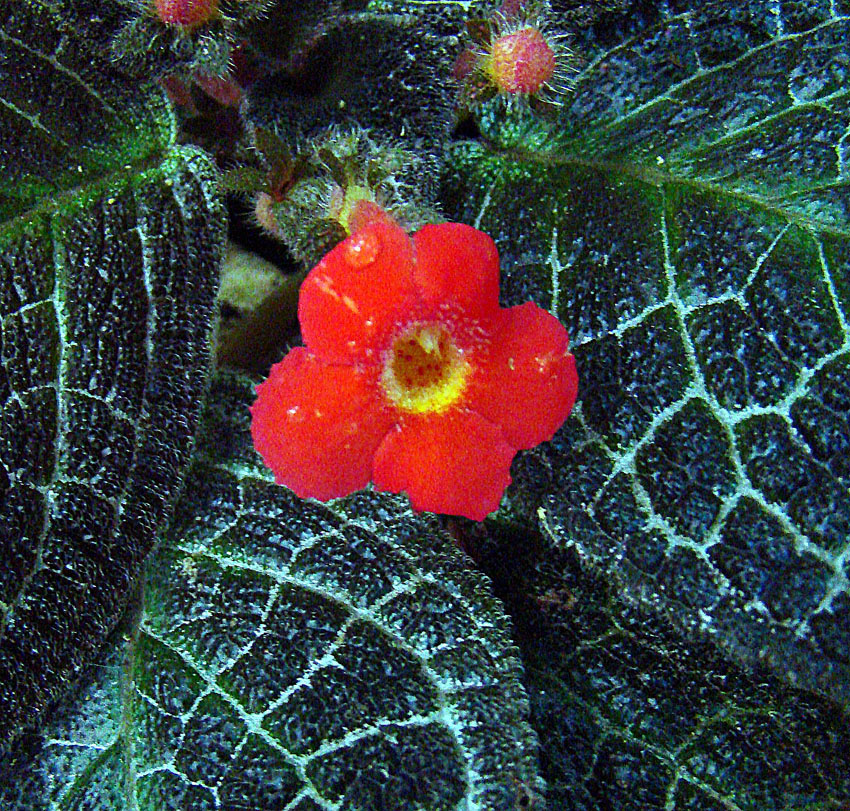
Photo: Dick Culbert from Gibsons, B.C., Canada, CC BY 2.0 · source

Houseplant · Gesneriaceae
Flame violet
Episcia cupreata
In other languages: Episcia (Nederlands) · Episcia (Français)
The flame violet comes from the rainforests of Central and South America, including Colombia and Venezuela, where it grows as a low carpet under tall trees. It is a creeping plant with velvety, quilted leaves in bronze, copper, olive green and silver, often marked with pink or silvery veins. With its long runners it forms a dense mat or trails gracefully over the rim of a pot. It also produces bright red to orange-red tubular flowers. It is related to the African violet and wants the same warm, humid conditions.
Light
Partial shade
no harsh midday sun
Moisture
Normal
no wet feet
Legal basis
Potting soil
Hardiness
Houseplant
min. 15 °C
Size
0.15 m
tall, 0.4 m wide
Flowering
May–September
| Pruning months | March |
|---|---|
| Height | 0.15 m |
| Poisonous to people and pets | Not known to be poisonous |
| Flowering | May–September |
Identify
Flame violet: how do you recognise it?
- Growth habit
- Low, creeping and trailing; about 15 cm tall and up to 40 cm wide, with long runners that form new plantlets.
- Leaves
- Oval, quilted and finely hairy, 5–10 cm long. Bronze to coppery with silvery-green or pink veins, depending on the variety.
- Flower
- Tubular, bright red to orange-red, with a yellow throat and a lobed mouth, from May to September.
- Roots
- Fine and shallow: a wide, shallow pot or a hanging basket suits it best.
- Runners
- Long red stolons with a new plantlet at the tip, as on a strawberry.
Flowering: May–September · Plants: March–April · Pruning: March
In your garden
Why grow it?
- Beautiful velvety foliage in copper, bronze and silver tones, attractive all year.
- Flowers from May to September with bright red to orange tubular blooms, even in partial shade.
- Ideal for a hanging basket, a terrarium or a humid spot such as a bathroom with a window.
- The runners form new plantlets by themselves, so it is easy to make more.
- Stays small: a compact plant of about 15 cm tall.
Flame violet: where does it grow best?
- Plenty of light but no direct sun: a bright spot by an east- or north-facing window, or a little way back from a south-facing one. Full sun scorches the velvety leaves.
- Light, humus-rich, slightly acid compost: African violet compost or a mix of potting compost, peat and perlite.
- Warm and humid: 18–24 °C and never below 15 °C. High humidity is important.
- Keep it out of draughts and away from radiators. A tray of damp pebbles or a terrarium helps against dry air.
- Light
- Bright, out of direct sun
- Potting soil
- Multi-purpose compost or airy, humus-rich compost
- Acidity
- Acid or neutral
- Watering
- Moderately
- Size
- 0.15 m tall, 0.4 m wide
- Temperature
- Minimum 15 °C
Goes well with
- African violet: A relative with the same warm, bright spot and the same watering.
- Nerve plant (Fittonia): A veined foliage plant that also loves warmth and humidity.
- Prayer plant (Calathea): A foliage plant for the same humid, warm spot.
- Ferns: A green counterpart in a humid terrarium.
Maintenance
Flame violet: when and how to plant it?
Plant in March–April.
- Repot in March–April, when the roots fill the pot or the leaves go limp.
- Choose a wide, shallow pot or hanging basket with drainage holes; the roots stay close to the surface.
- Use a loose, airy compost: two parts African violet compost and one part perlite.
- Set the plant at the same depth as before and firm the compost lightly.
- Water with lukewarm water at the edge of the pot and put it in a bright, warm spot out of the sun.
Care
- Water
- Keep the compost evenly and lightly moist, never wet. Water with lukewarm, low-lime water at the edge of the pot and do not pour over the leaves: cold water causes brown spots.
- Humidity
- It wants high humidity, at least 50–60%. Use a pebble tray or a humidifier and do not mist the leaves.
- Feeding
- From March to October, every 2 weeks, give half the dose of a feed for flowering houseplants. Do not feed in winter.
- Spent flowers
- Remove faded flowers and limp stalks to keep it flowering.
- Repotting
- Once a year in spring, or divide the plant and pot the runners separately.
Tip: Put it in a terrarium or on a pebble tray with water: it will get the high humidity it wants. Water with lukewarm, low-lime water at the edge of the pot, never over the leaves.
Flame violet: when to prune it?
Pruning months: March.
When: In spring (March), and in between as needed.
How:
- Pinch out the tips of long shoots to get a bushier plant.
- Cut overly long or bare runners back, or pot them up as new plantlets.
- Remove dead or brown leaves at the base.
- Cut bare or yellowing stems right out; the plant soon regrows.
Caution: Cut with clean scissors and do not prune a cold, wet plant: it is more likely to get mould.
Propagation
- Runners
- All year, best in spring: place the plantlet at the end of a runner on moist compost, let it root and cut the link. In 2–4 weeks you have a new plant.
- Cuttings
- Take cuttings of 5–8 cm with a few leaves and set them in moist peat or perlite under a clear bag or in a terrarium. They root in a few weeks at 20–25 °C.
Flame violet: how does it get through the winter?
- Not hardy: the minimum temperature is 15 °C. It must never overwinter outdoors.
- Keep it warm (18–22 °C) and bright, out of the cold draught from a window.
- Water less and do not feed: the compost may dry out slightly between waterings.
- Put a pebble tray or humidifier near the heating, because dry air turns leaf edges brown.
Diseases and pests
- Brown spots on the leaves: Ring-shaped brown spots come from cold water or water drops in the sun. Use lukewarm water at the edge of the pot and dry any splashed leaves.
- Brown leaf edges: Dry air or water that is too hard. Raise the humidity and use rainwater or filtered water.
- Long, floppy shoots: Too little light: the colours fade and the plant stretches. Move it somewhere brighter, out of direct sun.
- Mealybugs and spider mites: White fluffy patches or fine webbing on the leaves. Remove mealybugs with a cotton bud dipped in soapy water; raise the humidity against spider mites.
Through the year
- January: Rest: keep warm, little water, no feeding.
- February: Rest. Still no feeding.
- March: Repot and prune. More water again.
- April: Start feeding. Let runners root.
- May: First flowers. Feed every 2 weeks.
- June: Flowering. Remove spent flowers.
- July: Flowering. Watch lukewarm watering and humidity.
- August: Flowering. Root runners to make new plants.
- September: Last flowers. Feed less.
- October: Stop feeding. Keep warm and bright.
- November: Rest. Little water, high humidity.
- December: Rest. Keep warm and bright.
You and this species
Did you know?
- It is related to the African violet and streptocarpus, which belong to the same plant family (the Gesneriaceae).
- The name Episcia comes from the Greek ‘episkios’, meaning ‘shaded’, after the place where it grows in the rainforest.
- The leaf colours are best in plenty of light without direct sun; in too little light they fade.