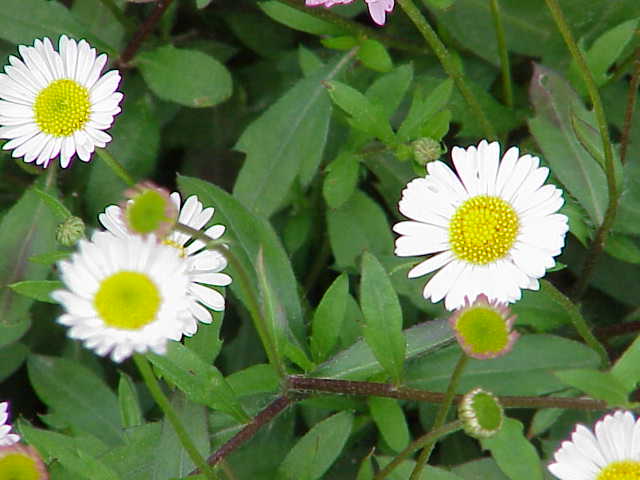
Photo: Kurt Stüber [1], CC BY-SA 3.0 · source

Perennial · Asteraceae
Mexican fleabane
Erigeron karvinskianus
In other languages: Mexicaanse fijnstraal (Nederlands) · Vergerette de Karvinski (Français)
Mexican fleabane is a small, exuberant perennial from Mexico and Central America. From May until the first frost it bears countless daisy-like flowers with a yellow centre, which open white and then turn pink. As a result, one plant seems to flower in white and pink at the same time. It is happiest in wall crevices, between steps and stones, in a rock garden or in a pot, where it seeds itself about. In garden centres you will often find the variety ‘Profusion’.
Light
Full sun
warm and bright
Moisture
Dry to normal
no wet feet
Legal basis
Sand or loam
any pH
Hardiness
down to -15 °C
protect young plants
Size
0.3 m
tall, 0.6 m wide
Flowering
May–October
| Pruning months | April and July |
|---|---|
| Height | 0.3 m |
| Native to Belgium | No, planted |
| Good for bees, butterflies and birds | Yes, for bees and butterflies |
| Poisonous to people and pets | Not known to be poisonous |
| Flowering | May–October |
Identify
Mexican fleabane: how do you recognise it?
- Habit
- A loose, cushion-forming to slightly trailing plant, about 30 cm tall and 60 cm wide.
- Leaves
- Small and narrow, sometimes three-lobed, on thin, wiry stems.
- Flower
- Daisies 1.5–2 cm across with fine rays around a yellow centre, from May to October.
- Colour
- White when opening, then pink to purplish pink; both colours at once on one plant.
- Seed
- Fluffy seed carried by the wind, which germinates in cracks and joints.
Flowering: May–October · Sowing: February–April · Plants: April–June · Pruning: April and July
In your garden
Why grow it?
- One of the longest-flowering perennials: from May until the frosts.
- Grows where little else will: in walls, between stones and in cracks in steps.
- Bees and butterflies visit the flowers all summer.
- Drought-tolerant and happy without fertiliser.
- Softens the hard edges of patios, walls and pots with an airy cloud of little flowers.
Mexican fleabane: where does it grow best?
- Full sun: that is where it flowers best.
- Well-drained sandy or loamy soil, including poor soil or a wall joint; acid, neutral or chalky.
- Dry to normally moist; it dislikes wet soil, especially in winter.
- Ideal in a wall, between steps, in a rock garden, along the edge of a patio or in a pot or hanging basket.
- Allow 30–40 cm between plants.
- Light
- Sun
- Soil type
- Sand or loam
- Acidity
- Not fussy
- Moisture
- Dry or normal
- Size
- 0.3 m tall, 0.6 m wide
- Hardiness
- Hardy (to -15 °C)
Goes well with
- Thyme: A low, fragrant ground cover for the same dry spot.
- Lavender: Blue spikes above the cloud of white and pink flowers.
- Stonecrop: Low succulents for walls and rock gardens.
- Catmint: A soft blue companion that also flowers for a long time.
Maintenance
Mexican fleabane: when and how to plant it?
Plant in April–June.
- Plant in April, May or June, as the soil warms up.
- Dig a small hole and on heavy soil mix in some coarse sand.
- In a wall crevice: scrape out a little old mortar, push a young plant with a little soil into the gap and firm it in.
- In a border, space plants 30–40 cm apart.
- Water well and keep the plant moist until it is established; in a wall this takes a little longer.
- Do not mulch; a thin layer of gravel around the base is fine.
Care
- Watering
- Hardly needed once established, except in pots and hanging baskets.
- Feeding
- Not needed; in a pot, give a little flowering-plant fertiliser now and then in summer.
- Trimming
- If it gets untidy or woody, trim it lightly in summer: it soon flowers again.
- Self-seeding
- It seeds itself about; pull out seedlings where you do not want them.
Tip: Put it once in a wall crevice or between steps and let it get on with it: it seeds itself about and fills the joints with flowers from May until the frosts.
Mexican fleabane: when to prune it?
Pruning months: April and July.
When: Remove old, withered stems in April, and trim lightly in July if it gets untidy.
How:
- In April, cut out old, withered and frosted stems back to the new growth.
- In summer, cut the clump back by a third if it loses its shape; it flowers again after a few weeks.
- Leave the stems standing in autumn: they protect the plant over winter.
Caution: Do not cut back in autumn: that makes it more vulnerable to frost.
Propagation
- Seed
- Sow indoors in February–April. Press the fine seed onto the compost and barely cover it. Plants flower in their first year.
- Seedlings
- In spring, dig up self-sown seedlings with a little root ball and move them where you want them.
- Division
- Large clumps can be divided in spring.
Mexican fleabane: how does it get through the winter?
Hardy to −15 °C: protect young plants.
- Moderately hardy, to about −15 °C. In a dry, sheltered spot it survives most Belgian winters.
- In wet soil or a harsh winter it can be killed; self-sown seedlings then often take over.
- Leave the old stems until April as protection.
- In winter, move pots against a sheltered wall or into a cold, light greenhouse.
Diseases and pests
- Winter losses: After a wet or harsh winter it does not come back. Plant it in a dry spot and keep a few seedlings in reserve.
- Too many seedlings: It self-seeds readily, even in paving joints. Pull out unwanted seedlings while they are small.
- Untidy or woody: After a few months of flowering it looks tired. Trim it lightly.
- Rot: In heavy, wet soil it rots. Plant it in a wall, between stones or in gritty soil.
Through the year
- February: Sow indoors.
- March: Sow indoors. Prick out seedlings.
- April: Remove old stems. Plant.
- May: Flowering begins. Plant.
- June: Plant. Water pots in dry spells.
- July: Trim lightly if it gets untidy.
- August: Flowering. Pull out unwanted seedlings.
- September: Flowering.
- October: Flowering until the first frost.
- November: Leave the stems standing. Move pots to shelter.
Use
Good for wildlife
- Bees
- Nectar and pollen for honeybees and wild bees.
- Butterflies
- Nectar for butterflies.
You and this species
Did you know?
- The flowers open white and turn pink over the following days, so one plant seems to carry two colours at once.
- The species name honours Wilhelm Karwinski, a plant collector who travelled through Mexico in the 19th century.
- In mild regions, such as south-west England, it has naturalised in old walls and steps.