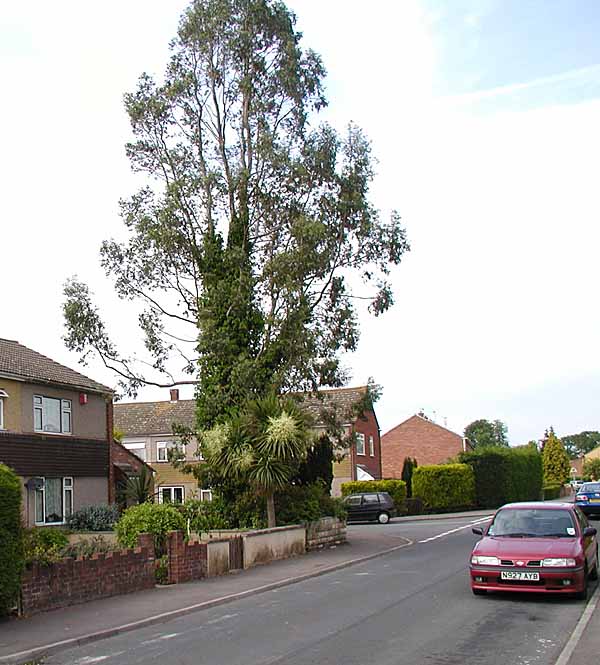
Photo: Wikimedia Commons, Copyrighted free use · source

Tree · Myrtaceae
Cider gum
Eucalyptus gunnii
In other languages: Eucalyptus (Nederlands) · Gommier cidre (Français)
The cider gum comes from the cool highland plateaus of Tasmania and is one of the hardiest eucalyptus species. It is a fast-growing evergreen tree with two kinds of leaves: young plants have small round, blue-grey leaves in opposite pairs, older branches long, grey-green leaves. Its smooth bark peels in patches of cream, grey and pink. In July–August older trees bear small, white, fluffy flowers. If you cut it back every spring, you keep a shrub with the much-loved round juvenile leaves, which also look lovely in bouquets.
Caution: The leaves and oil are poisonous if swallowed, for people and for pets such as dogs, cats and horses. Do not let children or animals chew them. Grown as a tree it soon gets big: do not plant it too close to the house.
Light
Full sun
warm and bright
Moisture
Normal
no wet feet
Legal basis
Sand or loam
acid to neutral
Hardiness
down to -15 °C
protect young plants
Size
15 m
tall, 8 m wide
Flowering
July–August
| Pruning months | April |
|---|---|
| Height | 15 m |
| Native to Belgium | No, planted |
| Poisonous to people and pets | Yes, take care with children and pets |
| Flowering | July–August |
Identify
Cider gum: how do you recognise it?
- Habit
- Fast-growing tree with a narrow to oval crown, up to about 15 m high and 8 m wide. Cut back every year, it stays a multi-stemmed shrub.
- Leaves
- Juvenile leaves round, blue-grey and opposite; adult leaves long and lance-shaped, grey-green. Evergreen.
- Scent
- The leaves contain essential oil and smell fresh and spicy when crushed.
- Flowers
- Small white to cream tufts of stamens in July–August, on older branches. A plant cut back every year rarely flowers.
- Bark
- Smooth and peeling, in patches of cream, grey, green and pink.
Flowering: July–August · Plants: April–June · Pruning: April
In your garden
Why grow it?
- The round, blue-grey juvenile leaves look good all year and smell fresh and spicy when crushed.
- Evergreen and hardy to about −15 °C.
- Grows fast: as a tree, a striking focal point with mottled, peeling bark.
- Cut back every year, it fits a smaller garden or a large pot.
- Superb cut foliage for bouquets and wreaths, fresh or dried.
Cider gum: where does it grow best?
- Full sun; in shade it grows thin and lopsided.
- Free-draining sandy or loamy soil, acid to neutral. On chalky or wet soil the leaves may turn yellow.
- Sheltered from cold, drying easterly winds.
- As a tree: plant it well away from the house, as it grows fast and becomes large. As a coppiced shrub, 1.5–2 m of space is enough.
- Light
- Sun
- Soil type
- Sand or loam
- Acidity
- Acid or neutral
- Moisture
- Normal
- Size
- 15 m tall, 8 m wide
- Hardiness
- Hardy (to -15 °C)
Goes well with
- Lavender: Silver-grey and purple in the same sunny, dry spot.
- Globe thistle: Blue globes that suit the blue-grey leaves.
- Ornamental grasses: Light, swaying plumes next to the firm, round leaves.
- Rosemary: Another scented evergreen for a sunny spot.
Maintenance
Cider gum: when and how to plant it?
Plant in April–June.
- Plant in April–June, so it has a whole summer to root in before winter.
- Choose a young plant in a small pot: it establishes far better than a large one.
- Dig a hole twice as wide as the root ball and set the plant at the same depth as in the pot.
- Gently tease out circling roots, but do not break up the root ball.
- Use a short stake tied low on the stem, so the top can move and the trunk grows stronger.
- Water in well and water in dry spells during the first summer.
Care
- Water
- Regularly in dry weather during the first summer. After that little: once well rooted, it is fairly drought-tolerant.
- Feeding
- Not needed; too much feed produces soft wood that is more easily damaged by frost.
- Mulching
- A mulch in autumn protects the roots of young plants.
- Cut foliage
- Cut stems for the vase all year round; dried, they keep their colour for a long time.
- In a pot
- A large pot with free-draining compost. Water when the surface is dry and repot every two years.
Tip: To keep the round, blue-grey juvenile leaves, cut it back every year in April: it stays a compact shrub and you have cut foliage all year round.
Cider gum: when to prune it?
Pruning months: April.
When: In April, when hard frosts are over. If you let it grow as a tree, pruning is hardly needed.
How:
- For round juvenile leaves, coppice the shrub every spring to 30–50 cm above the ground. Only start once it has been in the ground for two or three years.
- Or pollard it: keep a trunk of 1–2 m and cut back all the branches at the top every spring.
- As a tree: remove only frost-damaged, dead and crossing branches and keep a single main stem.
- Only cut frost-damaged shoots back in May, to where it is reshooting.
Caution: Do not prune in late summer or autumn: the new shoots will not ripen in time and will be killed by frost in winter.
Propagation
- Seed
- Sow indoors in February–March on moist seed compost and cover the seed only very thinly. A few weeks in the fridge beforehand improves germination. Prick out the seedlings young into small pots.
- Cuttings
- Rarely successful: seed is the reliable method.
Cider gum: how does it get through the winter?
Hardy to −15 °C: protect young plants.
- Hardy to about −15 °C; young plants are more sensitive in their first winters.
- Put a thick mulch around the base of young plants and protect them with fleece in severe frost.
- Frost-damaged leaves and shoots: wait until May to prune, as it often reshoots from the trunk or the base.
- In a pot: stand it against a sheltered wall and wrap the pot in hessian, or overwinter it somewhere cool and light.
Diseases and pests
- Frost damage: Brown, dried-up leaves after a harsh winter. Wait until May, then cut back to where it is reshooting.
- Wind-rock: A fast, top-heavy tree with a small root ball is easily blown askew or over. Plant young, use a short stake and keep the crown smaller by pollarding or coppicing.
- Psyllids: Small sap-suckers on the young shoots, with white waxy fluff and sticky honeydew. Usually harmless; cut off badly affected tips.
- Yellow leaves: On chalky or wet soil. Improve the drainage or grow it in a pot with lime-free compost.
Through the year
- February: Sow indoors.
- April: Coppice or pollard. Planting.
- May: Planting. Cut frost-damaged shoots back to where it reshoots.
- June: Planting. Water in dry spells.
- July: Flowers on older trees. Cut foliage.
- August: Flowering. Water young plants in dry spells. No more pruning.
- October: Mulch around young plants.
- December: Cut stems for Christmas wreaths and bouquets.
Use
Edible and useful
Not edible. The leaves and oil of eucalyptus are poisonous if swallowed: even a small amount of eucalyptus oil can cause drowsiness, vomiting, seizures and breathing problems in a child. So keep bottles of essential oil out of reach of children, never use them undiluted and do not put them in a diffuser where cats are nearby: the oil is especially toxic to cats. Do not let children, dogs, cats or horses chew the leaves. Hang dried branches in a vase or bouquet out of reach of cats and small children. If any is swallowed, call a poison centre (in Belgium 070 245 245) or your doctor at once.
You and this species
Did you know?
- The name eucalyptus comes from Greek and means ‘well covered’: the flower bud has a little lid that falls off when the flower opens.
- The name cider gum refers to its sweet sap, which was once tapped in Tasmania and fermented into a drink resembling cider.
- It forms two kinds of leaves: as long as you cut it back every year, it produces only the round juvenile foliage.