Photo: Ghislain118 http://www.fleurs-des-montagnes.net, CC BY-SA 3.0 · source

Perennial · Geraniaceae
Renard’s cranesbill
Geranium renardii
In other languages: Ooievaarsbek (Nederlands) · Géranium de Renard (Français)
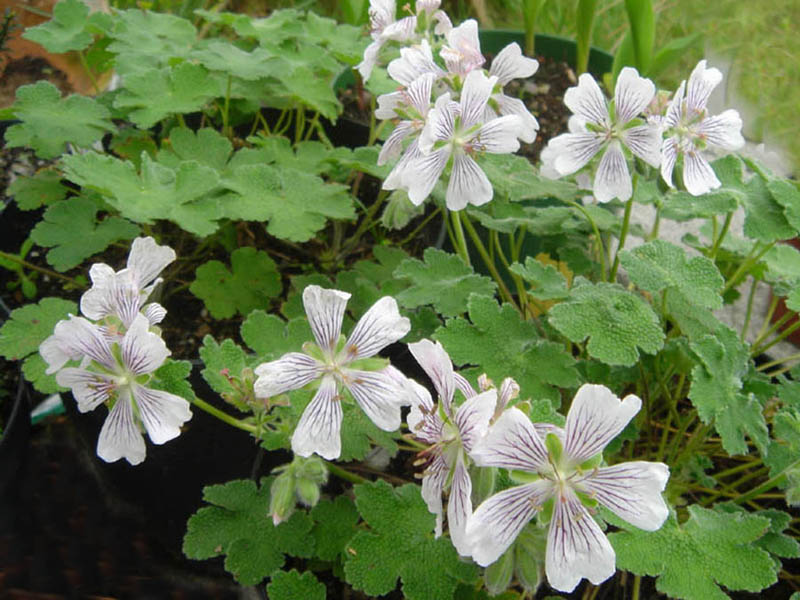
Geranium renardii is a low, compact cranesbill from the Caucasus, where it grows on sunny, rocky mountain slopes. It forms a dense mound of rounded, shallowly lobed leaves that feel velvety, are sage to grey-green and have a finely wrinkled, quilted surface. In May–June white to very pale lilac flowers with striking purple veins appear above them. Gardeners grow it mainly for the foliage, which stays attractive from spring until late autumn, and because it copes well with drought. Well-known forms include ‘Zetterlund’, with pale lilac flowers, and the hybrid ‘Philippe Vapelle’, with blue-violet flowers and the same soft leaves.
Light
Full sun
warm and bright
Moisture
Dry to normal
no wet feet
Legal basis
Sand or loam
any pH
Hardiness
Fully hardy
down to -25 °C
Size
0.3 m
tall, 0.3 m wide
Flowering
May–June
| Pruning months | March and July |
|---|---|
| Height | 0.3 m |
| Native to Belgium | No, planted |
| Good for bees, butterflies and birds | Yes, for bees |
| Poisonous to people and pets | Not known to be poisonous |
| Flowering | May–June |
Identify
Renard’s cranesbill: how do you recognise it?
- Habit
- Dense, rounded mound 25–30 cm tall and about as wide.
- Foliage
- Round to kidney-shaped, 5–10 cm, shallowly lobed with a wrinkled, velvety surface; sage to grey-green.
- Flower
- Saucer-shaped flowers of about 3 cm in May–June, white or very pale lilac with fine purple veins.
- Fruit
- A dry fruit with a long beak, as in all cranesbills; when ripe it flings out its seeds.
- Roots
- A thick, fleshy rhizome that spreads slowly.
Flowering: May–June · Plants: March–April and September–October · Pruning: March and July
In your garden
Why grow it?
- The soft, grey-green foliage looks good from April to November, even when the plant is not in flower.
- Tolerates drought and poor soil: ideal for a sunny border, a rock garden or a gravel garden.
- Bees love the open flowers in May and June.
- Stays compact and tidy: it spreads slowly and never takes over.
- A calm, neat edging plant for the front of the border.
- Little work: no staking, no feeding and few problems in the right spot.
Renard’s cranesbill: where does it grow best?
- Full sun gives the most flowers and the best foliage; it tolerates light shade but flowers less there.
- Poor, free-draining soil: sand or light loam, acid, neutral or chalky. On rich soil it flowers poorly.
- Dry to normally moist: it will not tolerate wet feet, especially in winter.
- Allow 30–35 cm between plants; a group of three to five gives the best effect.
- Light
- Sun
- Soil type
- Sand or loam
- Acidity
- Not fussy
- Moisture
- Dry or normal
- Size
- 0.3 m tall, 0.3 m wide
- Hardiness
- Hardy (to -25 °C)
Goes well with
- Catmint: Blue flowers and just as drought-tolerant in the sun.
- Lavender: Silver-grey leaves and purple flowers alongside the grey-green foliage.
- Lamb’s ears: Even softer, silvery-white leaves for a calm, grey edging.
- Ice plant (sedum): Fleshy leaves and late-summer flowers, once the cranesbill has finished.
- Ornamental onion: Purple globes rising above the low mounds in May–June.
Maintenance
Renard’s cranesbill: when and how to plant it?
Plant in March–April and September–October.
- Plant in March–April or September–October, when the soil is neither frozen nor waterlogged.
- Dig a hole a little larger than the pot. Do not add manure or compost, but work some coarse sand or grit into heavy soil.
- Set the plant at the same depth as it was in the pot and firm the soil well.
- Space plants 30–35 cm apart.
- Water in straight away, then during dry spells for the first few weeks.
- If you mulch, use a thin layer of gravel rather than compost: it keeps the crown dry.
Care
- Watering
- Only in the first year during dry spells. After that it looks after itself, even in dry summers.
- Feeding
- Not needed. Fertiliser and fresh compost give lots of leaves and few flowers.
- Mulching
- A thin layer of gravel keeps the foliage dry and prevents rot at the crown.
- Deadheading
- Cut off the faded flower stems in July: the mound stays neat and the foliage shows off better.
- Dividing
- Rarely needed; only when, after many years, the centre of the clump becomes bare.
Tip: Plant it in poor, gritty soil and never feed it: the leaner the soil, the more compact the mound and the better the flowering.
Renard’s cranesbill: when to prune it?
Pruning months: March and July.
When: It hardly needs pruning: a tidy-up in March and cutting off the flower stems in July are enough.
How:
- In March, remove old, damaged leaves just before the new foliage emerges.
- After flowering, in July, cut the faded stems off at the base.
- Leave the healthy foliage alone: it is the plant’s main attraction.
Propagation
- Division
- In March–April or September: cut off a piece of the clump with buds and roots and replant it straight away in its new spot.
- Seed
- Sow ripe seed in autumn in a pot of gritty seed compost and leave it outdoors; germination is erratic. Named cultivars do not come true from seed.
Renard’s cranesbill: how does it get through the winter?
Hardy to −25 °C.
- Fully hardy, to about −25 °C: no protection is needed in Belgian winters.
- In winter, wet soil is a greater danger than frost: make sure drainage is good.
- In a pot or container: use an open, gritty mix and move it under cover in winter, out of the worst of the rain.
Diseases and pests
- Few flowers: Usually caused by rich soil, fertiliser or too much shade. Move it to a leaner, sunny spot and stop feeding.
- Root rot: The clump goes soft and rots at the base, especially in wet winters on heavy soil. Plant it higher or in gritty soil.
- Slugs: They eat the young leaves in spring. Pick them off in the evening and keep the base open and dry.
- Bare centre: Old plants open up in the middle. Divide them in spring and replant the young outer pieces.
Through the year
- March: Remove old leaves. Plant.
- April: Plant. New leaves appear: watch out for slugs.
- May: Flowering begins. Bees on the flowers.
- June: In flower. Water young plants in dry spells.
- July: Cut off faded flower stems.
- August: Little to do: the grey-green foliage stays attractive.
- September: Plant or divide. Collect seed.
- October: Plant. Sow seed in a pot outdoors.
- November: Leave the foliage; it stays attractive for a long time.
- December: Rest.
Use
Good for wildlife
- Bees
- Nectar and pollen for honeybees and wild bees.
You and this species
Did you know?
- The name Geranium comes from the Greek ‘geranos’, crane: the long, pointed fruit looks like a beak. The Dutch name, ooievaarsbek, means stork’s bill.
- The ‘geraniums’ on balconies and windowsills are really pelargoniums, a different genus in the same family.
- The ripe fruit suddenly curls open and catapults its seeds some distance from the parent plant.