Photo: Wikimedia Commons, Public domain · source

Annual · Caryophyllaceae
Cushion baby’s breath
Gypsophila muralis
In other languages: Muurgipskruid (Nederlands) · Gypsophile des murailles (Français)
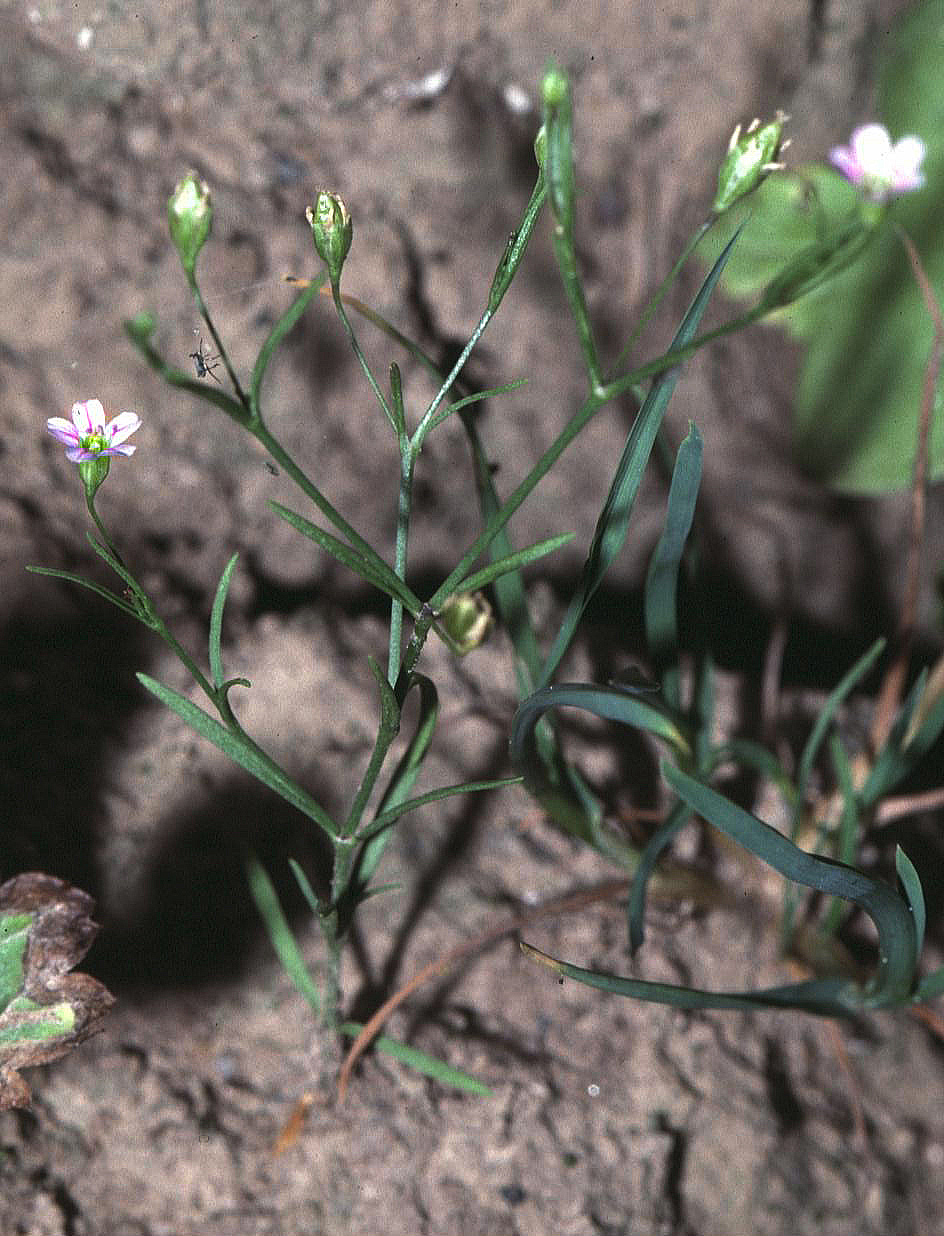
Cushion baby’s breath is a small annual of the pink family that grows wild on open, sandy and damp ground in Europe. It forms an airy cushion of wiry, much-branched stems with narrow leaves. From June to September it is covered in tiny pink stars with darker veins. Gardeners enjoy its light, playful look, its easy cultivation from seed and its use in rock gardens, containers and hanging baskets. It is a generous filler that does not ask for demanding soil.
Caution: Toxic if eaten: the plant contains saponins. Do not eat it; keep small children and pets (cats, dogs) away from the plant parts and seed.
Light
Full sun
warm and bright
Moisture
Dry to normal
no wet feet
Legal basis
Sand or loam
any pH
Hardiness
down to -5 °C
protect in harsh winters
Size
0.2 m
tall, 0.3 m wide
Flowering
June–September
| Pruning months | July |
|---|---|
| Height | 0.2 m |
| Native to Belgium | Yes |
| Good for bees, butterflies and birds | Yes, for bees |
| Poisonous to people and pets | Yes, take care with children and pets |
| Flowering | June–September |
Identify
Cushion baby’s breath: how do you recognise it?
- Habit
- Annual, a compact cushion about 20 cm high and up to 30 cm wide, with wiry, branching stems.
- Leaves
- Narrow and linear, opposite, fresh green and fine; the foliage is hardly noticed beneath the flowers.
- Flower
- Five-petalled flowers only a few millimetres across, in loose sprays, from June to September.
- Colour
- Soft pink to purplish pink, with darker veins.
- Seed
- Very fine seed in small capsules; on bare soil the plant often sows itself.
Flowering: June–September · Sowing: March–May · Plants: May · Pruning: July
In your garden
Why grow it?
- Flowers from June to September with little care, even on poor, dry soil.
- An airy filler: the cloud of small flowers softens sturdier plants in a border or container.
- Bees and other insects readily visit the small flowers.
- Quick and cheap from seed: it flowers a few months after sowing.
- Suits rock gardens, gaps between stones, patio containers and hanging baskets.
Cushion baby’s breath: where does it grow best?
- Full sun for the richest flowering; in shade the plant becomes thin and flowers little.
- Poor to ordinary, well-drained soil: sandy or loamy, acid to chalky. Soil that is too rich gives plenty of leaf and few flowers.
- Dry to average moisture: let the soil dry out slightly between waterings, because soggy soil causes rot.
- Space plants 15–20 cm apart; in a container or basket you can group several together.
- Light
- Sun
- Soil type
- Sand or loam
- Acidity
- Not fussy
- Moisture
- Dry or normal
- Size
- 0.2 m tall, 0.3 m wide
- Hardiness
- Tolerates light frost (to -5 °C)
Goes well with
- California poppy: Cheerful orange and yellow flowers that enjoy the same sunny, dry spot.
- Cornflower: Blue flowers with a light habit, pretty beside the pink clouds.
- Verbena: Flowers for a long time in sunny containers and fills the space beneath the baby’s breath.
- Stonecrop: Fleshy leaves and little stars in the rock garden, with the same need for dry soil.
- Lavender: A sun-loving perennial, at whose feet the cushion shows off its stars.
Maintenance
Cushion baby’s breath: when and how to plant it?
Plant in May.
- Sow indoors in March–April at about 15–20 °C, or straight outdoors in May as the soil warms up.
- Scatter the very fine seed on loose, moist seed compost and barely cover it: a very thin layer of sand is enough.
- The seed germinates within a few weeks. Keep the seedlings lightly moist, in a bright, cool place.
- Plant the young plants out in May, 15–20 cm apart in a border, or several together in a container or basket.
- Water well once after planting, then moderately.
- Sow again every three to four weeks until July for continuous flowering.
Care
- Water
- Moderate: let the soil dry out slightly between waterings. In containers and baskets, water more often in hot weather.
- Feeding
- Little or none in open ground; poor soil gives the best flowering. In containers, a weak dose of liquid flower feed every few weeks.
- Spent flowers
- There is no need to remove the tiny flowers one by one. If the plant becomes untidy or bare, trim it back lightly.
- Support
- Not needed: the stems trail and spill softly over the edge.
- Weeding
- Keep young plants free of weeds; they are small and quickly swamped.
- Self-seeding
- Let a few plants set seed if you want flowers again next year. Surplus seedlings are easy to weed out.
Tip: Sow again every three to four weeks until July and the cushion stays full of flowers all summer. Err on the side of too dry rather than too wet.
Cushion baby’s breath: when to prune it?
Pruning months: July.
When: Pruning is hardly necessary. If the plant becomes untidy after its first flush in July, trim it back lightly.
How:
- Cut back about a third of the stems with scissors, just above a side shoot or leaf.
- Remove dead or shrivelled stems.
- Water afterwards and, in containers, give a weak dose of feed so that new shoots follow quickly.
Propagation
- Seed
- Sow indoors in March–April or outdoors in May. The seed is very fine: scatter it on loose soil and barely cover it.
- Collecting seed
- In September, when the capsules are brown and dry: shake out the seed, store it dry and cool and sow it the following spring.
Cushion baby’s breath: how does it get through the winter?
Hardy to −5 °C: protect in harsh winters.
- Annual: the plant dies after flowering, in late autumn.
- Young plants and seedlings tolerate light frost, down to about −5 °C; the seed overwinters by itself in the soil.
- Clear the plants in October, or leave them in place if you want them to self-sow. Containers can be emptied and stored dry.
Diseases and pests
- Basal rot: In soil that is too wet or heavy, the plant discolours and wilts at the base. Sow in free-draining soil, water moderately and use containers with drainage holes.
- Grey mould: Grey fuzz on faded flowers in damp weather. Remove affected parts and allow enough space and airflow.
- Aphids: Small green or black insects on young shoots. Wash them off with water or let ladybirds deal with them.
- Few flowers: Usually too much shade or soil that is too rich. Choose a sunny spot and do not feed too much.
Through the year
- March: Sow indoors at 15–20 °C.
- April: Sow indoors. Keep seedlings bright and cool.
- May: Sow outdoors and plant out young plants.
- June: Flowering begins. Sow again for later flowers.
- July: Full flower. Trim back lightly after the first flush if needed.
- August: Flowering. Water moderately, especially in containers.
- September: Last flowers. Collect seed.
- October: Clear dead plants.
Use
Edible and useful
Not edible. Baby’s breath contains saponins, especially in the root and seeds: eating it causes vomiting, stomach ache and diarrhoea, in small children as well as in cats and dogs. The greatest risk is indoors: baby’s breath is in many bouquets, and cats like to chew the fine, dry stems. Keep a vase or dried arrangement with baby’s breath out of reach of cats and small children, and clear up fallen flowers. The root was once used as soap; do not make anything from it to swallow. The sap can irritate the skin of sensitive people: wear gloves if you cut a lot. If any is swallowed, call a poison centre (in Belgium 070 245 245) or your doctor at once.
Good for wildlife
- Bees
- Nectar and pollen for honeybees and wild bees.
You and this species
Did you know?
- The name Gypsophila comes from Greek and means roughly gypsum-loving or chalk-loving.
- Cushion baby’s breath belongs to the pink family, like carnations, chickweed and soapwort.
- The flowers are only a few millimetres across: the effect comes from the mass, not from the single bloom.