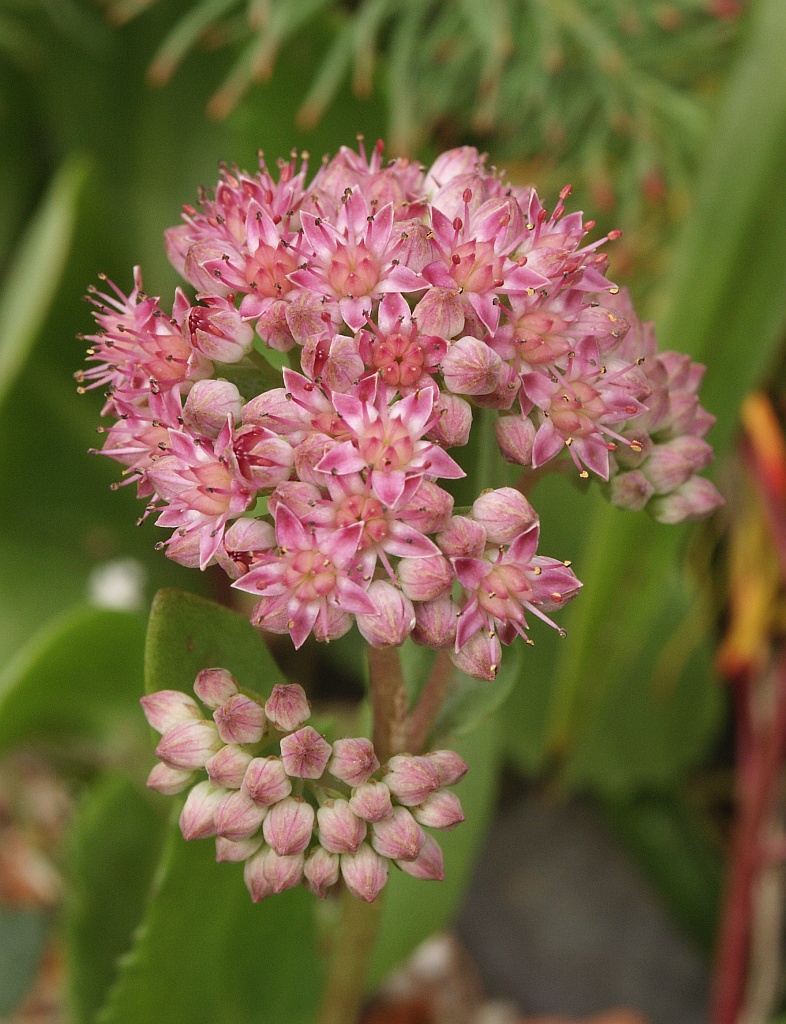
Photo: Bernd Haynold, CC BY-SA 2.5 · source

Perennial · Crassulaceae
Orpine
Hylotelephium telephium
In other languages: Hemelsleutel (Nederlands) · Orpin reprise (Français)
Orpine is a native succulent that used to be called Sedum telephium. In the wild it grows in dry, sunny places: on rocks, along roadsides, on banks and at woodland edges. From a clump of fleshy, grey-green leaves rise upright stems that carry flat heads of small pink to purple-red stars from August to October. Bees, bumblebees and butterflies love them in late summer. There are also varieties with purple-red to almost black leaves, such as ‘Purple Emperor’, and the dry flower heads stay attractive all winter.
Light
Full sun
warm and bright
Moisture
Dry to normal
no wet feet
Legal basis
Sand or loam
any pH
Hardiness
Fully hardy
down to -35 °C
Size
0.6 m
tall, 0.45 m wide
Flowering
August–October
| Pruning months | March and May |
|---|---|
| Height | 0.6 m |
| Native to Belgium | Yes |
| Good for bees, butterflies and birds | Yes, for bees and butterflies |
| Poisonous to people and pets | Not known to be poisonous |
| Flowering | August–October |
Identify
Orpine: how do you recognise it?
- Habit
- An upright clump about 60 cm tall and 45 cm wide, with sturdy, unbranched stems.
- Leaves
- Fleshy, oval and toothed, grey-green to purple-red depending on the variety. They store water, so the plant copes well with drought.
- Flower
- Small star-shaped flowers in dense, flat heads, pink to purple-red, from August to October.
- Winter silhouette
- The flower heads dry to a rusty brown and stay standing until spring.
- Roots
- Fleshy, tuberous roots; in spring new, compact shoots appear at the base.
Flowering: August–October · Plants: March–May and September · Pruning: March and May
In your garden
Why grow it?
- One of the last flowers for bees and butterflies, from August to October.
- Native and very drought-tolerant: ideal for a sunny, poor spot or a gravel garden.
- The fleshy grey-green or purple leaves look good from spring to autumn.
- The brown flower heads stand through winter and catch frost and snow.
- Little work: no watering, no feeding and one pruning a year.
Orpine: where does it grow best?
- Full sun: in shade the stems go floppy and it flowers less.
- Poor, well-drained sandy or loamy soil; acid, neutral or chalky makes no difference.
- Dry to normally moist. On rich or wet soil it flops open or rots.
- Lovely in a gravel garden, a rock garden, on a bank or at the front of a sunny border, and also in a pot.
- Allow 40–45 cm between plants.
- Light
- Sun
- Soil type
- Sand or loam
- Acidity
- Not fussy
- Moisture
- Dry or normal
- Size
- 0.6 m tall, 0.45 m wide
- Hardiness
- Hardy (to -35 °C)
Goes well with
- Ornamental grasses: Fine stems next to the fleshy leaves, and lovely together in winter.
- Coneflower: Flowers at the same time and also attracts butterflies.
- Catmint: A blue base in summer, before the orpine flowers.
- Autumn aster: Purple and blue stars beside the pink heads in September.
- Thyme: A low, fragrant ground cover for a dry, sunny edge.
Maintenance
Orpine: when and how to plant it?
Plant in March–May and September.
- Plant in March–May or in September, when the soil is not wet.
- Dig a hole slightly larger than the pot; on heavy soil, mix in some coarse sand or gravel.
- Set the plant at the same depth as in the pot and firm the soil.
- Space plants 40–45 cm apart; it looks best in a group of three or five.
- Water well when planting and in dry spells for the first few weeks.
- Do not put compost or fertiliser in the hole; a gravel mulch is fine.
Care
- Watering
- Only for the first weeks after planting. After that it survives dry summers unaided; water pots now and then.
- Feeding
- Do not feed: it gives floppy stems that fall open.
- Pinching back
- At the end of May, cut the stems back by half for a more compact plant (see pruning).
- Spent flowers
- Leave them: they decorate the winter border and protect the young shoots at the base.
- Dividing
- Every four to five years, when the clump falls open or goes bare in the middle.
Tip: At the end of May, cut the stems back by half: the plant stays compact and does not flop. Leave the flower heads all winter and only cut them off in March.
Orpine: when to prune it?
Pruning months: March and May.
When: Cut off the old flower stems in March, and cut back the new stems at the end of May for a more compact plant.
How:
- In March, cut last year’s dry stems off just above the new shoots at the base. Take care not to damage those shoots.
- At the end of May, cut the stems back by half: the plant stays lower, stands more firmly and flowers a little later with more, smaller heads.
- To spread the flowering, cut back only half of the stems.
- After flowering there is nothing to do: leave the flower heads.
Caution: Do not cut the old stems down in autumn: they protect the new shoots and are a winter feature.
Propagation
- Division
- In March–April, when the new shoots appear. Cut the clump into pieces with a few shoots and roots each and replant straight away.
- Cuttings
- In May–July, take 8–10 cm cuttings from non-flowering shoots. Let them dry for a day and push them into sandy soil; they root quickly.
- Leaf cuttings
- Even a single leaf can form roots and a new shoot on moist, sandy soil, although it takes longer.
Orpine: how does it get through the winter?
Hardy to −35 °C.
- Very hardy, to about −35 °C: no protection is needed.
- Heavy, wet soil in winter is the greatest danger: the roots can rot.
- Leave the dry stems until March; they look lovely with frost and protect the buds at the base.
- In a pot: stand it against a wall and make sure excess water can drain away.
Diseases and pests
- Flopping: The stems fall outwards and the centre is empty. Cause: soil too rich, too much water or shade. Cut back at the end of May and do not feed.
- Slugs: They eat the young shoots in spring. Pick them off in the evening or put a ring of gravel around the plant.
- Vine weevil: The larvae eat the roots, especially in pots: the plant wilts and comes loose. Use nematodes against the larvae, in spring or late summer.
- Rot: Soft, brown stem bases in wet soil. Move the plant to a drier, sunnier spot.
Through the year
- March: Cut old stems back to just above the new shoots. Divide and plant.
- April: Plant. Watch for slugs on the young shoots.
- May: Plant. At the end of May, cut the stems back by half.
- June: Take cuttings from non-flowering shoots.
- July: Little to do. Water only young plants and pots in dry spells.
- August: Flowering begins: bees and butterflies on the flower heads.
- September: Full flower. Planting is still possible.
- October: End of flowering; the heads turn rusty brown.
- November: Leave the flower heads for winter.
- December: Rest. The dry heads decorate the garden.
Use
Good for wildlife
- Bees
- Nectar and pollen for honeybees and wild bees.
- Butterflies
- Nectar for butterflies.
You and this species
Did you know?
- A cut stem stays fresh for a long time and can even grow roots; that is why it used to be called livelong in English.
- The fleshy leaves store water, so it survives long droughts, even on a wall or between stones.
- In the mountains, the caterpillars of the rare Apollo butterfly feed on stonecrops such as orpine.