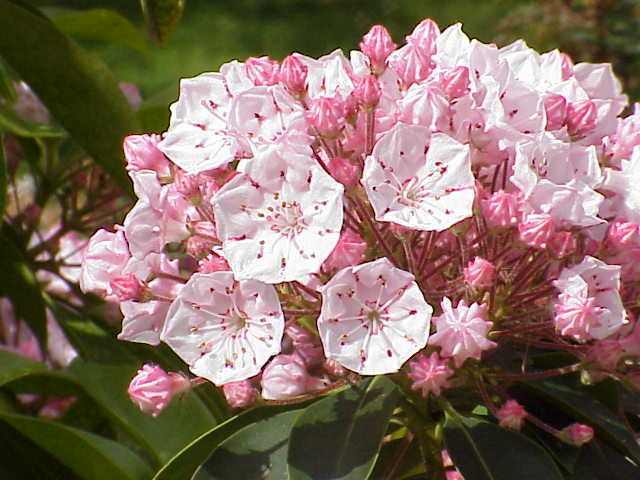
Photo: Kurt Stüber [1], CC BY-SA 3.0 · source

Shrub · Ericaceae
Mountain laurel
Kalmia latifolia
In other languages: Kalmia (Nederlands) · Laurier des montagnes (Français)
Mountain laurel comes from the woods and mountain slopes of eastern North America. It is an evergreen shrub with glossy, leathery leaves reminiscent of a rhododendron. In May–June large clusters of flowers appear: the crimped buds look like piped icing on a cake and open into saucer-shaped flowers in white, pink or red. Gardeners love it for those remarkable flowers and because it stays green all year. It grows slowly and needs acid, humus-rich soil. Well-known cultivars are ‘Ostbo Red’, with red buds, and the compact ‘Elf’.
Caution: All parts are highly poisonous if eaten. Keep young children away from the leaves and flowers, and take care with dogs and cats. Grazing animals such as sheep, goats and horses are most at risk: never plant it near a paddock and never give clippings to animals.
Light
Sun or partial shade
preferably some sun
Moisture
Normal
no wet feet
Legal basis
Sand, loam or peat
acid
Hardiness
Fully hardy
down to -30 °C
Size
2 m
tall, 2 m wide
Flowering
May–June
| Pruning months | June–July |
|---|---|
| Height | 2 m |
| Native to Belgium | No, planted |
| Good for bees, butterflies and birds | Yes, for bees |
| Poisonous to people and pets | Yes, take care with children and pets |
| Flowering | May–June |
Identify
Mountain laurel: how do you recognise it?
- Habit
- Dense, rounded shrub that slowly grows to about 2 m tall and as wide.
- Leaves
- Elliptic, 5–12 cm long, leathery and glossy dark green, paler underneath.
- Flower
- Clusters up to 15 cm across of saucer-shaped, five-sided flowers 2–3 cm wide, in May–June.
- Colour
- White, pink or red, often with dark markings inside; the buds are usually darker than the open flowers.
- Stamens
- Each flower has ten stamens held under tension in small pockets of the petals. When a bee lands, they spring free and dust it with pollen.
- Roots
- Fine and shallow, as in rhododendrons: they cannot cope with drying out or compacted soil.
Flowering: May–June · Plants: March–April and September–October · Pruning: June–July
In your garden
Why grow it?
- Exceptionally beautiful flowers: crimped buds and saucer-shaped flowers with fine markings.
- Glossy evergreen leaves that give the garden structure in winter too.
- Bees and bumblebees visit the flowers in May–June.
- A fine partner for rhododendrons and azaleas in an acid-soil border.
- Slow and compact growth: little pruning.
Mountain laurel: where does it grow best?
- Sun or light partial shade; in full sun it needs a cool, moist root run, and in deep shade it flowers poorly.
- Acid, humus-rich soil: sand, loam or peat with plenty of leaf mould. It does not tolerate chalky soil.
- Moderately moist and free-draining: the soil must not dry out, nor stay wet.
- Somewhat sheltered from strong, drying winds and bright winter sun.
- Allow 1.5–2 m of space per plant.
- Light
- Sun and partial shade
- Soil type
- Sand, loam or peat
- Acidity
- Acid
- Moisture
- Normal
- Size
- 2 m tall, 2 m wide
- Hardiness
- Hardy (to -30 °C)
Goes well with
- Rhododendron: The same acid, humus-rich soil; together they flower from April to June.
- Pieris: Evergreen, with white flower trusses in spring and red young leaves.
- Skimmia: A compact evergreen shrub for the foreground, also on acid soil.
- Ferns: Fresh underplanting in partial shade.
Maintenance
Mountain laurel: when and how to plant it?
Plant in March–April and September–October.
- Plant in March–April or September–October.
- Dig a wide, shallow hole and fill it with a mix of garden soil, leaf mould and ericaceous compost.
- Set the plant at the same depth as in the pot or slightly higher, never deeper: otherwise the roots suffocate.
- Leave 1.5–2 m between plants.
- Water generously with rainwater straight away and keep the soil moist in the first year.
- Spread a mulch of leaf mould, pine needles or bark around the base.
Care
- Water
- Preferably rainwater, as tap water is often hard. In dry spells give a full watering can every week.
- Feeding
- In March–April, some organic fertiliser for acid-loving plants. Not after June.
- Mulching
- Every spring, a layer of leaf mould or pine needles keeps the soil acid, cool and moist.
- Spent flowers
- Carefully snap off the spent clusters without damaging the new shoots beneath. This gives more flowers next year.
- Digging
- Do not dig or hoe around the plant: the roots lie just below the surface.
Tip: Water it with rainwater rather than tap water and mulch every year with leaf mould or pine needles: that keeps the soil acid and the flowering generous.
Mountain laurel: when to prune it?
Pruning months: June–July.
When: It hardly needs pruning. In June–July, after flowering, remove the spent clusters and prune lightly if needed.
How:
- Snap or cut off the spent clusters just above the new shoots.
- After flowering, cut an overlong or lopsided branch back to just above a rosette of leaves.
- Remove dead or damaged branches back to healthy wood.
Caution: Wear gloves when pruning and clear up the clippings straight away: all parts are poisonous.
Propagation
- Layering
- In spring, make a small cut in a low branch, lay it in the soil and peg it down. After 1–2 years it has enough roots to be severed.
- Semi-ripe cuttings
- In July–August, insert 8–10 cm cuttings in an acid cutting mix under plastic. They root slowly and not always.
- Seed
- In late winter, scatter the fine seed on moist, acid seed compost without covering it. Seedlings grow very slowly.
Mountain laurel: how does it get through the winter?
Hardy to −30 °C.
- Fully hardy, to about −30 °C: in Belgium it needs no protection.
- In a dry winter, water on frost-free days: the evergreen leaves keep losing moisture.
- In a pot: stand it against a sheltered wall and wrap the pot in hessian in severe frost.
Diseases and pests
- Chlorosis: Yellow leaves with green veins: the soil is too chalky. Use rainwater, mulch with pine needles and give fertiliser for acid-loving plants.
- Leaf spot: Brown or purplish spots on the leaves, especially in wet weather and shade. Remove affected and fallen leaves and choose an airy spot.
- Brown leaf edges: Caused by drought, bright winter sun or drying wind. Water in dry weather and choose a fairly sheltered spot.
- Poor flowering: Too much shade, a young plant or old flower clusters left on. Give more light and snap off the spent clusters.
Through the year
- January: In a dry winter, water on frost-free days.
- March: Plant. Give fertiliser for acid-loving plants.
- April: Plant. Mulch with leaf mould or pine needles.
- May: Flowering begins. Water in dry weather, preferably with rainwater.
- June: Full flower. Snap off spent clusters after flowering.
- July: Remove spent clusters and prune lightly. Take semi-ripe cuttings.
- August: Water in dry weather.
- September: Plant.
- October: Plant. Top up the mulch.
Use
Edible and useful
Not edible. All parts of kalmia are highly poisonous, especially the leaves, flowers and nectar: like rhododendron it contains grayanotoxins, which cause drooling, vomiting, weakness and a slow heartbeat. Sheep, goats and alpacas above all, but also horses, cattle, rabbits and guinea pigs are at risk; the narrow-leaved species is not called lambkill for nothing. Do not plant it next to a field, never throw clippings over the fence or into a pen or hutch and do not give them to animals; if an animal has eaten some, call your vet at once. Keep small children, dogs and cats away from the leaves and flowers too, and wear gloves when pruning. If any is swallowed, call a poison centre (in Belgium 070 245 245) or your doctor at once.
Good for wildlife
- Bees
- Nectar and pollen for honeybees and wild bees.
You and this species
Did you know?
- The stamens are held like tensioned springs in pockets of the flower and flick free as soon as a bee lands, dusting it with a little cloud of pollen.
- The genus is named after Pehr Kalm, a Swedish pupil of Linnaeus who collected plants in North America in the 18th century.
- It is the state flower of Connecticut and Pennsylvania.