Photo: Wikimedia Commons, CC BY-SA 3.0 · source

Perennial · Caprifoliaceae
Macedonian scabious
Knautia macedonica
In other languages: Macedonische knautia (Nederlands) · Knautie de Macédoine (Français)
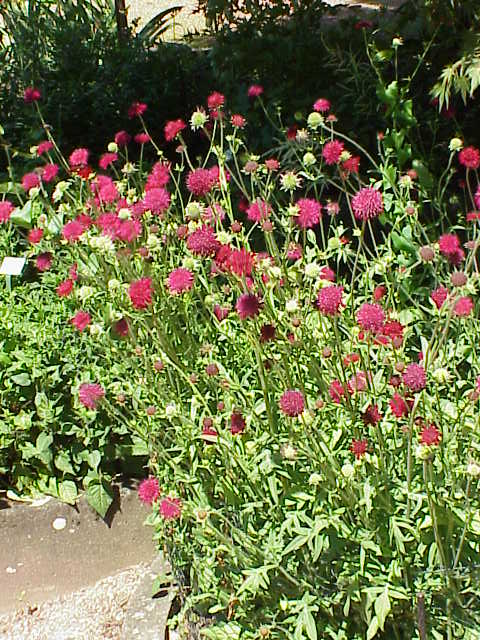
Macedonian scabious comes from the Balkans, where it grows in grassland and scrub. It is a perennial with a rosette of grey-green leaves and thin, much-branched stems about 70 cm tall. From June to October these carry countless deep crimson to wine-red flower heads 2–3 cm across, like little pincushions. Gardeners love its rich colour, its long flowering season and the many bees and butterflies it attracts; it is also a lovely cut flower. There are compact cultivars such as ‘Mars Midget’ and seed mixtures in pink, red and lilac shades, such as ‘Melton Pastels’.
Light
Full sun
warm and bright
Moisture
Dry to normal
no wet feet
Legal basis
Sand or loam
any pH
Hardiness
Fully hardy
down to -25 °C
Size
0.7 m
tall, 0.5 m wide
Flowering
June–October
| Pruning months | March and June–September |
|---|---|
| Height | 0.7 m |
| Native to Belgium | No, planted |
| Good for bees, butterflies and birds | Yes, for bees and butterflies |
| Poisonous to people and pets | Not known to be poisonous |
| Flowering | June–October |
Identify
Macedonian scabious: how do you recognise it?
- Habit
- Loose, somewhat sprawling clump 60–70 cm tall and about 50 cm wide, with thin, branched stems.
- Leaves
- Rosette leaves oblong, entire to lobed; stem leaves smaller and often divided; grey-green and slightly hairy.
- Flower
- Domed heads 2–3 cm across, packed with tiny tubular flowers, on long, thin stalks.
- Colour
- Deep crimson to wine red; also pink and lilac in seed mixtures.
- Roots
- A taproot with side roots: as a result it does not like being moved.
Flowering: June–October · Sowing: March–April · Plants: March–May and September · Pruning: March and June–September
In your garden
Why grow it?
- Deep red flower heads from June to October: a rich colour that goes with almost anything.
- A magnet for bees, bumblebees and butterflies.
- A graceful cut flower for a summer bouquet.
- Copes well with drought and needs little care.
- Its airy growth fills gaps between grasses and other perennials.
Macedonian scabious: where does it grow best?
- Full sun: in shade it flops and flowers less.
- Sandy or loamy soil, acid to chalky, well drained.
- Dry to normal soil; it dislikes wet feet in winter.
- Plant 40–50 cm apart, four to five plants per m², preferably among grasses or sturdy neighbours.
- Light
- Sun
- Soil type
- Sand or loam
- Acidity
- Not fussy
- Moisture
- Dry or normal
- Size
- 0.7 m tall, 0.5 m wide
- Hardiness
- Hardy (to -25 °C)
Goes well with
- Feather grass: Fine, swaying grass that supports it and lets the red heads float.
- Purpletop vervain: Clusters of purple flowers on tall stems, also a butterfly magnet.
- Catmint: A low, blue cloud at the base.
- Woodland sage: Violet-blue spikes as a contrast to the red bobbles.
- Purple coneflower: Larger pink flowers for a summery prairie-style border.
Maintenance
Macedonian scabious: when and how to plant it?
Plant in March–May and September.
- Plant from March to May or in September, when the soil is not too wet.
- Dig a hole twice as wide as the pot; on heavy soil, mix in coarse sand.
- Set the plant at the same depth as it was in the pot, with the crown at soil level.
- Plant an ornamental grass or a few sturdy neighbours next to it straight away, so it has support.
- Water in well; after that only in prolonged dry spells.
Care
- Water
- Rarely needed once established; regularly in pots.
- Feeding
- Not needed: in rich soil the stems become floppy and it falls apart even more.
- Deadheading
- Cut faded heads back to a side bud regularly: it will keep flowering into October.
- Support
- Plant it among grasses or other plants, or give it a few twigs for support.
- Cut flowers
- In the morning, cut stems with freshly opened heads and buds, and put them in water straight away.
- Seedlings
- At the end of the season, let a few heads ripen: it self-seeds, so you keep it when the parent plant fades after a few years.
Tip: It tends to fall apart: plant it among grasses or other plants that support it, and deadhead for flowers into October.
Macedonian scabious: when to prune it?
Pruning months: March and June–September.
When: From June to September, deadhead regularly. In March, clear away the old stems.
How:
- Cut faded heads back with their stalk to a leaf or side bud.
- If the plant falls apart completely in midsummer, shorten the longest stems by a third: new flowering stems will follow.
- In March, cut the old stems back to just above the leaf rosette.
Caution: Do not cut right down to the ground in autumn: leave the leaf rosette until spring.
Propagation
- Seed
- Indoors in March–April in a seed tray; cover lightly and keep moist. Plant out after mid-May. Plants sown early sometimes flower in their first year.
- Cuttings
- In April–May, take cuttings of young shoots from the base and root them in sandy cutting compost. This keeps cultivars true.
Macedonian scabious: how does it get through the winter?
Hardy to −25 °C.
- Hardy to about −25 °C: no problem in Belgium on well-drained soil.
- Wet soil in winter is its worst enemy: the crown then rots.
- In a pot: stand it under cover in winter so the compost does not become waterlogged.
Diseases and pests
- Powdery mildew: White powder on the leaves, mainly in dry late summers. Water in dry spells and leave space around the plant; cut off badly affected stems.
- Falling apart: Too rich a soil, too much shade or no support. Plant it in sun among grasses and do not feed it.
- Root rot: In wet winters on heavy soil. Plant it in a well-drained spot.
- Aphids: Sometimes on the stem tips. Ladybirds usually deal with them; otherwise hose them off with water.
- Short life: After a few years it weakens. Keep some seedlings or take cuttings.
Through the year
- March: Cut down old stems. Sow indoors. Plant.
- April: Sow indoors. Plant. Take cuttings.
- May: Plant out seedlings after mid-May. Plant.
- June: Flowering begins. Cut flowers for the vase.
- July: In flower. Deadhead.
- August: In flower. Deadhead. Watch for powdery mildew.
- September: In flower. Let a few heads ripen. Plant.
- October: Last flowers. Leave the leaf rosette.
Use
Good for wildlife
- Bees
- Nectar and pollen for honeybees and wild bees.
- Butterflies
- Nectar for butterflies.
You and this species
Did you know?
- The genus Knautia is named after Knaut, a 17th-century German physician and botanist.
- It is related to field scabious, Knautia arvensis, which grows wild in Belgium on verges and in grassland, with lilac flower heads.
- Knautia and Scabiosa look very alike. You can tell them apart by the tiny flowers: in Knautia they usually have four lobes, in Scabiosa five.