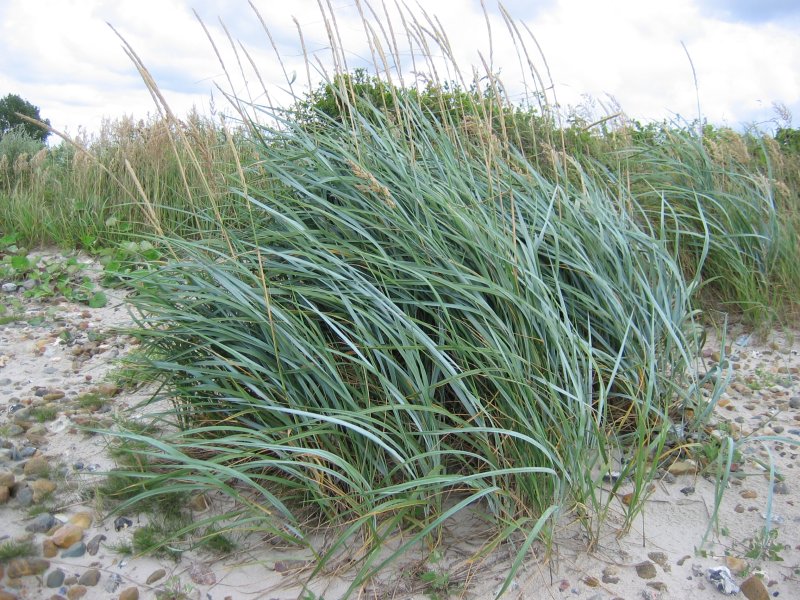
Photo: Kristian Peters -- Fabelfroh 09:25, 14 October 2005 (UTC), CC BY-SA 3.0 · source

Ornamental grass · Poaceae
Lyme grass
Leymus arenarius
In other languages: Zandhaver (Nederlands) · Élyme des sables (Français)
Lyme grass is a tough, blue-grey grass of the coasts of northern and western Europe, including the dunes of the Belgian coast. It does not form a neat clump but creeps through sand on long rhizomes, binding the shifting sand as it goes. The broad, stiff leaves are a striking steel blue, and in summer thick, upright flower spikes of 15–30 cm appear that dry to the colour of straw. Gardeners love its cool colour and its toughness: sun, wind, salt air and drought do it no harm. The cultivar ‘Blue Dune’ has extra blue foliage.
Caution: Lyme grass spreads aggressively by rhizomes that run far under other plants and paths and are hard to get rid of. Never plant it in an ordinary border without a root barrier. Do not dig up plants in the dunes, which are protected nature reserves: buy them from a nursery.
Light
Full sun
warm and bright
Moisture
Dry
tolerates drought
Legal basis
Sand
any pH
Hardiness
Fully hardy
down to -30 °C
Size
1 m
tall, 1 m wide
Flowering
June–August
| Pruning months | February–March and August |
|---|---|
| Height | 1 m |
| Native to Belgium | Yes |
| Poisonous to people and pets | Not known to be poisonous |
| Flowering | June–August |
Identify
Lyme grass: how do you recognise it?
- Habit
- Creeping grass that forms broad, loose mats from its rhizomes; leaves up to 60 cm, flower spikes up to 1 m tall.
- Leaves
- Broad, stiff and flat to rolled, blue-grey from a waxy coating; in winter they fade and become ragged.
- Flowers
- Dense, upright spikes of 15–30 cm in June–August, grey-green at first, later straw-coloured.
- Roots
- Long, creeping rhizomes that spread vigorously every year, also under paths and other plants.
- Hardiness
- Very hardy (to −30 °C) and tolerant of salt and wind.
Flowering: June–August · Plants: March–May and September–October · Pruning: February–March and August
In your garden
Why grow it?
- One of the bluest ornamental grasses: a cool accent among grey and silver plants.
- Grows where almost nothing else will: in dry sand, in the wind and even in salty sea air.
- Native to our coast and ideal for a dune or seaside garden.
- Its rhizomes bind loose sandy soil and banks.
- After its first summer it needs hardly any watering.
Lyme grass: where does it grow best?
- Full sun: in shade the leaves lose their blue colour and the plant flops open.
- Poor, free-draining soil: sand is ideal, but it grows in any dry soil, acid to chalky.
- Dry: it dislikes wet soil in winter.
- It tolerates wind and sea wind, so it suits the coast and open, exposed spots.
- Allow at least 1 m of space and plant it in a large pot or inside a root barrier 40–50 cm deep.
- Light
- Sun
- Soil type
- Sand
- Acidity
- Not fussy
- Moisture
- Dry
- Size
- 1 m tall, 1 m wide
- Hardiness
- Hardy (to -30 °C)
Goes well with
- Sea holly: Silvery blue and spiny: together they create a real dune feel.
- Sea kale: Large grey-blue leaves and white flowers in May–June, another coastal plant.
- Sea thrift: Pink flowers on low cushions at the front.
- Lavender: Purple against blue-grey, in the same dry, sunny spot.
- Catmint: Lilac flowers and grey leaves, just as drought-tolerant.
Maintenance
Lyme grass: when and how to plant it?
Plant in March–May and September–October.
- Plant in March–May or in September–October.
- First sink a root barrier of sturdy plastic, 40–50 cm deep with the rim 5 cm above ground, or choose a large pot of at least 40 cm.
- Dig a hole twice as wide as the root ball; on heavier soil mix in coarse sand or gravel for drainage.
- Set the plant at the same depth as it was in the pot and firm the soil well.
- Water thoroughly after planting and again in dry spells during the first weeks.
- Mulch with gravel or sand, not compost: rich soil makes it floppy and even more vigorous.
Care
- Water
- Only in long dry spells during the first year. After that it is not needed, even in hot summers.
- Feeding
- Not needed. Fertiliser and compost make it spread even more and turn the leaves less blue.
- Runners
- Every spring, chop off runners outside the chosen spot with a sharp spade and pull out the rhizomes.
- Flower spikes
- Cut them off if you mainly want the blue foliage: the plant stays neater.
- In a pot
- Water now and then in summer; divide and repot every two or three years.
Tip: If you want it in a border, first sink a root barrier 40–50 cm deep with the rim just above ground: you get the blue foliage without it taking over everything.
Lyme grass: when to prune it?
Pruning months: February–March and August.
When: Cut the old foliage back in late February or March, before the new leaves appear. Spent flower spikes can be removed in August.
How:
- Cut all leaves and old spikes back to 5–10 cm above the ground.
- Remove any runners that have popped up outside their space at the same time.
- In August, cut faded flower spikes off at the base if they look untidy.
Caution: Cutting back does not stop it spreading: only a root barrier or a pot keeps the rhizomes in place.
Propagation
- Division
- In March–April or September, chop off a piece of rhizome with a few shoots and replant it straight away. It almost always takes.
- Runners
- Pot up runners pulled out with a piece of rhizome, to give away or use elsewhere.
Lyme grass: how does it get through the winter?
Hardy to −30 °C.
- Fully hardy to about −30 °C: no protection is needed in Belgium.
- In winter the leaves turn pale and ragged; leave them until late February, they protect the base.
- Wet feet are more dangerous than frost: make sure the soil drains well.
- In a pot it can stay outside; stand the pot on feet so water can drain away.
Diseases and pests
- Spreading: Runners pop up far from the clump, among other plants or under paving. Use a root barrier or pot and chop off runners every spring.
- Green, floppy leaves: Too much shade, water or fertiliser. Move it to a sunny, poor spot.
- Collapsing spikes: After rain or on rich soil. Do not feed, and cut the spikes off if they get in the way.
- Rot: Losses in winter on heavy, wet soil. Improve drainage or move it to sand or gravel.
Through the year
- February: Cut old foliage back to 5–10 cm.
- March: Cut back if not done yet. Plant and divide. Chop off runners.
- April: Plant and divide. Check the root barrier.
- May: Plant. New blue foliage. Water young plants in dry spells.
- June: Flowering begins. Pull out runners outside their space.
- July: Flowering. No water or feeding needed.
- August: Cut off spent flower spikes.
- September: Plant and divide.
- October: Plant. Chop off the last runners.
- December: Rest. Leave the foliage standing.
You and this species
Did you know?
- Together with marram grass, lyme grass stabilises dunes: its rhizomes hold the sand together and the plant grows back up when it is buried by blown sand.
- It is related to wheat and barley. In Iceland its grain was once harvested and eaten as a cereal.
- The blue colour comes from a waxy coating on the leaves, which helps the plant save water.