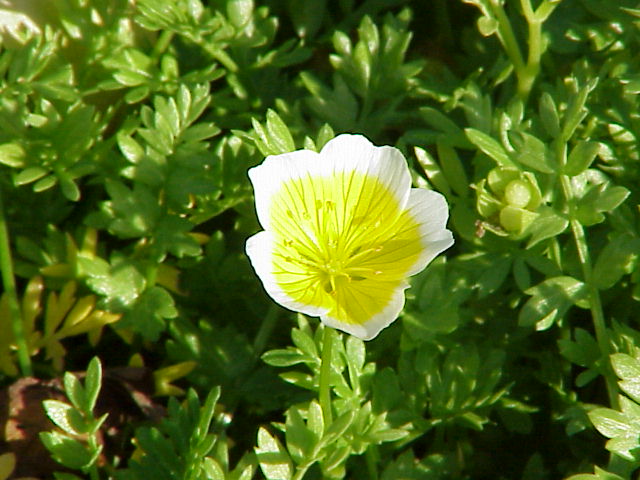
Photo: Kurt Stüber [1], CC BY-SA 3.0 · source

Annual · Limnanthaceae
Poached egg plant
Limnanthes douglasii
In other languages: Moerasbloem (Nederlands) · Limnanthe de Douglas (Français)
Poached egg plant is a low, hardy annual from California and southern Oregon, where it grows in spring in damp meadows and in hollows that are flooded in winter. It forms a little carpet 15 cm tall with finely cut, glossy, pale green leaves. In May–July it covers itself in saucers 2–3 cm across, yellow in the centre and white at the edge, like a poached egg. The flowers attract bees and hoverflies, whose larvae eat aphids. That is why many gardeners sow it along the vegetable plot or under fruit bushes. It self-seeds every year, but surplus seedlings are easy to weed out.
Light
Full sun
warm and bright
Moisture
Normal
no wet feet
Legal basis
Sand, loam or clay
any pH
Hardiness
down to -10 °C
protect in harsh winters
Size
0.15 m
tall, 0.15 m wide
Flowering
May–July
| Height | 0.15 m |
|---|---|
| Native to Belgium | No, planted |
| Good for bees, butterflies and birds | Yes, for bees |
| Poisonous to people and pets | Not known to be poisonous |
| Flowering | May–July |
Identify
Poached egg plant: how do you recognise it?
- Habit
- Low, spreading carpet 15 cm high and wide, with succulent, somewhat sprawling stems.
- Leaves
- Finely divided like a feather, glossy and pale green.
- Flower
- Saucer-shaped, 2–3 cm across, with five petals, from May to July.
- Colour
- Yellow in the centre and white at the edge, like a poached egg. An all-yellow form also exists.
- Seed
- Fairly large seeds that drop to the ground after flowering and germinate in autumn or spring.
Flowering: May–July · Sowing: March–April and September
In your garden
Why grow it?
- One of the earliest annuals to flower: a carpet of yellow and white as early as May.
- Attracts hoverflies, whose larvae clear aphids from the vegetable garden.
- A first-rate plant for bees, which visit the open flowers busily.
- Hardy: sown in September, it flowers particularly early the following spring.
- A cheerful, low ground cover for edges, under fruit bushes or between paving.
- Self-seeds, so you only need to sow it once.
Poached egg plant: where does it grow best?
- Full sun: the flowers then open wide.
- Any garden soil: sand, loam or clay, acid to chalky.
- Moderately moist: a cool root run and moisture in spring give the longest flowering. In a dry summer it finishes sooner.
- Ideal along the edges of the vegetable garden, under fruit bushes or between paving and gravel.
- Thin to 10–15 cm apart.
- Light
- Sun
- Soil type
- Sand, loam or clay
- Acidity
- Not fussy
- Moisture
- Normal
- Size
- 0.15 m tall, 0.15 m wide
- Hardiness
- Tolerates light frost (to -10 °C)
Goes well with
- Forget-me-not: Sky blue beside the yellow and white, in the same spring.
- Pot marigold: Another useful annual for the edge of the vegetable plot, with orange flowers.
- Phacelia: A purple-blue bee plant that is just as easy to sow in situ.
- Chives: Purple pompons and an edible edging along the vegetable bed.
Maintenance
Poached egg plant: when and how to plant it?
- Sow where it is to flower in September or in March–April, as it dislikes being transplanted.
- Rake the soil to a fine tilth and sow thinly, 0.5–1 cm deep, in a row or broadcast.
- Firm the soil lightly and keep it moist until the seedlings appear, usually after one to two weeks.
- Thin the seedlings to 10–15 cm.
- In a pot or trough, sow straight into the container, in potting compost with a little sand.
- September sowings flower as early as May; spring sowings a few weeks later.
Care
- Watering
- Only in dry spells in spring: it likes a cool, moist root run while flowering.
- Feeding
- Not needed: ordinary garden soil is enough.
- Weeding
- Keep young seedlings weed-free; later the carpet closes up by itself.
- After flowering
- By July it has finished and dies off. Pull up the plants, or leave them a few more weeks so they drop their seed.
- Seedlings
- New seedlings come up in autumn. Recognise them by their fine, pale green leaves and do not weed them out.
Tip: Sow it in situ in September or March along the vegetable plot or under fruit bushes: the flowers attract hoverflies, whose larvae eat aphids. After flowering, leave a few plants standing and it will self-seed.
Poached egg plant: when to prune it?
When: An annual that is not pruned. After flowering in July, pull it up or let it self-seed.
How:
- No pruning is needed: the plant stays low and compact by itself.
- After flowering, leave a few plants until the seed drops if you want it to self-seed.
- Pull up the dead plants in July and put them on the compost heap.
Propagation
- Seed
- Sow where it is to flower in September or March–April. You can collect seed from spent plants in July and keep it dry until September.
- Self-sowing
- It self-seeds every year. Simply weed out surplus seedlings.
Poached egg plant: how does it get through the winter?
Hardy to −10 °C: protect in harsh winters.
- Hardy to about −10 °C: plants sown in September overwinter in Belgian gardens as small rosettes.
- In a severe winter there are sometimes losses; sow again in March to fill gaps.
- No protection is needed. Do keep pots sheltered, though, and never stand them in a saucer of water.
Diseases and pests
- Slugs: They eat young seedlings in autumn and spring. Check in the evening and pick them off.
- Aphids: Sometimes on young shoots. Hoverflies and ladybirds usually deal with them quickly.
- Short flowering: In hot, dry weather flowering is soon over. Sow in September for earlier flowers and water in dry spells.
- Powdery mildew: White powder on the leaves at the end of flowering in dry weather. No cause for concern: the plant is dying back by then anyway.
- Too many seedlings: It self-seeds generously. Weed out the surplus while the seedlings are still small.
Through the year
- March: Sow where it is to flower.
- April: Sow where it is to flower. Thin to 10–15 cm.
- May: Autumn sowings in flower. Bees and hoverflies at work.
- June: Full flower. Water in dry spells.
- July: Last flowers. Let the seed drop or collect it; clear dead plants.
- September: Sow in situ for early flowers next year.
- October: Seedlings appear. Thin them but do not weed them all out.
- November: Young rosettes overwinter in the garden.
Use
Good for wildlife
- Bees
- Nectar and pollen for honeybees and wild bees.
You and this species
Did you know?
- Its English name, poached egg plant, refers to the yellow and white flowers.
- The name Limnanthes means ‘marsh flower’, from the Greek limnè (pool) and anthos (flower): in California it grows in hollows that flood in winter.
- It is named after David Douglas, the Scottish plant hunter who also brought the Douglas fir to Europe.