Photo: Ghislain118 http://www.fleurs-des-montagnes.net, CC BY-SA 3.0 · source

Perennial · Linaceae
Perennial flax
Linum perenne
In other languages: Overblijvend vlas (Nederlands) · Lin vivace (Français)
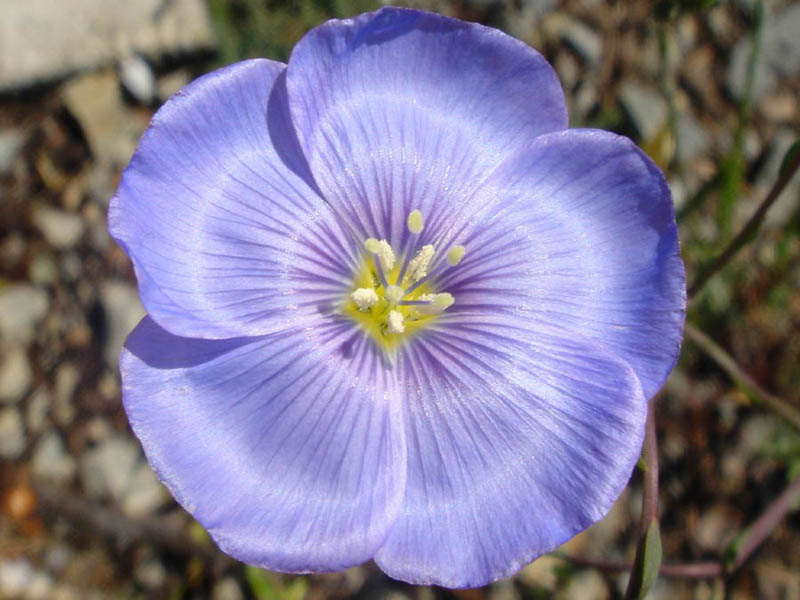
Perennial flax is native to dry, chalky grasslands and mountain pastures across Europe. It is a light, airy perennial of 40–50 cm with thin, flexible stems and narrow, grey-green leaves. From May to August it carries sky-blue, saucer-shaped flowers about 2.5 cm across that open in the morning. Each flower lasts only a day and the petals soon drop, but new buds keep opening for weeks. The plant is very hardy, loves sun and lean soil, usually does not live long, but seeds itself around easily.
Light
Full sun
warm and bright
Moisture
Dry
tolerates drought
Legal basis
Sand or loam
neutral to chalky
Hardiness
Fully hardy
down to -30 °C
Size
0.5 m
tall, 0.3 m wide
Flowering
May–August
| Pruning months | March |
|---|---|
| Height | 0.5 m |
| Native to Belgium | No, planted |
| Good for bees, butterflies and birds | Yes, for bees |
| Poisonous to people and pets | Not known to be poisonous |
| Flowering | May–August |
Identify
Perennial flax: how do you recognise it?
- Habit
- Loose, airy clump 40–50 cm tall and about 30 cm wide, with many thin, arching stems.
- Leaves
- Narrow and lance-shaped, about 2 cm long, grey-green and scattered along the stems.
- Flower
- Saucer-shaped, about 2.5 cm across, sky blue with fine veins; from May to August. Each flower lasts one day.
- Fruit
- Small, round seed capsules with glossy brown seeds after flowering.
- Roots
- Deep taproot: it tolerates drought well but resents being moved when older.
Flowering: May–August · Sowing: March–May · Plants: April–May · Pruning: March
In your garden
Why grow it?
- Sky-blue flowers for four months, a colour that is rare in the summer border.
- A light, see-through plant that lets other perennials show through without shading them.
- Very drought tolerant and undemanding: it suits a gravel garden or a dry, sunny border.
- The flowers attract bees.
- In a suitable spot it seeds itself, so you keep getting new plants.
Perennial flax: where does it grow best?
- Full sun: in part shade it flops and flowers less.
- Poor to moderately fertile, well-drained sandy or loamy soil, preferably neutral to chalky.
- Dry to normal moisture: wet, heavy clay in winter is fatal to the roots.
- Suits a rock garden, gravel garden, dry slope and sunny edge.
- Allow 25–30 cm between plants; preferably plant a few together.
- Light
- Sun
- Soil type
- Sand or loam
- Acidity
- Neutral or chalky
- Moisture
- Dry
- Size
- 0.5 m tall, 0.3 m wide
- Hardiness
- Hardy (to -30 °C)
Goes well with
- Ox-eye daisy: White flowers that contrast softly with the sky blue.
- Evening primrose: Yellow in the evening, same sun and the same dry soil.
- Ornamental grasses: Light plumes that support the airy plant.
- Catmint: Blue spikes that enjoy the same dry, sunny position.
- Stonecrop: A low plant that covers the base without holding too much moisture.
Maintenance
Perennial flax: when and how to plant it?
Plant in April–May.
- Plant in April or May, once the soil has warmed up.
- Dig a hole as deep as the pot and twice as wide; open up heavy soil with coarse sand or grit.
- Set the plant at the same depth as in its pot and firm the soil lightly around it.
- Space plants 25–30 cm apart in groups of three to five for an airy effect.
- Water well straight away, then only during long dry spells.
- Leave the soil bare or spread grit; no thick layer of compost or bark around the crown.
Care
- Watering
- In the first year during long dry spells; after that no longer needed.
- Feeding
- Not needed. Rich soil gives long, floppy stems and shortens the plant’s life.
- Spent flowers
- Cut off faded stems to prolong flowering. Leave a few in August if you want it to self-seed.
- Mulching
- Only with grit or gravel, to keep the crown dry.
- Renewing
- The plant is short-lived. Let it self-seed or sow again every few years so you always have young plants.
Tip: Each flower lasts only a day, but new ones keep coming for weeks. Give it poor, dry soil and let it self-seed, because the plant is short-lived.
Perennial flax: when to prune it?
Pruning months: March.
When: In March, before the new shoots start. In summer you also cut off faded stems.
How:
- In March, cut the old stems back to a few centimetres above the ground.
- Between May and August, cut faded stems back to just above a side shoot.
- Late in the season, leave a few stems for seed if you want natural self-seeding.
Propagation
- Sowing indoors
- In March, in a tray of sandy seed compost, on the surface and barely covered. Keep lightly moist; seeds germinate in two to four weeks. Plant out after the last frosts.
- Sowing outdoors
- In April–May, straight into a sunny, well-drained spot. Thin later to 25–30 cm.
- Self-seeding
- The plant seeds itself; move the seedlings while still small, as they have a deep taproot.
Perennial flax: how does it get through the winter?
Hardy to −30 °C.
- Fully hardy, down to about −30 °C: no protection is needed in Belgian winters.
- The danger is not frost but lasting wetness: make sure the soil drains well.
- In a pot: stand it against a wall, under a roof or somewhere the pot does not become waterlogged.
Diseases and pests
- Root rot: Limp, yellow-brown plants in wet, heavy soil. Improve drainage with grit or choose another spot.
- Floppy growth: In shade or rich soil the stems fall over. Give more sun and no feed.
- Slugs: Young plants and seedlings get nibbled. Collect the slugs in the evening.
- Aphids: Sometimes on young shoots. A jet of water is usually enough.
Through the year
- March: Cut old stems back. Sow indoors.
- April: Plant. Sow outdoors.
- May: Plant or sow. Flowering begins.
- June: Flowering. Cut off faded stems.
- July: Flowering. Cut off faded stems.
- August: Last flowers. Leave a few stems for seed.
- September: Move seedlings if needed.
- November: Check that rainwater drains away well.
Use
Good for wildlife
- Bees
- Nectar and pollen for honeybees and wild bees.
You and this species
Did you know?
- The flowers open in the morning and usually drop their petals during the day, so the plant looks ‘new’ every day.
- The genus Linum is best known for common flax, whose fibres give linen and whose seed gives linseed.
- In the wild, perennial flax grows on dry grassland and mountain pastures across large parts of Europe.