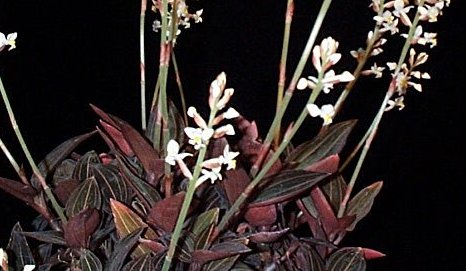
Photo: Nitesh8de at English Wikipedia, Public domain · source

Houseplant · Orchidaceae
Jewel orchid
Ludisia discolor
In other languages: Juweelorchidee (Nederlands) · Orchidée bijou (Français)
The jewel orchid (Ludisia discolor) grows in the tropical forests of South-East Asia, among moss and leaf litter on the forest floor. Unlike most orchids, it is grown mainly for its foliage: velvety, dark green to reddish brown, with fine pink, red or silvery-white veins that glitter like jewels. In winter an upright spike appears with dozens of small white flowers with a yellow centre. The plant stays low and compact, which makes it ideal for a partly shaded windowsill, a terrarium or a humid bathroom with some daylight.
Light
Partial shade or shade
tolerates little sun
Moisture
Normal to wet
must not dry out
Legal basis
Potting soil
Hardiness
Houseplant
min. 15 °C
Size
0.2 m
tall, 0.3 m wide
Flowering
November–February
| Pruning months | March–April |
|---|---|
| Height | 0.2 m |
| Poisonous to people and pets | Not known to be poisonous |
| Flowering | November–February |
Identify
Jewel orchid: how do you recognise it?
- Habit
- Terrestrial orchid about 20 cm tall and 30 cm across, with fleshy, creeping stems that root along the ground and then turn upwards.
- Leaves
- Oval, about 3–7 cm long, velvety dark green to reddish brown, with lengthwise veins in pink, red or silver.
- Flower
- Upright spike about 15–25 cm long with many small white flowers with a yellow column, from November to February.
- Roots
- Thin roots that form at the nodes of the creeping stems; they are shallow and need an airy, moist mix.
- Habitat
- In the wild on the forest floor among moss, leaf litter and rocks, in warm, humid air.
Flowering: November–February · Plants: March–April · Pruning: March–April
In your garden
Why grow it?
- The velvety leaves with pink veins are decorative all year round, even without flowers.
- It flowers in winter (November–February), when little else is in bloom indoors.
- Low and creeping, so a small plant fits in a shallow dish or a terrarium.
- Tolerates partial shade and shade better than most orchids, with no need for strong sun.
- Easy to propagate from cuttings: one plant quickly becomes a whole group.
Jewel orchid: where does it grow best?
- Partial shade to shade: plenty of bright but indirect light, for example at an east- or north-facing window. Direct sun scorches the leaves.
- Airy, acidic, moisture-retentive mix based on peat or sphagnum, with fine bark and perlite; a special terrestrial orchid compost also works.
- Evenly, lightly moist and in humid air of about 50–70 %. It does well in a terrarium or on a tray of wet pebbles.
- Warm, 18–25 °C, never below 15 °C; away from draughts and cold window panes.
- Light
- Bright, out of direct sun or low light
- Potting soil
- Airy, humus-rich compost
- Acidity
- Acid
- Watering
- Moderately or generously
- Size
- 0.2 m tall, 0.3 m wide
- Temperature
- Minimum 15 °C
Goes well with
Maintenance
Jewel orchid: when and how to plant it?
Plant in March–April.
- Pot in March–April, after flowering, or as soon as the plant outgrows its pot.
- Choose a shallow, wide pot with drainage holes; the roots are shallow and the stems creep over the rim.
- Make an airy mix of fine bark, peat or sphagnum and perlite, with a few clay pebbles at the bottom for drainage.
- Lay the stems horizontally on the mix and cover only the roots; the leaves and growing points stay above the surface.
- Water with lukewarm, low-lime water (rainwater is ideal) and let the excess drain away.
Care
- Water
- Keep the mix lightly moist, but not wet. Let the top layer dry out a little between waterings; use low-lime water and never let water stand in the pot or saucer. A little less in winter, but the mix must not dry out completely.
- Feeding
- From April to September, every 2–4 weeks, give a weak dose of orchid feed (a quarter to half of the recommended strength). Do not feed in winter.
- Humidity
- Keep the air humid, for example with a tray of wet pebbles or a humidifier; brown leaf edges point to air that is too dry.
- Flower spikes
- Cut the spike off as soon as all the flowers have faded, just above the soil or just above a node.
- Repotting
- Every 2–3 years in spring, in fresh orchid mix; the stems creep, and the plant otherwise becomes too long and bare.
Tip: Give it a spot with plenty of bright but indirect light and high humidity; slightly cooler autumn nights help it to flower in winter.
Jewel orchid: when to prune it?
Pruning months: March–April.
When: A jewel orchid is hardly pruned. Cut off the flower spikes after flowering and shorten long, bare stems in March–April.
How:
- Cut spent flower spikes right off with clean scissors as soon as the flowers have faded.
- Shorten long, bare stems to just above a node with a leaf or a root; new shoots grow from the nodes.
- Use the cut pieces of stem with 2–3 nodes as cuttings.
- Remove withered or yellow leaves.
Propagation
- Cuttings
- In spring or summer cut 5–10 cm lengths with 2–3 nodes. Lay them flat or push them in at an angle in moist orchid mix or sphagnum, under clear film, warm and bright. After a few weeks roots and new shoots appear.
- Division
- When repotting in spring, divide a dense plant into pieces that each have a few stems and roots, and pot them separately.
Jewel orchid: how does it get through the winter?
- Not hardy: keep it above 15 °C all year, including winter, at 18–22 °C or slightly cooler.
- Winter is its flowering time: put it in a bright place without direct sun, away from radiators and cold window panes.
- Water a little less, but do not let the mix dry out, and keep the air humid: heated air is very dry.
Diseases and pests
- Scorched or pale leaves: Pale, brown or dried patches caused by too much sun. Move the plant further from the window or behind a net curtain.
- Brown leaf edges: Caused by dry air, hard water or too much fertiliser. Raise the humidity, use rainwater and feed more weakly.
- Stem rot: A soft, dark or slimy stem base after too much water or cold. Let the mix dry, cut off the healthy part and root it again as a cutting in fresh mix.
- Mealybug: White, cottony tufts in the leaf axils. Wipe them off with a cloth and a little soapy water or with a cotton bud; repeat after a week.
- No flowers: Usually too little light or an autumn that is too warm. Move it to a brighter spot and let the autumn nights cool by a few degrees.
Through the year
- January: Flowering. Keep bright, warm and humid. Water moderately.
- February: Flowering. Cut off spent flower spikes.
- March: Repot and divide. Shorten long stems, take cuttings.
- April: Repot, take cuttings. Start feeding weakly.
- May: Feed weakly every 2–4 weeks. Keep humidity high.
- June: Keep out of full sun. Keep lightly moist.
- July: Out of the sun. Humid air and regular water.
- August: Water lightly and regularly. Check for mealybug.
- September: Stop feeding. Let the room cool a little at night.
- October: Flower spikes form. Avoid moving the plant around.
- November: Flowering begins. Bright and warm.
- December: Flowering. Humid air, away from radiators.
You and this species
Did you know?
- Ludisia is a genus with just one species. The name discolor means ‘of different colours’ and refers to the marked leaves.
- Jewel orchids are grown mainly for their foliage: the flowers, however pretty, are a bonus.
- In the wild the plant grows on the ground among moss, leaf litter and rocks, not in trees like many other orchids.