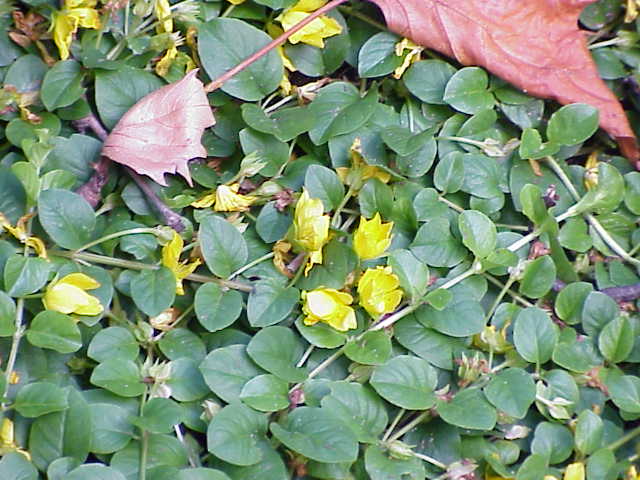
Photo: Kurt Stüber [1], CC BY-SA 3.0 · source

Perennial · Primulaceae
Creeping Jenny
Lysimachia nummularia
In other languages: Penningkruid (Nederlands) · Herbe aux écus (Français)
Creeping Jenny is a native, creeping perennial that grows in damp places across most of Europe: in wet grassland, along ditches and in moist woodland. Its stems lie flat on the ground, root wherever they touch the soil and grow to about 60 cm long, with small, round leaves like little coins. From June to August, yellow, cup-shaped flowers about 2 cm across appear in the leaf axils. Gardeners use it as a fast ground cover for damp spots, as an edging to a pond or trailing over the rim of a pot. The golden-leaved form ‘Aurea’ is the best known and colours best in partial shade.
Caution: It spreads quickly with creeping, rooting stems and can smother low plants and invade a lawn. Plant it where it may take up space, trim the edges regularly and never dump plant waste in ditches or the countryside: in North America, outside its natural range, it has become a problem plant.
Light
Sun to shade
not fussy
Moisture
Normal to wet
must not dry out
Legal basis
Loam, clay or peat
any pH
Hardiness
Fully hardy
down to -30 °C
Size
0.05 m
tall, 0.6 m wide
Flowering
June–August
| Pruning months | March and July |
|---|---|
| Height | 0.05 m |
| Native to Belgium | Yes |
| Good for bees, butterflies and birds | Yes, for bees |
| Poisonous to people and pets | Not known to be poisonous |
| Flowering | June–August |
Identify
Creeping Jenny: how do you recognise it?
- Habit
- Flat, creeping mats only 5 cm tall, with stems up to about 60 cm long that root at the nodes.
- Leaves
- Small, round and opposite, 1.5–2.5 cm, fresh green; golden yellow in ‘Aurea’. In mild winters they stay partly green.
- Flower
- Open yellow cups about 2 cm across, single or in pairs in the leaf axils, from June to August.
- Colour
- Bright buttercup yellow.
- Roots
- Shallow, fibrous roots at every node that touches the soil.
Flowering: June–August · Plants: March–May and September–October · Pruning: March and July
In your garden
Why grow it?
- A fast, flat ground cover that gives weeds little chance.
- Yellow flowers from June to August, in the axils of the leaves.
- It grows in sun, partial shade and shade, in moist soil.
- Native and good for bees, including the yellow loosestrife bee, which specialises in loosestrifes such as this one.
- Lovely trailing over the rim of a pot, a low wall or a pond edge.
Creeping Jenny: where does it grow best?
- Sun, partial shade or shade; ‘Aurea’ colours best in partial shade and scorches in strong sun on dry soil.
- Moist, humus-rich soil: loam, clay or peat, acid to chalky.
- Normal to wet: ideal at a pond edge or in a damp corner.
- Allow 30–40 cm between plants; it closes up quickly.
- Light
- Sun, partial shade and shade
- Soil type
- Loam, clay or peat
- Acidity
- Not fussy
- Moisture
- Normal or wet
- Size
- 0.05 m tall, 0.6 m wide
- Hardiness
- Hardy (to -30 °C)
Goes well with
- Hosta: Large dark green or blue-green leaves above a carpet of golden creeping Jenny.
- Ferns: Fine green fronds above the low carpet, in moist partial shade.
- Water forget-me-not: A native plant with sky-blue flowers at the pond edge, beside the yellow ones.
- Japanese iris: Upright leaves and large flowers at the water’s edge, above the creeping stems.
Maintenance
Creeping Jenny: when and how to plant it?
Plant in March–May and September–October.
- Plant from March to May or in September–October, when the soil is neither frozen nor waterlogged.
- Loosen the soil and mix in some compost.
- Set the plant at the same depth as in the pot and lay the long stems out over the soil.
- Keep 30–40 cm between plants.
- Water straight away and keep the soil moist for the first few weeks.
- In a small border, do not plant it next to low, delicate plants that it could smother.
Care
- Watering
- Keep the soil moist, especially in sun and in pots; in drought the leaves scorch.
- Feeding
- Not needed in ordinary garden soil; in a pot, a little liquid feed now and then in summer.
- Keeping it in check
- In spring and summer, cut or dig out stems that spread too far.
- In pots
- Plant it at the edge of a container or hanging basket, so the stems can trail down.
- Bare patches
- Lay a few stems over the bare patch and peg them down: they root quickly.
Tip: Plant the golden form ‘Aurea’ in partial shade: that is where it colours best and does not scorch. In a pot or container, let it trail over the edge.
Creeping Jenny: when to prune it?
Pruning months: March and July.
When: It is not really pruned. In March, clear away dead stems, and in July, trim the edges if it spreads too far.
How:
- In March, cut off dead or bare stems; the plant soon grows again.
- In July, cut back stems that grow over paths or other plants.
- Slice off runners creeping into the lawn or border with a spade.
Propagation
- Division
- From March to October, dig out a piece of the mat with roots and plant it elsewhere. It could hardly be easier.
- Cuttings
- Put 10 cm pieces of stem into moist soil or even a glass of water; they root within a few weeks.
Creeping Jenny: how does it get through the winter?
Hardy to −30 °C.
- Fully hardy, to about −30 °C: no protection needed.
- In mild winters the leaves stay partly green; after hard frost it shoots again in spring.
- In a pot or hanging basket: keep it sheltered and make sure excess water can drain away.
Diseases and pests
- Spreading too much: It creeps quickly into borders and lawns. Trim the edges regularly and do not plant it next to low, delicate plants.
- Leaf scorch: Brown, withered leaves in strong sun on dry soil, especially in ‘Aurea’. Water more or choose a spot in partial shade.
- Bare patches: After drought or a hard winter. Lay stems over the bare patch and peg them down.
- Few flowers: ‘Aurea’ flowers less than the green form, and in deep shade it flowers little. Choose the green form if you want plenty of flowers.
Through the year
- March: Cut away dead stems. Plant or divide.
- April: Plant or divide. Fill bare patches with stems.
- May: Plant. Water in dry spells.
- June: Flowering begins. Bees visit.
- July: In flower. Trim the edges. Water in dry spells.
- August: In flower. Take cuttings.
- September: Plant or divide.
- October: Plant. Slice off runners in the lawn.
Use
Good for wildlife
- Bees
- Nectar and pollen for honeybees and wild bees.
You and this species
Did you know?
- The name nummularia comes from the Latin nummulus, ‘little coin’, after the round leaves. The French name herbe aux écus also refers to old coins.
- The flowers produce oil instead of nectar. The yellow loosestrife bee collects this oil to feed its larvae and to waterproof its nest.
- In the wild it sets little seed; it spreads mainly by its creeping stems.