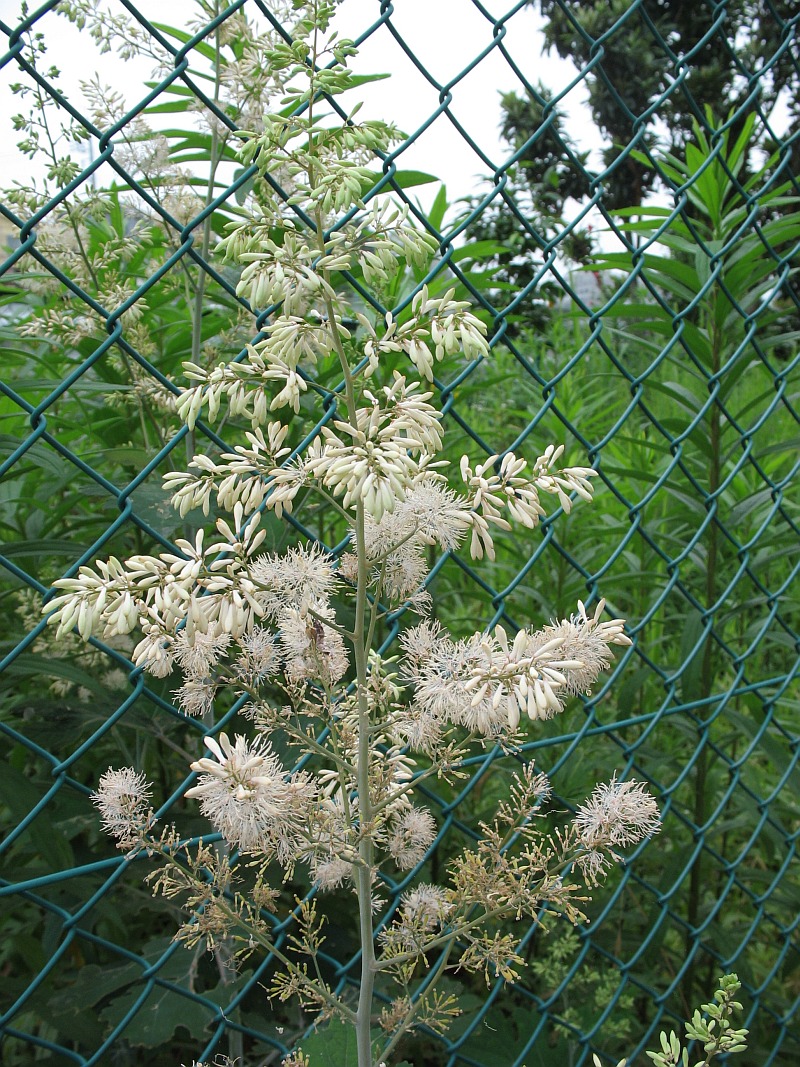
Photo: Sphl, CC BY-SA 3.0 · source

Perennial · Papaveraceae
Plume poppy
Macleaya cordata
In other languages: Pluimpapaver (Nederlands) · Pavot plume (Français)
Plume poppy comes from East Asia: China, Japan and Taiwan. It is an impressive perennial that grows back every year to about 2 m or more, with large, deeply lobed, heart-shaped leaves that are grey-green above and whitish and downy beneath. From July to September, airy plumes of hundreds of tiny cream to pinkish-buff flowers without petals rise above the leaves. Despite its name it looks nothing like a field poppy, although it does belong to the poppy family. It spreads by underground runners and has an orange sap that irritates the skin.
Caution: All parts are poisonous and the orange sap irritates the skin and eyes. Keep children, cats, dogs and grazing animals such as horses and sheep away, and wear gloves. It spreads by underground runners and can become rampant in a rich border.
Light
Sun or partial shade
preferably some sun
Moisture
Normal
no wet feet
Legal basis
Sand, loam or clay
any pH
Hardiness
Fully hardy
down to -30 °C
Size
2.2 m
tall, 1 m wide
Flowering
July–September
| Pruning months | March and November |
|---|---|
| Height | 2.2 m |
| Native to Belgium | No, planted |
| Poisonous to people and pets | Yes, take care with children and pets |
| Flowering | July–September |
Identify
Plume poppy: how do you recognise it?
- Habit
- Upright, sturdy, blue-grey bloomy stems 2–2.5 m tall, spreading by runners into a wide clump.
- Leaves
- Large, round to heart-shaped and deeply lobed; grey-green above, whitish and downy beneath.
- Flower
- Airy plumes of small flowers without petals, with many stamens, from July to September.
- Colour
- Cream to pinkish buff; after flowering, flat little seed pods in the same shade.
- Sap
- Orange sap in all parts, which runs from any wound.
- Roots
- Underground runners that send up new shoots some distance from the parent plant.
Flowering: July–September · Plants: March–May and October · Pruning: March and November
In your garden
Why grow it?
- A real eye-catcher: large, elegant leaves and plumes well over 2 m tall.
- Adds height at the back of a large border or as a loose summer screen.
- The leaves stay handsome from spring to autumn; their pale undersides shimmer in the wind.
- Fully hardy and easy in any ordinary garden soil.
- Seldom troubled by disease.
Plume poppy: where does it grow best?
- Sun to partial shade; in sun it stays more compact and sturdier.
- Ordinary garden soil: sand, loam or clay, acid to chalky. In rich soil it grows even bigger and spreads more.
- Normal soil that is not too wet; once established it tolerates some drought.
- A spot sheltered from strong wind, as the big leaves tear and the tall stems can snap.
- Allow at least 1 m per plant, at the back of a large border and not next to small, delicate plants.
- Light
- Sun and partial shade
- Soil type
- Sand, loam or clay
- Acidity
- Not fussy
- Moisture
- Normal
- Size
- 2.2 m tall, 1 m wide
- Hardiness
- Hardy (to -30 °C)
Goes well with
- Miscanthus: Also tall and airy, with plumes at the same time.
- Joe Pye weed: Pink flower heads in late summer, tall and loved by butterflies.
- Sneezeweed: Warm orange and red shades in front of the plumes, in the same sun.
- Japanese anemone: Flowers in late summer and tolerates the same partial shade.
Maintenance
Plume poppy: when and how to plant it?
Plant in March–May and October.
- Plant from March to May or in October, when the soil is neither frozen nor too wet.
- Wear gloves: broken stems or roots release orange sap.
- Dig a hole twice as wide as the root ball and mix in a spadeful of compost.
- To keep the runners in check, sink a root barrier 30–40 cm deep around the planting spot.
- Set the plant at the same depth as it was in the pot, firm in and keep at least 1 m clear all round.
- Water in well straight away and apply a mulch.
Care
- Water
- In the first year during dry spells. After that, only during long dry periods.
- Feeding
- A spadeful of compost in spring is enough; too much fertiliser makes it even bigger and more rampant.
- Runners
- Every spring, chop off and dig out any runners that appear outside the space you want it to fill.
- Support
- Usually not needed. In a windy spot or in partial shade, a sturdy stake can help.
- Gloves
- Always wear gloves: the orange sap irritates the skin and stains.
Tip: Plant it at the back of a large border, inside a root barrier 30–40 cm deep: you get the big leaves and plumes without the runners taking over the whole border.
Plume poppy: when to prune it?
Pruning months: March and November.
When: Cut the dead stems down in November, or leave them for winter interest and cut them away in March.
How:
- Cut all stems back to just above the ground.
- Wear gloves: orange sap runs from stems that are still green.
- During the March tidy-up, chop off any runners that have gone too far at the same time.
Caution: The orange sap irritates the skin and eyes. Wear gloves and rinse at once with water if you get any on you.
Propagation
- Runners
- In March–April: chop off a runner with roots and a shoot and replant it straight away in its new spot.
- Division
- In spring you can also lift the whole clump and split it with a spade.
- Root cuttings
- In winter: cut 5–8 cm pieces of root and lay them in a pot of cutting compost in a cool, frost-free place.
Plume poppy: how does it get through the winter?
Hardy to −30 °C.
- Fully hardy, to about −30 °C: no protection is needed in Belgium.
- It dies back in autumn and shoots up again in April.
- The dry stems and seed pods look good in winter; leave them until March if you like.
- Its size and runners make it less suitable for a pot; in a large tub it can overwinter outdoors, with the tub wrapped in severe frost.
Diseases and pests
- Spreading: Runners pop up some distance from the plant, even among other plants. Chop them off every spring or plant it inside a root barrier.
- Slugs: They eat the young shoots in April. Pick them off in the evening; older plants are rarely bothered.
- Wind damage: In an exposed spot stems snap or leaves tear. Choose a sheltered spot or give it a sturdy stake.
- Skin irritation: Red, irritated skin after working on the plant. Rinse with water and wear gloves from now on.
Through the year
- March: Cut away old stems if they are still standing. Plant. Chop off runners.
- April: Plant. Chop off and replant runners. Watch for slugs.
- May: Plant. Rapid growth.
- June: Water in dry spells. Keep an eye on runners.
- July: Flowering begins.
- August: Full flower. Water during long dry spells.
- September: Last flowers. The seed pods colour up.
- October: Plant.
- November: Cut down the stems or leave them for winter.
- December: Take root cuttings.
Use
Edible and useful
Not edible. All parts of plume poppy are poisonous: its orange milky sap contains alkaloids that cause vomiting, stomach ache and diarrhoea if swallowed, and it strongly irritates the skin and eyes. The sap flows as soon as you break a stem or leaf: wear gloves when cutting back and chopping out, do not rub your eyes and wash your hands afterwards; rinse sap out of the eyes at once with plenty of water. Keep children, dogs, cats and grazing animals such as horses and sheep away from the plant and its trimmings. It spreads by underground runners: put dug-out pieces in the green-waste bin, not in a field or in the wild. If any is swallowed, call a poison centre (in Belgium 070 245 245) or your doctor at once.
You and this species
Did you know?
- The genus is named after Alexander Macleay, a Scottish entomologist who later became Colonial Secretary of New South Wales.
- The little flowers have no petals: the sepals drop as the flower opens, leaving mainly the stamens.
- The orange sap contains alkaloids, including sanguinarine.