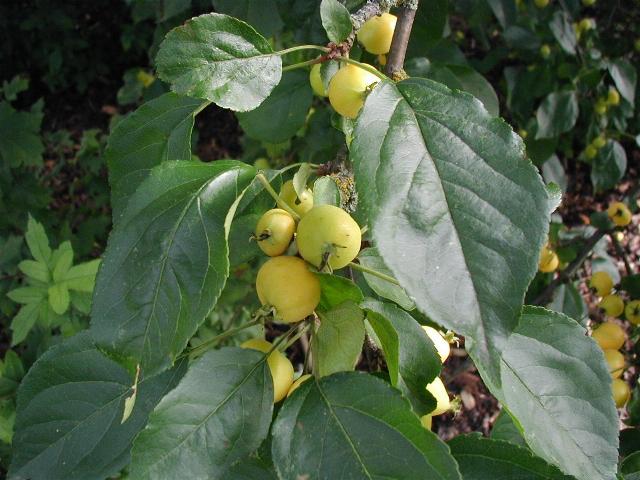
Photo: Sten at Danish Wikipedia, CC BY-SA 3.0 · source

Tree · Rosaceae
Siberian crab apple
Malus baccata
In other languages: Siberische appel (Nederlands) · Pommier de Sibérie (Français)
The Siberian crab apple grows wild from Siberia and Mongolia to northern China, Korea and the Himalayas. It is a medium-sized tree with a rounded, rather open crown that is smothered in fragrant white flowers in April–May. Masses of small round apples about 1 cm across follow, red or yellow, which hang on the tree for a long time and are eaten by birds in winter. The species is extremely hardy and has therefore often been used to breed cold-hardy apples and crab apples. A well-known cultivar is ‘Jackii’, with glossy red fruits.
Light
Sun or partial shade
preferably some sun
Moisture
Normal
no wet feet
Legal basis
Sand, loam or clay
any pH
Hardiness
Fully hardy
down to -40 °C
Size
10 m
tall, 8 m wide
Flowering
April–May
| Pruning months | December–February |
|---|---|
| Height | 10 m |
| Native to Belgium | No, planted |
| Good for bees, butterflies and birds | Yes, for bees and birds |
| Poisonous to people and pets | Not known to be poisonous |
| Flowering | April–May |
Identify
Siberian crab apple: how do you recognise it?
- Habit
- Medium-sized tree with a rounded to spreading, rather open crown; up to about 10 m tall and 8 m wide.
- Leaf
- Elliptic to ovate, 3–8 cm, finely toothed, on long stalks; fresh green, turning yellow in autumn.
- Flower
- Pure white, fragrant flowers about 3 cm across, in clusters on short spurs, in April–May.
- Fruit
- Round apples about 1 cm across, red or yellow, on long stalks; they often stay on into winter.
- Bark
- Grey-brown and smooth on young trees, rougher later.
Flowering: April–May · Harvest and fruit: September–November · Plants: March–April and October–December · Pruning: December–February
In your garden
Why grow it?
- An abundant, white and fragrant display of blossom in April–May.
- Bees and bumblebees visit the flowers.
- The small red apples hang on for a long time and feed blackbirds, thrushes and other birds in winter.
- Extremely hardy and undemanding about soil, including chalky soil.
- A good pollinator for eating apples that flower at the same time.
Siberian crab apple: where does it grow best?
- Sun or partial shade; it flowers most freely and the fruits colour best in full sun.
- Any well-drained soil: sand, loam or clay, neutral to chalky.
- Moist; it does not tolerate waterlogging.
- An open, airy position reduces scab and mildew.
- Allow 7–8 m of space; under the crown of a standard there is room for bulbs and perennials.
- Light
- Sun and partial shade
- Soil type
- Sand, loam or clay
- Acidity
- Not fussy
- Moisture
- Normal
- Size
- 10 m tall, 8 m wide
- Hardiness
- Hardy (to -40 °C)
Goes well with
- Daffodil: Flowers under the bare crown, before the tree comes into leaf.
- Forget-me-not: A blue carpet beneath the white blossom.
- Cranesbill: Tolerates the light shade under the crown and flowers for a long time.
- Michaelmas daisy: Flowers in autumn, at the same time as the red apples.
Maintenance
Siberian crab apple: when and how to plant it?
Plant in March–April and October–December.
- Plant in March–April or from October to December, when the soil is not frozen or waterlogged.
- Dig a hole twice as wide as the root ball and loosen the bottom; mix some compost into the excavated soil.
- Set the tree at the same depth as it was in the pot or nursery; the graft union stays above the soil.
- Drive in an angled stake on the windward side and tie the trunk loosely.
- Firm the soil well and water straight away with a few buckets.
- Keep a circle of about 1 m free of grass around the trunk and cover it with mulch.
Care
- Water
- For the first two years, water regularly in dry spells. After that it is rarely needed.
- Feeding
- A layer of compost in spring is enough.
- Clear base
- In the first years, keep the soil around the trunk free of grass and weeds: the tree grows better.
- Fruits
- Leave them on the tree: they are decorative and feed birds well into winter.
- Water shoots
- Remove upright water shoots and suckers at the base during the winter pruning.
Tip: Leave the apples on the tree: they decorate it into winter and are a welcome food source for birds. Clear up fallen leaves in autumn and you will have less trouble with scab.
Siberian crab apple: when to prune it?
Pruning months: December–February.
When: While dormant, from December to February, on a frost-free day.
How:
- Remove only dead, diseased, damaged or crossing branches.
- Take out upright water shoots and suckers.
- Keep the crown open to let in light and air: this reduces scab and mildew.
- Give a young tree a straight trunk and a few well-spaced main branches.
Caution: Do not prune hard: heavy pruning produces lots of water shoots and fewer flowers. Disinfect your tools when cutting out diseased wood.
Propagation
- Seed
- Take the pips from ripe fruits and sow them in autumn in a pot outdoors; they germinate after the winter cold. Seedlings may differ if other apples flower nearby.
- Grafting
- Cultivars are grafted in winter or budded in summer onto a rootstock; a job for professionals or experienced amateurs.
Siberian crab apple: how does it get through the winter?
Hardy to −40 °C.
- Extremely hardy, to about −40 °C: protection is never needed in Belgium.
- The small red apples often stay on into winter and attract birds.
- Protect young trunks from rabbits and hares with a guard or wire mesh.
- Prune on a frost-free day.
Diseases and pests
- Scab: Olive-brown spots on leaves and fruits, and early leaf fall. Clear up fallen leaves and keep the crown open.
- Powdery mildew: White powder on young shoots and leaves in spring. Cut off affected shoot tips.
- Aphids: Curled leaves at the shoot tips in spring. Ladybirds and earwigs usually deal with them.
- Fire blight: Flowers and shoots suddenly blacken and shrivel as if scorched, often with a hooked tip. Cut back well into healthy wood, disinfect tools and dispose of the wood.
- Canker: Sunken, cracking areas on the branches. Cut affected branches back into healthy wood.
Through the year
- January: Winter pruning on a frost-free day. Birds eat the small apples.
- February: Finish winter pruning. Check trunks for gnawing damage.
- March: Plant. Apply compost.
- April: Fragrant white blossom begins. Plant.
- May: Flowering. Watch for aphids and mildew.
- June: Young fruits. Water young trees in dry spells.
- August: Fruits colour up. Water in dry spells.
- September: Red or yellow apples on the tree.
- October: Plant. Clear up fallen leaves against scab.
- November: Plant.
- December: Plant in mild weather. Winter pruning.
Use
Edible and useful
- Fruit (September–November)
- Siberian crab apple bears clusters of round little apples of about 1 cm, red or yellow, on long stalks. They colour up in September and often hang on into winter: pick them from September to November, when they are well coloured and beginning to soften. Raw they are sour and astringent, and so small that there is little flesh around the core. So cook them: into a purée or fruit leather, or, like the fruits of the Japanese crab apple, into a clear jelly or pectin stock for your jams. Feel free to mix them with ordinary apples, which soften the flavour. Always leave a good share for the blackbirds and thrushes.
- Storing
- The little apples keep for a few weeks somewhere cool and airy or in the salad drawer of the fridge. You can also freeze them whole until you have enough; for a purée it does not matter that they go soft. Fruit leather keeps for a few weeks in a closed jar.
Caution: The pips contain amygdalin, which can release hydrogen cyanide: cook the apples whole and rub them through a sieve or a food mill (mouli) so that the pips stay whole, but never blend or purée them pips and all. Only pick from your own tree, not from crab apples in parks or along busy roads, and throw away rotten or mouldy fruits. People allergic to apple or birch pollen may react to the raw fruits. Never eat anything you have not identified with certainty.
Eating and using is at your own risk: see the terms of use.
Recipes
- Siberian crab apple purée (Compote · ± 1 litre · 45 min)
- Siberian crab apple fruit leather (Dried · 1 baking tray (± 20 strips) · 20 min + 6 to 8 hrs drying)
Good for wildlife
- Bees
- Nectar and pollen for honeybees and wild bees.
- Birds
- Berries, seeds or insects as food, or a place to nest.
You and this species
Did you know?
- Thanks to its extreme hardiness, the Siberian crab apple is a parent of many cold-hardy crab apples, and in cold regions it is used as a rootstock for eating apples.
- In this species the calyx drops off the fruit, so no ‘eye’ is left at its base, unlike most apples.
- Crab apples are good pollinators: their pollen can fertilise the flowers of eating apples that bloom at the same time.