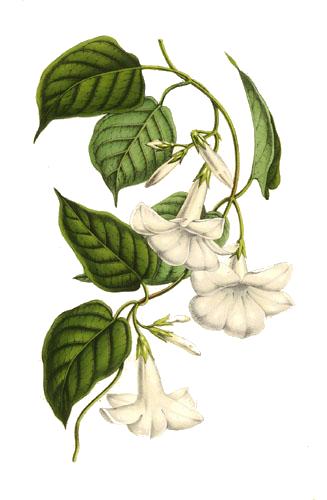
Photo: Wikimedia Commons, Public domain · source

Climber · Apocynaceae
Chilean jasmine
Mandevilla laxa
In other languages: Chileense jasmijn (Nederlands) · Jasmin du Chili (Français)
Chilean jasmine (Mandevilla laxa) is a misleading name: it actually comes from northern Argentina and Bolivia, not Chile. It is a twining climber with dark green, oval leaves, and from June to September it carries clusters of white, trumpet-shaped flowers with a strong fragrance. It grows to 4–5 m and is hardier than the red and pink Mandevillas sold at garden centres, but in Flanders it remains a plant for a sheltered, sunny wall or a tub. Against a wall it survives mild winters with protection; in a pot, bring it indoors, frost-free. The genus is named after Henry Mandeville, a British diplomat in Buenos Aires who helped introduce the plant to Europe in the nineteenth century.
Caution: Not fully hardy: bring tub plants indoors before the first night frost. The milky sap can irritate the skin, so wear gloves when pruning.
Light
Full sun
warm and bright
Moisture
Normal
no wet feet
Legal basis
Sand or loam
any pH
Hardiness
down to -8 °C
protect in harsh winters
Size
5 m
tall, 2 m wide
Flowering
June–September
| Pruning months | March |
|---|---|
| Height | 5 m |
| Native to Belgium | No, planted |
| Poisonous to people and pets | Not known to be poisonous |
| Flowering | June–September |
Identify
Chilean jasmine: how do you recognise it?
- Habit
- Twining climber with slender stems, up to 4–5 m tall and about 2 m wide. After a hard winter it is cut back by frost and often shoots again in spring.
- Leaves
- Oval to heart-shaped, about 8–15 cm, with a pointed tip, in opposite pairs; dark green. The leaves partly or wholly drop in winter.
- Flowers
- White, trumpet-shaped flowers about 5–6 cm across in loose clusters, from June to September. Strongly scented.
- Fruit
- Long, slender paired pods with seeds that carry a tuft of silky hairs.
- Sap
- All parts contain white, milky sap that oozes from cuts when pruning and can irritate the skin.
Flowering: June–September · Plants: May–June · Pruning: March
In your garden
Why grow it?
- Strongly scented white flowers from June to September: ideal close to the terrace or a seat.
- It twines itself round a trellis, mesh or taut wires, so there is little tying in to do.
- Hardier than the large-flowered Mandevilla hybrids: it tolerates a few degrees of frost for a short time.
- An elegant, airy climber for a small garden: it stays slim, about 2 m wide.
- It does well in a pot or tub, so you can easily move it to a frost-free place in winter.
Chilean jasmine: where does it grow best?
- Full sun in a warm, sheltered spot, preferably against a south- or west-facing wall.
- Loose, free-draining, humus-rich soil: sand or loam, acid to chalky.
- Keep evenly moist in summer, but never soggy. In a pot you need drainage holes and a layer of clay pebbles at the bottom.
- Provide a trellis, mesh or taut wires as support; it twines by itself. Allow 1–1.5 m between plants; choose a pot at least 30–40 cm across.
- Light
- Sun
- Soil type
- Sand or loam
- Acidity
- Not fussy
- Moisture
- Normal
- Size
- 5 m tall, 2 m wide
- Hardiness
- Half hardy (to -8 °C): protect it in harsh winters
Goes well with
- Climbing rose: A climbing rose on the same sunny wall flowers in June; after that the jasmine takes over.
- Lavender: At the front of the border, in the same sunny, free-draining spot: fragrance on fragrance.
- Argentinian vervain: Tall, airy purple flowers in summer, and a butterfly plant too.
- Pelargonium: In pots in front: sunny, flowers all summer and also overwinters frost-free.
- African lily: Blue flowers in a tub alongside; it too overwinters cool and frost-free.
Maintenance
Chilean jasmine: when and how to plant it?
Plant in May–June.
- Plant or move outdoors in May–June, only after the Ice Saints (mid-May), when nights no longer drop below 5 °C.
- Dig a hole twice as wide as the root ball and mix in compost and a little sand. For a pot: use potting compost with some sand and put clay pebbles in the bottom.
- Plant at the same depth as in the pot, about 30 cm from the wall, with the root ball angled slightly towards the support.
- Put the trellis or mesh in place before planting and tie in the first shoots loosely; after that it twines by itself.
- Water in generously straight away and spread a 5–8 cm layer of mulch (bark or compost) around the base, keeping it off the stems.
Care
- Water
- In summer water regularly and evenly, in a pot sometimes daily in hot weather. Let the top layer of soil dry out slightly between waterings. In winter, hardly any water.
- Feeding
- From May to August give a high-potassium flowering-plant feed every 2 weeks in the water. In the ground, a layer of compost in April is enough.
- Mulching
- A thick layer of mulch in May keeps the roots cool and protects them from frost in winter.
- Tying in
- Tie the long shoots in loosely for the first few weeks; after that it twines by itself. Re-tie floppy tips where needed.
- Repotting
- Repot a tub plant every 2 years in spring, in fresh compost and a pot 5 cm larger.
Tip: In winter keep the pot cool and light, at 5–10 °C, with hardly any water: that is how it survives best. Against a wall, put a thick layer of mulch over the base in November.
Chilean jasmine: when to prune it?
Pruning months: March.
When: In March, when the worst frosts are over. It flowers on young shoots, so spring pruning does not cost you any flowers.
How:
- Cut frosted or dead shoots back to healthy wood (green under the bark).
- Shorten last year’s side shoots to 2–3 buds and thin out overcrowded stems.
- Leave a few long main shoots to cover the wall or the trellis.
- In summer, trim shoots that are too long and tie them in.
Caution: Wear gloves: the milky sap can irritate the skin and must not get into the eyes.
Propagation
- Cuttings
- June–August: semi-ripe cuttings about 10 cm long with 2–3 pairs of leaves, lower leaves removed, in sandy compost at 20–25 °C under plastic. Roots form in 4–8 weeks.
- Seed
- March–April at about 20 °C, with the seeds only lightly covered. Seedlings grow slowly; cuttings are the faster route.
Chilean jasmine: how does it get through the winter?
Hardy to −8 °C: protect in harsh winters.
- Moderately hardy, briefly to about −8 °C. Against a sheltered, sunny wall it survives mild winters, but in a hard frost it may die back to the ground.
- Against the wall: in November, put a 10 cm layer of leaves or bark over the base and wrap the stems in horticultural fleece.
- In a pot or tub: bring it in before the first night frost (October) to a cool (5–10 °C), light, frost-free place and give hardly any water. Some leaf drop is normal.
- In spring, get it used to light and water gradually and put it outside only after mid-May.
Diseases and pests
- Spider mite and mealybug: Fine webs or white, woolly patches on the leaves, especially when overwintered in dry, warm air. Rinse the plant with lukewarm water, move it somewhere cooler and wipe off mealybugs with a cloth.
- Aphids: On young shoots in spring. Blast them off with a strong jet of water or rub them off by hand; ladybirds help.
- Root rot: Yellow, limp leaves from wet roots, especially in winter. Use free-draining compost, a pot with holes and hardly any water in winter.
- No flowers: Too little sun, too much nitrogen, or pruning too late and too hard. Move it into more sun, feed with a high-potassium fertiliser and prune in March.
Through the year
- January: Rest. Cool and light, hardly any water.
- February: Check for spider mite and mealybug.
- March: Prune. Repot or replace the top layer of compost.
- April: Water more. On mild days, get it used to being outdoors.
- May: After mid-May plant out or put outside. Apply mulch.
- June: First flowers. Feed every 2 weeks. Tie in.
- July: Full flower. Water. Take semi-ripe cuttings.
- August: Flowering. Water. Stop feeding at the end of August.
- September: Last flowers. Water less.
- October: Bring indoors before the first night frost, or protect against the wall.
- November: Cool and light, little water. Against the wall: fit winter fleece.
- December: Rest. Check now and then for aphids and mould.
You and this species
Did you know?
- The name ‘Chilean jasmine’ is misleading: the plant comes from Argentina and Bolivia and is not a true jasmine (Jasminum). It belongs to the Apocynaceae, the family of oleander and periwinkle.
- The genus Mandevilla is named after Henry Mandeville, a British diplomat and garden enthusiast in Buenos Aires, who sent plants to England around 1830–1840.
- The seeds carry a tuft of silky hairs, so the wind can carry them a long way.