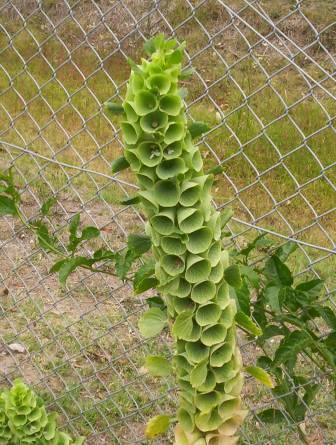
Photo: HelloMojo, CC BY-SA 3.0 · source

Annual · Lamiaceae
Bells of Ireland
Moluccella laevis
In other languages: Molukse melisse (Nederlands) · Molucelle (Français)
Bells of Ireland is an annual from Turkey, Syria and the Caucasus, so despite its name it comes from neither Ireland nor the Moluccas. It grows into an upright, branching plant of about 80 cm whose stems are lined with pale green, shell-shaped calyces. Inside each calyx sits a small, white flower that hardly shows. It is mostly the green calyx that is ornamental: cut, it lasts a long time in the vase and dried it keeps its shape. It is a favourite in bouquets, and bees visit the small flowers.
Light
Full sun
warm and bright
Moisture
Normal
no wet feet
Legal basis
Sand, loam or clay
any pH
Hardiness
down to 0 °C
protect in harsh winters
Size
0.8 m
tall, 0.3 m wide
Flowering
July–September
| Height | 0.8 m |
|---|---|
| Native to Belgium | No, planted |
| Good for bees, butterflies and birds | Yes, for bees |
| Poisonous to people and pets | Not known to be poisonous |
| Flowering | July–September |
Identify
Bells of Ireland: how do you recognise it?
- Habit
- Upright, sparsely branching annual 60–90 cm tall and 30 cm wide.
- Foliage
- Round to oval with a toothed edge, pale green; largest at the bottom of the stem.
- Flower
- Small white to pink flowers inside green, shell-shaped calyces set in whorls round the stem. July to September.
- Calyx
- Large, funnel-shaped, pale green with a net of veins and small sharp teeth along the rim.
- Stem
- Sturdy and upright; the small prickles under the calyces can sting.
Flowering: July–September · Sowing: March–May · Plants: May
In your garden
Why grow it?
- Striking, fresh-green flower stems: a rare green cut flower among the colourful summer blooms.
- An excellent cut flower that lasts long in the vase and dries well.
- Bees visit the small flowers hidden in the calyces from July to September.
- A vertical accent at the back of a border or in a cut-flower row.
- An easy annual: full-grown plants in a single summer.
Bells of Ireland: where does it grow best?
- Full sun for sturdy stems and plenty of calyces.
- Ordinary garden soil: sand, loam or clay, acid to chalky; well-drained is best.
- Moderately moist; keep the soil evenly moist but not waterlogged.
- Space 25–30 cm apart. Shelter or support stops the tall stems falling over.
- Light
- Sun
- Soil type
- Sand, loam or clay
- Acidity
- Not fussy
- Moisture
- Normal
- Size
- 0.8 m tall, 0.3 m wide
- Hardiness
- Frost tender: plant out after the last frost (mid-May)
Goes well with
Maintenance
Bells of Ireland: when and how to plant it?
Plant in May.
- Sow indoors in March–April: the seed germinates better after about a week in the fridge, in a damp bag or pot.
- Sow on the surface or very shallowly, firm down and keep moist at about 15–18 °C; germination is slow and uneven.
- Plant out after mid-May, when frost is no longer a risk, with the root ball intact and without damaging the roots.
- Space plants 25–30 cm apart in a sunny spot.
- Water in after planting. To sow in place, do so in May on warm, well-drained soil.
Care
- Water
- Keep the soil evenly moist, especially in dry spells. Water at the base, not over the calyces.
- Feeding
- Rarely needed; too much feed gives soft growth and floppy stems.
- Support
- In a windy garden, tie the plants to twigs or a net; the stems grow tall and heavy.
- Cutting
- Cut stems when most of the lower calyces are open; the buds at the top fill out in the vase.
- Clearing
- Pull the plants up in October and compost them.
Tip: Chill the seed in the fridge for a week before sowing and do not plant out until after mid-May. Wear gloves when picking: the calyces carry small prickles.
Bells of Ireland: when to prune it?
When: An annual is not pruned; you only cut stems for the vase or for drying.
How:
- Cut the stems in the morning and strip the leaves straight away; keep only the calyces.
- To dry, hang the stems upside down in a dry, airy place out of direct sunlight; they turn creamy.
- Wear gloves: the small prickles under the calyces sting.
- Pull the plant up in autumn and tidy the bed.
Propagation
- Sowing
- In March–April indoors, after a week in the fridge, at 15–18 °C; germination can be slow and uneven. Direct sowing outdoors is possible in May.
- Saving seed
- Let a few plants ripen; the dried calyces hold the seed. Store it cool and dry.
Bells of Ireland: how does it get through the winter?
Hardy to 0 °C: protect in harsh winters.
- An annual: the plant dies at the first frost. It is not hardy, since young plants tolerate at most a night around 0 °C.
- Store seed in a paper envelope in a cool, dry place.
- Dried stems can last all winter in a vase or dried arrangement.
Diseases and pests
- Toppling: Tall stems lean over in wind or rain. Support early and plant in shelter.
- Slugs: Young plants are soon eaten. Search for them in the evening or lay a ring of coarse sand or crushed shells.
- Damping off: Seedlings collapse at ground level. Use clean sowing compost, sow thinly and water moderately.
- Poor germination: Seed germinates slowly and unevenly. A week in the fridge and a steady 15–18 °C help; be patient.
Through the year
- March: Chill the seed for a week, then sow indoors.
- April: Prick out seedlings. Sow more if needed.
- May: Plant out after mid-May. Sow outdoors if wanted.
- June: Put supports in. Watch for slugs.
- July: Flowering begins. Cut the first stems.
- August: Full flower. Cut for the vase or for drying.
- September: Last stems for the dried arrangement.
- October: Clear the plants. Store seed.
Use
Good for wildlife
- Bees
- Nectar and pollen for honeybees and wild bees.
You and this species
Did you know?
- Despite its name, the plant comes neither from the Moluccas nor from Ireland, but from Turkey, Syria and the surrounding area.
- What look like flowers are in fact green calyces; the real flowers are small and white.
- Bells of Ireland belongs to the mint family (Lamiaceae), like mint, sage and lavender.