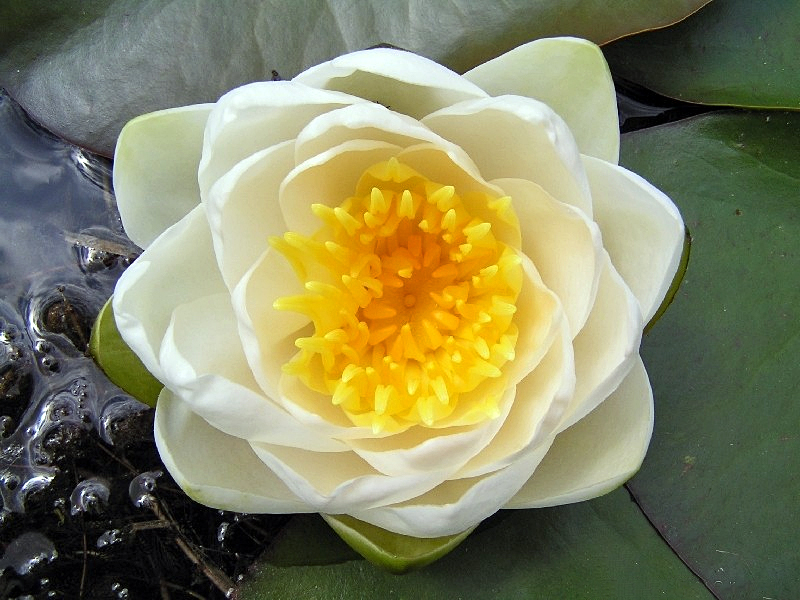
Photo: Wikimedia Commons, Public domain · source

Water or marginal plant · Nymphaeaceae
European white water lily
Nymphaea alba
In other languages: Witte waterlelie (Nederlands) · Nénuphar blanc (Français)
The European white water lily is a native aquatic plant of large ponds, lakes and slow rivers across Europe. From a thick rhizome in the mud it sends up round, floating leaves up to 30 cm across and, from June to September, large white flowers with a centre of yellow stamens. The flowers open in the morning and close again in the late afternoon or evening. Gardeners choose it for the classic, tranquil look it gives a pond, and its leaves offer shade and shelter to fish and frogs. It is vigorous, so it only suits large ponds.
Caution: For large ponds only: in a small pond the leaves soon cover the whole water surface. Never take water lilies from the wild.
Light
Full sun
warm and bright
Moisture
Moist to wet
must not dry out
Legal basis
Loam, clay or peat
acid to neutral
Hardiness
Fully hardy
down to -25 °C
Size
0.1 m
tall, 2 m wide
Flowering
June–September
| Height | 0.1 m |
|---|---|
| Native to Belgium | Yes |
| Poisonous to people and pets | Not known to be poisonous |
| Flowering | June–September |
Identify
European white water lily: how do you recognise it?
- Habit
- Rooted on the bottom; the floating leaves cover an area about 2 m across.
- Leaves
- Round, 10–30 cm across, with a deep notch up to the stalk; glossy green above, sometimes reddish below.
- Flower
- White, 10–20 cm across, with many petals around a centre of yellow stamens; it floats on the water.
- Roots
- A thick, creeping rhizome in the mud, with long, flexible stalks reaching to the surface.
- Fruit
- A round fruit that ripens under water; the seeds float for a while before sinking.
Flowering: June–September · Plants: May–June
In your garden
Why grow it?
- Large white flowers on the water from June to September.
- A native species, ideal for a wildlife pond.
- The floating leaves give shade and keep the water cooler, which slows the growth of algae.
- Fish, frogs and water insects shelter under the leaves; damselflies and dragonflies rest on them.
- Fully hardy: it overwinters on the bottom of the pond.
- Little work: once planted, it grows for years in the same spot.
European white water lily: where does it grow best?
- Full sun: at least six hours a day, otherwise it flowers poorly.
- A water depth of 50–150 cm above the basket; for large ponds only.
- Still water: no fountain or waterfall nearby, as it dislikes splashing or moving water.
- Heavy, fertile soil: clay or loam, possibly with some peat; acid to neutral.
- Allow about 2 m² of water surface per plant.
- Light
- Sun
- Soil type
- Loam, clay or peat
- Acidity
- Acid or neutral
- Moisture
- Wet
- Size
- 0.1 m tall, 2 m wide
- Hardiness
- Hardy (to -25 °C)
Goes well with
- Yellow flag: Tall yellow flowers on the bank in May–June.
- Flowering rush: Pink flower heads in the shallow zone in summer.
- Marsh marigold: Bright yellow at the edge in spring, before the water lily flowers.
- Rigid hornwort: A submerged oxygenator that takes up nutrients and so keeps algae down.
- Frogbit: Small floating rosettes with white flowers, a nice addition to the open water.
Maintenance
European white water lily: when and how to plant it?
Plant in May–June.
- Plant in May–June, once the water has warmed up.
- Use a large aquatic basket lined with hessian or landscape fabric, filled with heavy clay soil, without ordinary potting compost or fertiliser.
- Lay the rhizome flat or at a slant in the soil, with the growing tip just above the surface.
- Top the soil with 2–3 cm of gravel, so it does not wash away and fish do not stir it up.
- Soak the filled basket thoroughly first, so the air is driven out and the soil does not float up.
- Stand the basket on a few bricks at first so the leaves reach the surface, then lower it over a few weeks to 50–150 cm deep.
Care
- Leaves
- Remove yellowed and dead leaves regularly so they do not rot in the pond.
- Faded flowers
- Cut them off as low as possible before they sink.
- Feeding
- In May, push an aquatic fertiliser tablet deep into the basket; never add fertiliser loose in the water.
- Water
- Top up evaporation with rainwater; tap water is often harder and richer in nutrients, which encourages algae.
- Dividing
- Every 3–5 years, when the leaves start to stand up out of the water and flowering declines.
Tip: After planting, lower the basket in stages: the young leaves must be able to reach the surface. Only when they float do you move it one level deeper.
European white water lily: when to prune it?
When: A water lily is not pruned. From June to October you simply remove yellowed leaves and faded flowers.
How:
- Cut yellowed leaves off as low as possible with long scissors or a knife.
- Remove faded flowers before they sink and rot.
- In October, clear away the dying foliage so less sludge builds up on the bottom in winter.
Caution: Do not pull on the leaf stalks: the rhizome can come loose or be damaged.
Propagation
- Division
- In May–June, lift the basket out of the water and cut the rhizome into pieces of 10–15 cm, each with a growing tip. Plant each piece in its own basket.
- Seed
- Possible but slow: sow fresh seed in a tray of clay under a few centimetres of water. It takes several years before a seedling flowers.
European white water lily: how does it get through the winter?
Hardy to −25 °C.
- Fully hardy to about −25 °C, as long as the rhizome stays below the ice.
- In autumn the leaves die back; the plant rests on the bottom of the pond over winter.
- If the basket stands in a shallow pond, move it to the deepest spot in autumn so the rhizome does not freeze into the ice.
- Not suitable for a tub: there is too little room, and the rhizome can freeze in a hard winter.
Diseases and pests
- Few flowers: Too much shade, water that is too deep or an overcrowded basket. Give more sun, raise the basket or divide the plant.
- Leaves standing out of the water: A sign that the basket is overcrowded: time to divide.
- Water lily beetle: Small brown beetles and their larvae eat grooves into the leaves. Hose them off or briefly push the leaves under water so the fish eat them.
- Aphids: Dark aphids on leaves and buds in summer. Spray them off with water; the fish will clean them up.
- Algae: Too many nutrients in the water. Never add loose fertiliser, plant in clay soil without manure and add oxygenating plants.
Through the year
- April: The first leaves rise to the surface. Get the basket and clay soil ready.
- May: Plant or divide. Push a fertiliser tablet into the basket.
- June: Plant. First flowers. Remove yellowed leaves.
- July: Full bloom. Watch out for water lily beetle and aphids.
- August: Flowering. Top up the pond with rainwater.
- September: Last flowers. Remove faded blooms.
- October: Clear away dying foliage. Stretch a net over the pond against falling leaves.
- November: Resting on the pond bottom.
- December: Rest. The rhizome overwinters under the ice.
You and this species
Did you know?
- Unlike most plants, the floating leaves have their breathing pores (stomata) on the upper side, since the underside lies on the water.
- The leaf stalks and rhizome are full of air channels that carry oxygen down to the roots in the oxygen-poor mud.
- Each flower opens and closes for several days in a row; after that it sinks below the water, where the fruit ripens.