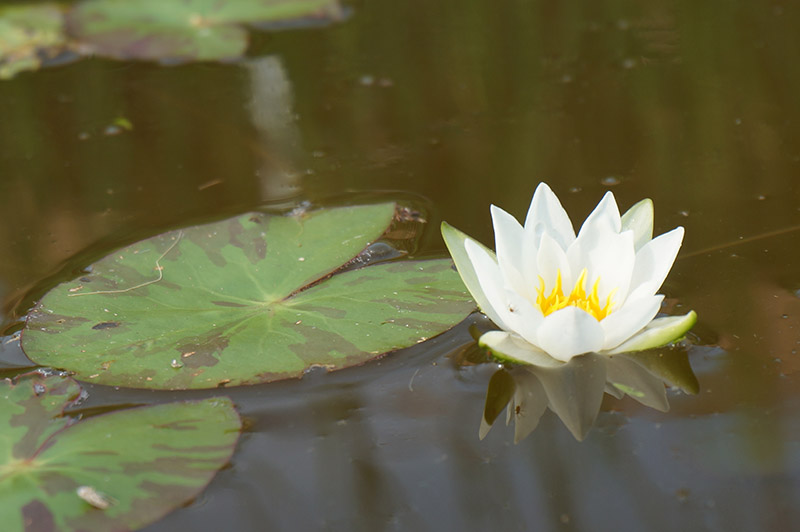
Photo: National Institute of Ecology, KOGL Type 1 · source

Water or marginal plant · Nymphaeaceae
Pygmy water lily
Nymphaea tetragona
In other languages: Dwergwaterlelie (Nederlands) · Nénuphar pygmée (Français)
Pygmy water lily is the smallest wild water lily and grows naturally in northern Asia, northern Europe and North America. It forms a compact plant with oval floating leaves 5–10 cm long, sometimes blotched brown when young, and spreads to about 50 cm. From June into September it bears dainty white flowers 3–5 cm across with a yellow centre, which open only in the afternoon and close again in the evening. Because it is happy in 15–30 cm of water, it is ideal for a small pond or a patio tub. It is fully hardy and a real winner for anyone short of space.
Light
Full sun
warm and bright
Moisture
Moist to wet
must not dry out
Legal basis
Loam, clay or peat
acid to neutral
Hardiness
Fully hardy
down to -30 °C
Size
0.05 m
tall, 0.5 m wide
Flowering
June–September
| Pruning months | July–September |
|---|---|
| Height | 0.05 m |
| Native to Belgium | No, planted |
| Poisonous to people and pets | Not known to be poisonous |
| Flowering | June–September |
Identify
Pygmy water lily: how do you recognise it?
- Habit
- Compact floating-leaved plant about 50 cm across, from a short rhizome.
- Leaves
- Oval with a deep notch, 5–10 cm, green and sometimes blotched brown when young; they float flat on the water.
- Flowers
- Star-shaped, 3–5 cm across, with white petals and a yellow centre; open from afternoon to evening, from June to September.
- Fruit
- After flowering the stalk bends underwater and a seed-filled fruit ripens there; unlike many hybrids, it sets seed readily.
- Planting depth
- 15–30 cm of water above the soil in the basket.
Flowering: June–September · Plants: May–June · Pruning: July–September
In your garden
Why grow it?
- The smallest water lily: it fits in a tub, a zinc trough or a mini pond.
- Flowers from June into September with dainty white blooms.
- Works even in a small pond: the floating leaves cast shade and hold back algae.
- Frogs and damselflies use the leaves as a resting place.
- Fully hardy, even in severe winters.
Pygmy water lily: where does it grow best?
- Full sun, at least six hours a day: in shade it hardly flowers.
- Still water, with no fountain or waterfall: water lilies dislike splashing and currents.
- Planting depth 15–30 cm, in a small pond, the shallow zone of a larger pond or a tub at least 50 cm across.
- Heavy loam or clay in the basket; soft to neutral water, rainwater is ideal.
- One plant per tub; in a pond, allow 50 cm per plant.
- Light
- Sun
- Soil type
- Loam, clay or peat
- Acidity
- Acid or neutral
- Moisture
- Wet
- Size
- 0.05 m tall, 0.5 m wide
- Hardiness
- Hardy (to -30 °C)
Goes well with
- Frogbit: A small floating plant that fits in the same tub or pond.
- Water violet: An oxygenator with pale pink flowers in May, before the water lily blooms.
- Water forget-me-not: Blue flowers along the edge of the pond or tub.
- Dwarf reedmace: Small brown cigar-shaped heads, ideal for a tub.
Maintenance
Pygmy water lily: when and how to plant it?
Plant in May–June.
- Plant in May or June, once the water has warmed up.
- Use a 3–5 litre aquatic basket or pot and fill it with heavy garden soil or clay, without potting compost or fertiliser.
- Set the rhizome with its growing tip just above the soil and firm in well.
- Top with 2 cm of gravel so the water does not turn cloudy.
- Stand the basket at 5–10 cm deep at first, then lower it to 15–30 cm as soon as the leaves reach the surface.
- Fill a tub with rainwater if possible.
Care
- Feeding
- In a tub, push one aquatic fertiliser cone deep into the soil once a year in May; in a pond this is rarely needed.
- Yellow leaves
- Cut off yellow leaves and spent flowers as low as possible.
- Water level
- Top up with rainwater in summer; a tub loses a lot of water to evaporation.
- Algae
- Algae can appear in a sunny tub: a few oxygenators and a small floating plant help.
- Repotting
- Every three or four years in May, replant in fresh soil, or as soon as the leaves push up out of the water because the basket is overcrowded.
Tip: Lower the basket in stages: start at 5–10 cm and only move it deeper, to 15–30 cm, once the leaves reach the surface. That way it establishes faster.
Pygmy water lily: when to prune it?
Pruning months: July–September.
When: No real pruning is needed, but from July to September regularly cut off yellow leaves and spent flowers.
How:
- Cut yellow leaves and their stalks off as close to the rhizome as possible.
- Spent flowers sink below the water: remove them if you do not want seedlings.
- Leave healthy leaves, as they shade the water and feed the plant.
Propagation
- Seed
- Unlike many hybrids, it sets seed readily. In late summer, collect the ripe fruit underwater and sow the seeds straight away in a small pot of clay soil, a few centimetres under water, in a light, warm place. It takes a few years for seedlings to flower.
- Division
- If it forms side shoots, cut them off in May with a piece of rhizome and roots and plant them separately in a basket.
Pygmy water lily: how does it get through the winter?
Hardy to −30 °C.
- Fully hardy, to about −30 °C: it comes from cold regions.
- In a pond, simply leave the basket in place, ideally at the deepest point, below the ice.
- In a tub the water can freeze solid. Then stand the basket in a bucket of water in a cool, frost-free place such as a garage, or move the tub against a sheltered wall.
- In autumn, cut off the dying leaves so they do not rot in the water.
Diseases and pests
- Water lily aphid: Small dark aphids on leaves and flowers. Hose them into the water or wipe them off.
- Water lily beetle: Small brown beetles and their larvae eat grooves in the leaves. Pick them off by hand and cut off affected leaves.
- No flowers: Too little sun, planted too deep or too cramped in the basket. Move it into more sun or shallower water, or repot.
- Green water in the tub: Algae in the sun. Add oxygenators, do not overfeed and replace some of the water with rainwater.
Through the year
- April: New leaves appear. Return a basket stored indoors to the outside.
- May: Plant or repot. Lower the basket gradually.
- June: Flowering begins. Last month for planting.
- July: In flower. Cut off yellow leaves and spent flowers.
- August: In flower. Top up with rainwater, especially in a tub.
- September: Last flowers. Cut off yellow leaves.
- October: Clear dying leaves. Prepare the tub for winter.
- November: Move the basket to the deepest spot or store it indoors.
You and this species
Did you know?
- In Japan it is called hitsujigusa, ‘plant of the hour of the sheep’, because its flowers open around that hour of the old Japanese timekeeping system, in the early afternoon.
- The name tetragona means ‘four-angled’ and refers to the square base of the flower.
- It is a parent of several small hybrid water lilies, such as the yellow-flowered ‘Helvola’.