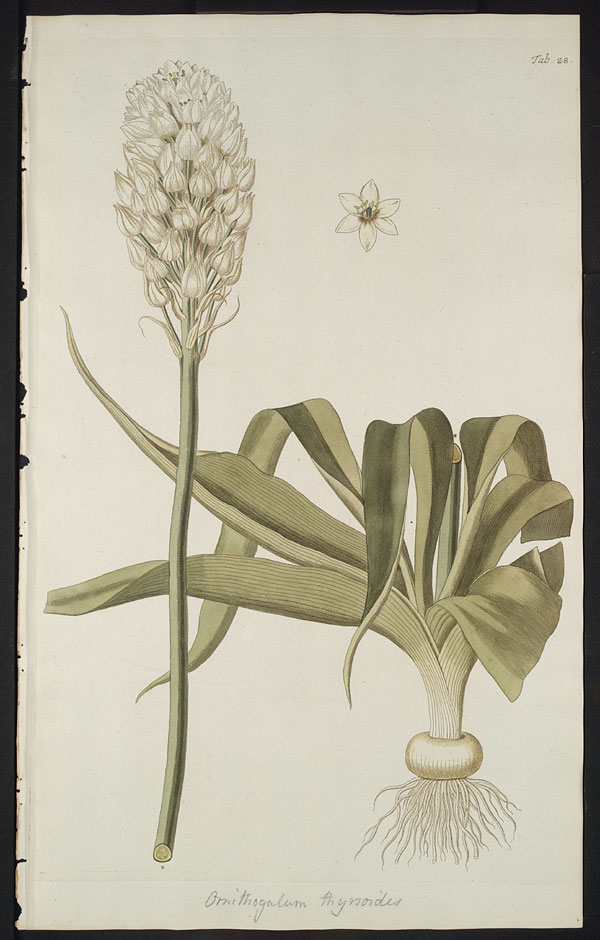
Photo: Nikolaus Joseph von Jacquin, Public domain · source

Bulb or tuber · Asparagaceae
Chincherinchee
Ornithogalum thyrsoides
In other languages: Ornithogalum thyrsoides (Nederlands) · Ornithogalum thyrsoides (Français)
Ornithogalum thyrsoides, known as chincherinchee, comes from the Cape province of South Africa. From a clump of narrow, lance-shaped leaves rise sturdy stems about 40 cm tall with a dense, cone-shaped raceme of white flowers with a dark centre. It flowers from June to August and is especially popular as a cut flower: the racemes stay fresh for up to three weeks in a vase. Because it does not tolerate frost, you plant the bulbs in spring and lift them in autumn, or grow it in a pot.
Caution: All parts of the plant, especially the bulb, are poisonous; the plant is known to be toxic to livestock. Do not eat them: children, cats, dogs and grazing livestock are at risk. The vase water is not safe for pets either. The sap can irritate the skin of some people: wear gloves when planting and wash your hands after cutting.
Light
Full sun
warm and bright
Moisture
Normal
no wet feet
Legal basis
Sand or loam
neutral to chalky
Hardiness
down to 0 °C
protect in harsh winters
Size
0.4 m
tall, 0.15 m wide
Flowering
June–August
| Height | 0.4 m |
|---|---|
| Native to Belgium | No, planted |
| Poisonous to people and pets | Yes, take care with children and pets |
| Flowering | June–August |
Identify
Chincherinchee: how do you recognise it?
- Habit
- Bulb about 40 cm tall and 15 cm wide, with straight, sturdy stems.
- Leaves
- Narrow, lance-shaped, in a clump at the base; they grow fast after planting.
- Flower
- Dense, cone-shaped raceme of white, star-shaped flowers with a dark green-brown centre, from June to August.
- Bulb
- Round bulb that is lifted in autumn and stored dry and frost-free.
Flowering: June–August · Plants: April–May
In your garden
Why grow it?
- Pure white flower racemes with a dark centre in summer, from June to August.
- Excellent cut flower: the racemes stay fresh for up to three weeks in a vase.
- Compact in size: fits a border, a cutting garden or a pot.
- The flowers open gradually from the bottom upward, so flowering lasts for weeks.
- Low maintenance: plant in spring and lift in autumn.
Chincherinchee: where does it grow best?
- Full sun: in shade it flowers poorly and the stems get long.
- Free-draining sandy or loamy soil, neutral to chalky; not too heavy and not too wet.
- Moderately moist during growth; dry during the rest period.
- Plant 10–15 cm apart, in groups of at least 5–10 bulbs.
- Not hardy: choose a spot where you can easily lift the bulbs in autumn, or use a pot.
- Light
- Sun
- Soil type
- Sand or loam
- Acidity
- Neutral or chalky
- Moisture
- Normal
- Size
- 0.4 m tall, 0.15 m wide
- Hardiness
- Frost tender: lift the bulbs or tubers before the frost and store them frost-free
Goes well with
Maintenance
Chincherinchee: when and how to plant it?
Plant in April–May.
- Plant in April–May, as soon as you no longer expect night frost.
- Choose a sunny spot with free-draining soil; in heavier soil, mix in some sand.
- Set the bulb pointed end up, 5–8 cm deep.
- Leave 10–15 cm between bulbs and plant in groups of 5–10 for more effect.
- Water a little after planting, then sparingly until the leaves grow.
- In a pot: use a mix of potting compost and sharp sand, a pot with holes, and put in 3–5 bulbs.
Care
- Water
- Keep the soil lightly moist during growth; water weekly in dry weather. Do not let it get waterlogged.
- Feeding
- Now and then a little fertiliser for flowering plants during growth, until flowering.
- Cutting
- Cut the stems for a bouquet when the first flowers at the bottom open. Change the water every few days.
- Spent stems
- Cut faded stems off at the base.
- Lifting and storing
- Lift the bulbs in October, when the leaves are yellow. Let them dry and store them dry and frost-free until spring.
Tip: Cut the racemes when the first flowers at the bottom open and change the water: they stay fresh for up to three weeks. Not hardy: plant in spring and lift the bulbs in autumn.
Chincherinchee: when to prune it?
When: No pruning is needed. Cut off spent stems and cut flowers for the vase when the first flowers open.
How:
- Cut faded stems off at the base.
- Leave the leaves until they turn yellow so the bulb can build up reserves.
- Remove the dead leaves when lifting the bulbs in autumn.
Caution: Do not cut off the green leaves: the bulb needs them to build up reserves for next year.
Propagation
- Offsets
- When lifting in October: pull the small offsets off the large bulb, store them dry and plant them in spring. They flower after a few years.
- Seed
- Sow in spring in pots of seed compost in a warm, bright spot. Seedlings only flower after a few years.
Chincherinchee: how does it get through the winter?
Hardy to 0 °C: protect in harsh winters.
- Not hardy: the bulb does not tolerate frost. Lift it in October, when the leaves are yellow.
- Let the bulbs dry and store them dry and frost-free, in a paper bag or a box of dry sand or peat, until spring.
- In a pot: let the pot dry out after flowering and bring it inside, frost-free, until March.
Diseases and pests
- Bulb rot: The bulb is soft and mouldy, because of wet soil or damp storage. Provide well-drained soil, store the bulbs dry and throw away affected ones.
- No flowers: Only leaves appear. The cause is usually too little light, a bulb that is too small or a bulb that did not get a dry rest. Put it in the sun and give it a dry rest after flowering.
- Frost damage: The leaf tips freeze in late frosts. Plant only after mid-May or cover the plants.
- Slugs: Holes in young leaves in spring. Collect them in the evening with a torch.
Through the year
- April: Plant; or start off in a pot.
- May: Plant. Watch for slugs.
- June: Flowering begins. Keep lightly moist.
- July: Full flower. Cut for a bouquet.
- August: Flowering ends. Cut off faded stems.
- September: Leaves turn yellow. Cut back on watering.
- October: Lift the bulbs and let them dry.
- November: Store dry and frost-free.
Use
Edible and useful
Not edible. All parts of star-of-Bethlehem are poisonous, especially the bulbs, which look like little onions; the flowers and the vase water are poisonous too, to people and pets. Never store the bulbs with the vegetables and keep a vase out of reach of children and cats. If any is swallowed, call a poison centre (in Belgium 070 245 245) or your doctor at once.
You and this species
Did you know?
- The name ‘chincherinchee’ is said to imitate the squeaking sound of the stems rubbing against each other in the wind.
- The species name thyrsoides refers to the dense, cone-shaped flower cluster, a thyrse.
- The flowers open from the bottom up, so the raceme stays fresh for about three weeks as a cut flower.