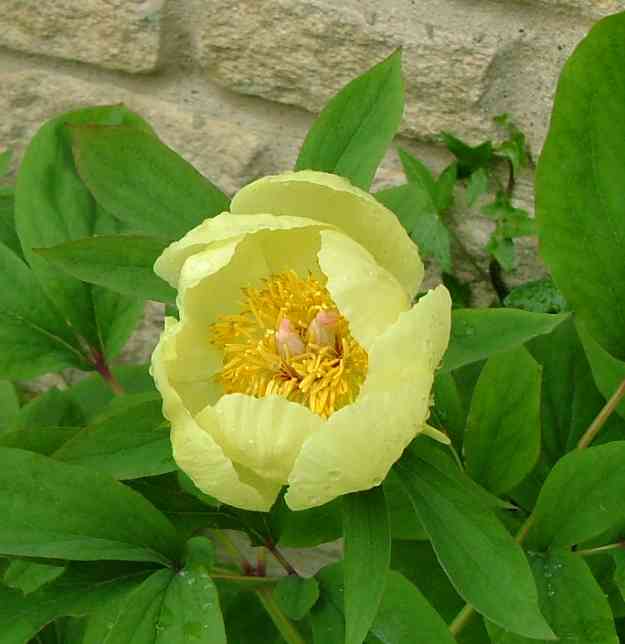
Photo: Mel Etitis, CC BY 2.5 · source

Perennial · Paeoniaceae
Molly-the-witch
Paeonia mlokosewitschii
In other languages: Gele pioen (Nederlands) · Pivoine du Caucase (Français)
Molly-the-witch comes from the mountain forests and grasslands of the Caucasus. It is a bushy perennial of about 70 cm with blue-green leaves that emerge reddish-brown in spring. In April and May it bears large, single, bowl-shaped flowers of 10–12 cm, soft yellow with a ring of golden stamens. The flowering is short but magnificent, and the handsome foliage remains afterwards. In late summer the seed pods split open to show red and glossy blue-black seeds. It is a slow-growing, faithful plant that can stay in the same place for years, but it dislikes being moved.
Caution: All parts of the plant, especially the roots and seeds, are mildly toxic. Children, dogs, cats and grazing animals can suffer nausea, vomiting and diarrhoea if they eat any of it. Do not let children play with the red and blue-black seeds and wear gloves when dividing. If in doubt, call the Poison Centre (070 245 245) or the vet.
Light
Sun or partial shade
preferably some sun
Moisture
Normal
no wet feet
Legal basis
Loam or clay
neutral to chalky
Hardiness
Fully hardy
down to -25 °C
Size
0.7 m
tall, 0.7 m wide
Flowering
April–May
| Pruning months | October–November |
|---|---|
| Height | 0.7 m |
| Native to Belgium | No, planted |
| Poisonous to people and pets | Yes, take care with children and pets |
| Flowering | April–May |
Identify
Molly-the-witch: how do you recognise it?
- Habit
- Bushy, rounded clump 60–80 cm tall and wide, regrowing from the ground each year.
- Foliage
- Deeply cut, blue-green and a little bluish beneath; reddish-brown to purple-red when young.
- Flower
- Single, bowl-shaped flowers of 10–12 cm with a ring of golden stamens, in April and May; each flower stays open only briefly.
- Colour
- Soft yellow, often tinged lemon.
- Fruit
- Seed pods that split open in late summer, showing red, sterile and glossy blue-black, fertile seeds.
- Roots
- Thick, fleshy roots that dislike being disturbed.
Flowering: April–May · Plants: September–October · Pruning: October–November
In your garden
Why grow it?
- Soft yellow single flowers of 10–12 cm in April–May, earlier than most peonies.
- The blue-green foliage emerges reddish-brown in spring and stays handsome all summer.
- In late summer the seed pods split open with red and blue-black seeds: another lovely moment in the garden.
- Bees and other insects find pollen in the open flowers.
- A plant for life: once established it flowers for decades with little care.
Molly-the-witch: where does it grow best?
- Sun or partial shade; it likes light shade in the hottest hours.
- Humus-rich, well-drained loam or clay, neutral to chalky.
- Moderately moist: not left waterlogged, but not too dry either.
- Allow 70–80 cm per plant; sheltered from strong wind and late spring frost that damages the young shoots.
- Light
- Sun and partial shade
- Soil type
- Loam or clay
- Acidity
- Neutral or chalky
- Moisture
- Normal
- Size
- 0.7 m tall, 0.7 m wide
- Hardiness
- Hardy (to -25 °C)
Goes well with
- Forget-me-not: Blue clouds beneath the yellow bowls, in the same spring.
- Brunnera: Blue flowers and large leaves next to the yellow peony.
- Hardy geranium: Covers the ground after flowering and fills the gap when the peony rests.
- Tulip: White or purple spring bulbs contrast nicely with the yellow.
Maintenance
Molly-the-witch: when and how to plant it?
Plant in September–October.
- Plant in September–October, while the soil is still warm and moist.
- Dig a hole about 40 cm deep and wide and mix in well-rotted compost.
- Plant shallowly: the red buds (eyes) should lie no more than 3–5 cm below the surface; planted too deep it will not flower.
- Keep 70–80 cm from its neighbours and firm the soil gently.
- Water in at once; do not mulch directly over the crown, to prevent rot.
Care
- Water
- In the first year, water regularly and deeply in dry weather; later in long droughts.
- Feeding
- A spade of compost or well-rotted manure in spring; no fresh manure or excess nitrogen.
- Mulching
- A thin layer of leaf mould in autumn, kept away from the crown.
- Support
- Usually not needed: the single flowers are light and the clump stands firm.
- Patience
- After planting it often takes three years or more before it really flowers; do not move it.
Tip: Plant it shallowly, with the eyes no more than 3–5 cm below the soil, and do not move it again. Be patient: flowers come after three years or more.
Molly-the-witch: when to prune it?
Pruning months: October–November.
When: In October–November, when the foliage turns yellow or brown and dies back.
How:
- Cut all dead stems to just above the ground.
- Put the foliage in the household waste if the plant was diseased; do not compost it.
- Leave the seed pods in place until they have split open, if you like them.
Propagation
- Seed
- Sow fresh seed outdoors in autumn in a pot or tray; it needs warmth followed by cold. Germination takes one to two years, and flowering only after five to six years.
- Division
- In September–October, with care and only on a large, old clump; each piece needs 3–5 eyes and roots. It recovers slowly.
Molly-the-witch: how does it get through the winter?
Hardy to −25 °C.
- Fully hardy, down to about −25 °C: no protection is needed in Belgian winters.
- The above-ground parts die back in autumn; the buds overwinter just below the soil.
- Late spring frost can damage the red young shoots in March–April: cover them with fleece if frost is forecast.
Diseases and pests
- Grey mould (Botrytis): Young shoots or buds turn brown, wilt or rot in cool, damp weather. Cut affected parts back into healthy tissue and discard them; clear all foliage in autumn.
- No flowers: Usually planted too deep, too much shade, or the plant is newly established or moved. Plant shallowly, give a sunnier spot and be patient.
- Powdery mildew: White powder on the leaves in late summer. Usually harmless; cut off affected leaves in autumn.
- Slugs: Young shoots nibbled in spring. Collect them in the evening or lay a ring of coarse grit around the plant.
Through the year
- March: Red shoots appear. Cover in frost. Add compost.
- April: First flowers. Watch for slugs.
- May: Full flower. Water in dry weather.
- June: Seed pods form. Water in dry weather.
- July: Water in long dry spells.
- August: Seed pods split open with red and blue-black seeds. Collect fresh seed.
- September: Plant or divide. Sow.
- October: Plant. Cut back dead stems.
- November: Cut back dead stems and clear the foliage.
Use
Edible and useful
Not edible. Peonies are mildly poisonous, especially the roots and seeds: eating them causes nausea, vomiting, stomach ache and diarrhoea, in children as well as in dogs, cats and grazing animals. In autumn the seed pods split open to show glossy red and blue-black seeds, which children like to pick up: cut them off or do not let children play with them. The root of the common peony was once used as a remedy, and its seeds as a necklace for teething babies: do not do this. The sap can irritate the skin: wear gloves when dividing and moving plants. If any is swallowed, call a poison centre (in Belgium 070 245 245) or your doctor at once.
You and this species
Did you know?
- In English it is called ‘Molly-the-witch’, a nickname that arose from its hard-to-pronounce species name mlokosewitschii.
- The species is named after Ludwik Młokosiewicz, a Polish naturalist who discovered it in the Caucasus.
- The split seed pods hold two kinds of seed: the red ones are sterile and the glossy blue-black ones are fertile.