Photo: Hardyplants at English Wikipedia, Public domain · source

Perennial · Lamiaceae
Obedient plant
Physostegia virginiana
In other languages: Scharnierbloem (Nederlands) · Physostégie de Virginie (Français)
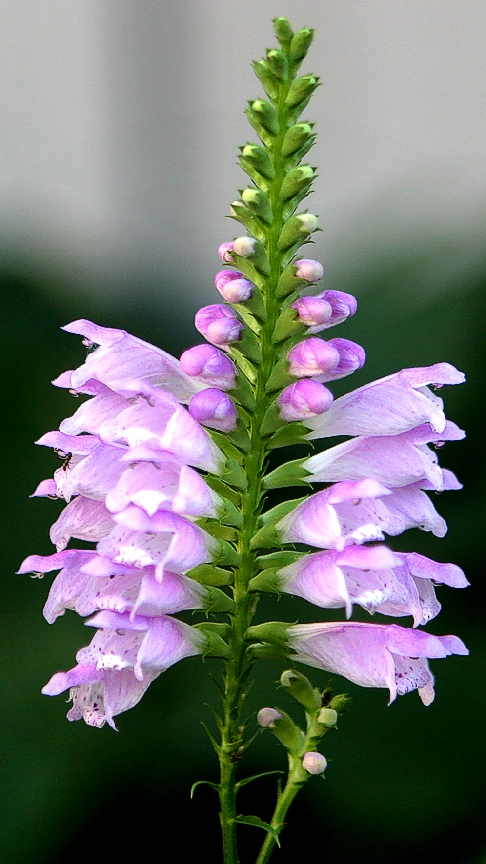
Obedient plant comes from eastern North America, where it grows in damp grassland, along stream banks and at woodland edges. It is an upright perennial about 90 cm tall, with square stems and narrow, toothed leaves. From July to September it carries long spikes of pink tubular flowers, neatly arranged in four rows. Push a flower to one side and it stays there: hence the name. Gardeners love its late flowering and its sturdy stems for cutting. There are also white cultivars, such as ‘Summer Snow’.
Caution: In moist, rich soil it spreads quickly by underground runners and can swamp neighbouring plants. Slice off the edges every spring or plant it inside a root barrier, and never dump unwanted pieces in the wild.
Light
Sun or partial shade
preferably some sun
Moisture
Normal to wet
must not dry out
Legal basis
Loam, clay or peat
acid to neutral
Hardiness
Fully hardy
down to -30 °C
Size
0.9 m
tall, 0.6 m wide
Flowering
July–September
| Pruning months | March |
|---|---|
| Height | 0.9 m |
| Native to Belgium | No, planted |
| Good for bees, butterflies and birds | Yes, for bees and butterflies |
| Poisonous to people and pets | Not known to be poisonous |
| Flowering | July–September |
Identify
Obedient plant: how do you recognise it?
- Habit
- Upright clump about 90 cm tall and 60 cm wide that spreads by underground runners.
- Stem
- Square and sturdy, typical of the mint family.
- Leaves
- Narrowly lance-shaped, 5–12 cm, sharply toothed, glossy green and opposite.
- Flower
- Two-lipped tubular flowers 2–3 cm long, in dense spikes 15–25 cm long, arranged in four straight rows.
- Colour
- Pink to lilac-pink; white cultivars exist too.
- Roots
- Creeping rhizomes: in moist soil it spreads quickly.
Flowering: July–September · Plants: March–May and September–October · Pruning: March
In your garden
Why grow it?
- Late flowering, from July to September, when many other perennials have finished.
- An excellent cut flower that lasts a long time in a vase.
- Attracts bees, bumblebees and butterflies.
- Also thrives in moist to wet soil and in partial shade, where many sun-lovers give up.
- Children love the way the flowers stay wherever you push them.
Obedient plant: where does it grow best?
- Sun to partial shade; in full sun it needs plenty of moisture.
- Moisture-retentive loam, clay or peaty soil, acid to neutral.
- Moist to wet: it even tolerates a spot at the edge of a pond.
- Plant 45–60 cm apart in a place where it may spread a little, or use a root barrier.
- Light
- Sun and partial shade
- Soil type
- Loam, clay or peat
- Acidity
- Acid or neutral
- Moisture
- Normal or wet
- Size
- 0.9 m tall, 0.6 m wide
- Hardiness
- Hardy (to -30 °C)
Goes well with
- Michaelmas daisy: Takes over when the obedient plant stops, in the same moist soil.
- Purple loosestrife: Purple spikes beside the pink: ideal for a damp border or pond edge.
- Garden phlox: Fragrant flower heads in the same summer months and the same moist soil.
- Hemp agrimony: Tall pink flower heads for the back of the border, and a feast for butterflies.
Maintenance
Obedient plant: when and how to plant it?
Plant in March–May and September–October.
- Plant in March–May or September–October.
- Dig a hole twice as wide as the pot and mix in some compost.
- In a small border: sink a bottomless bucket or a strip of root barrier 25–30 cm deep and plant inside it.
- Set the plant at the same depth as it was in the pot and firm the soil.
- Water in thoroughly and keep the soil moist until it has settled.
- A layer of compost or leaf mould around the base keeps the soil moist.
Care
- Watering
- Keep the soil moist, especially in sun and in dry summers.
- Feeding
- A layer of compost in spring. Too much fertiliser makes the stems floppy.
- Edging
- Every spring, slice off the runners around the edge with a sharp spade so it does not grow into its neighbours.
- Support
- In a windy or shady spot the stems may flop; put in a plant support in May.
- Spent flowers
- Cut off faded spikes: the side shoots will then flower a little longer.
- Dividing
- Every two or three years in spring, to keep the plant compact and free-flowering.
Tip: The flowers stay in whatever direction you push them. In moist soil it spreads quickly: slice off the edges every spring or plant it in a bottomless bucket.
Obedient plant: when to prune it?
Pruning months: March.
When: Leave the stems standing over winter and cut them down in March, before the new shoots appear.
How:
- Cut the old stems down to just above the ground.
- During flowering, cut faded spikes back to above a few leaves for later flowers on the side shoots.
- Cut flowers for the vase when the lowest flowers on the spike are open.
Propagation
- Division
- In March–April: slice off a piece of the clump or of the runners and replant it straight away. It almost always takes.
- Cuttings
- In April–May: cut young 5–8 cm shoots at the base and root them in moist cutting compost.
Obedient plant: how does it get through the winter?
Hardy to −30 °C.
- Fully hardy, to about −30 °C: no protection is needed in Belgium.
- The top growth dies back; in spring new shoots come up from the rhizomes.
- In a pot: keep the compost slightly moist and stand the pot against a wall.
Diseases and pests
- Spreading: In moist, rich soil shoots pop up everywhere. Slice off the edges every spring or plant it inside a root barrier.
- Flopping: The stems sag in shade or in overly rich soil. Support them in May and do not overfeed.
- Slugs: They eat young shoots in spring. Pick them off in the evening.
- Drying out: Drooping leaves and brown edges in a dry summer. Water and mulch the soil.
Through the year
- March: Cut down old stems. Plant and divide.
- April: Slice off the edges. Add compost. Take cuttings.
- May: Plant. Put in supports. Watch for slugs.
- July: Flowering begins. Water in dry spells.
- August: In full flower. Cut flowers. Remove faded spikes.
- September: Last flowers. Plant.
- October: Plant. Leave the stems standing.
Use
Good for wildlife
- Bees
- Nectar and pollen for honeybees and wild bees.
- Butterflies
- Nectar for butterflies.
You and this species
Did you know?
- Push a flower to one side and it stays put. That is why it is called the obedient plant.
- In the garden it is anything but obedient: in moist soil its runners head off in every direction.
- The genus name comes from the Greek words for bladder and covering, after the inflated calyx around the fruits.