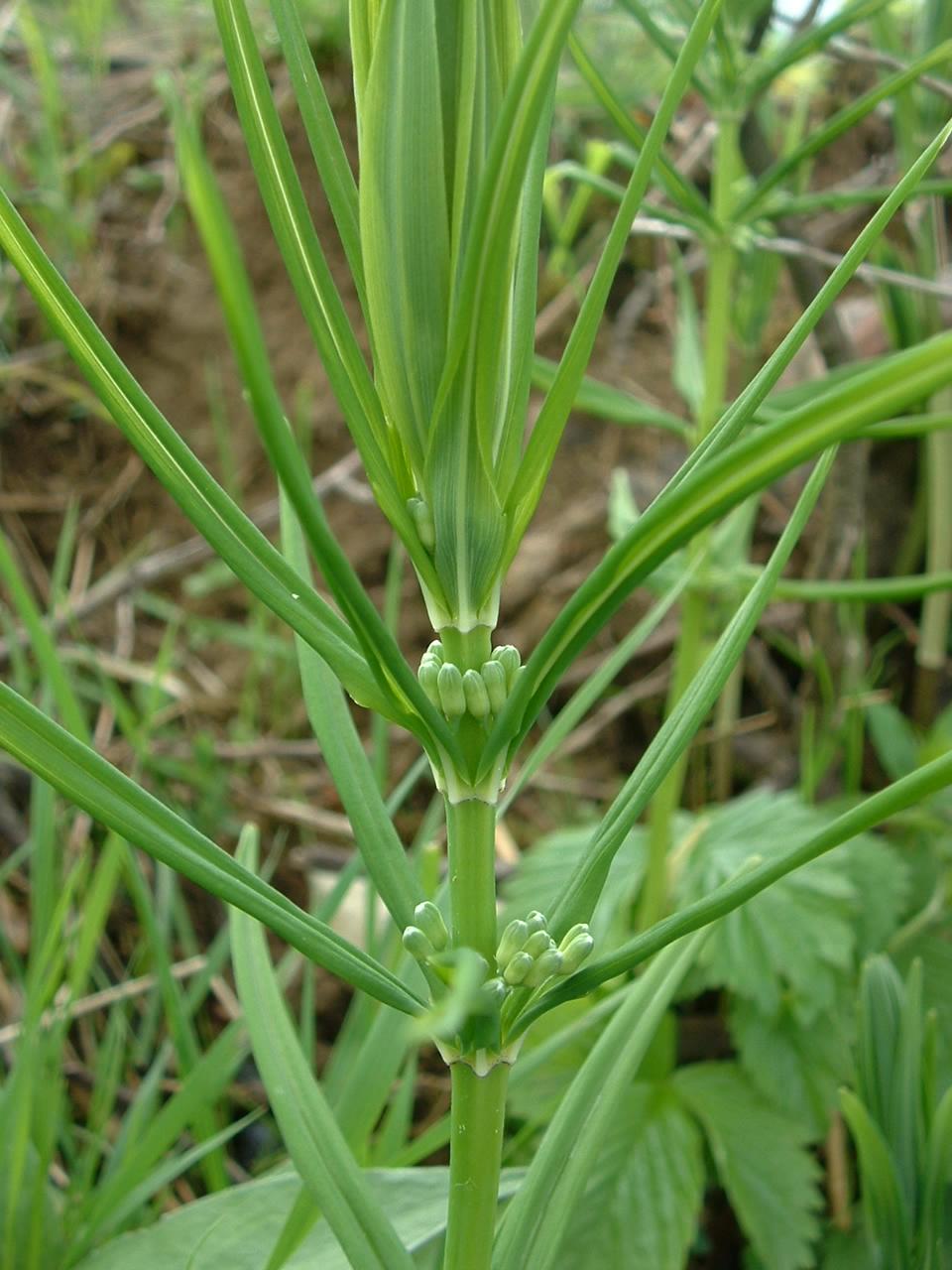
Photo: Jeffdelonge, CC BY-SA 3.0 · source

Perennial · Asparagaceae
Whorled Solomon's seal
Polygonatum verticillatum
In other languages: Kranssalomonszegel (Nederlands) · Sceau de Salomon verticillé (Français)
Whorled Solomon’s seal is a native plant of cool, moist woods and woodland edges in Europe and Asia, mainly in mountain regions. Unlike the other Solomon’s seals, its stems stand upright, up to about 1 m tall. The narrow, pointed leaves sit in whorls of three to six (or more) around the stem, giving the plant a light, airy look. In May and June small, greenish-white bells hang from it, and in late summer berries follow that turn red. It is a lovely plant for a cool, humus-rich shade garden among ferns. All parts are poisonous.
Caution: Poisonous: all parts, especially the berries and the rhizome, are poisonous to people and pets. Keep children, cats, dogs and grazing animals away from the berries, wear gloves when dividing the plant and wash your hands afterwards.
Light
Partial shade or shade
tolerates little sun
Moisture
Normal
no wet feet
Legal basis
Loam or clay
acid to neutral
Hardiness
Fully hardy
down to -30 °C
Size
1 m
tall, 0.4 m wide
Flowering
May–June
| Pruning months | March |
|---|---|
| Height | 1 m |
| Native to Belgium | Yes |
| Good for bees, butterflies and birds | Yes, for bees |
| Poisonous to people and pets | Yes, take care with children and pets |
| Flowering | May–June |
Identify
Whorled Solomon's seal: how do you recognise it?
- Habit
- Upright clump 60–100 cm high and about 40 cm wide, with straight stems rising from a creeping rhizome.
- Leaves
- Narrow, lance-shaped and pointed, in whorls of three to six (sometimes more) around the stem; yellow in autumn.
- Flower
- Small, hanging, greenish-white bells, 1–3 per leaf axil, from May to June. They are not scented.
- Fruit
- Berries that turn red in late summer. They are poisonous.
- Roots
- Creeping rhizome marked with round scars of old stems; the clump spreads slowly.
Flowering: May–June · Plants: March–April and September–October · Pruning: March
In your garden
Why grow it?
- Upright, graceful stems with whorls of narrow foliage, a light structure for the shade border.
- Small greenish-white bells in May and June that bees and bumblebees visit.
- Red berries in late summer, unlike the blue-black berries of the other species.
- A native plant that suits a natural shade garden or woodland edge.
- Fully hardy (to about −30 °C) and little work.
Whorled Solomon's seal: where does it grow best?
- Part shade to shade, preferably cool and sheltered.
- Humus-rich, moisture-retentive loam or clay, acid to neutral.
- Normally moist: do not let the soil dry out completely in summer.
- Lovely among ferns, under shrubs and trees, or at a woodland edge.
- Allow 30–40 cm per plant.
- Light
- Partial shade and shade
- Soil type
- Loam or clay
- Acidity
- Acid or neutral
- Moisture
- Normal
- Size
- 1 m tall, 0.4 m wide
- Hardiness
- Hardy (to -30 °C)
Goes well with
- Ferns: Fine green foliage in the same cool shade.
- Hosta: Broad leaves that contrast with the narrow whorls.
- Astilbe: Pink and white plumes in summer, in the same moist part shade.
- Goat’s beard: A tall, airy plant for cool shade with creamy-white plumes.
- Hellebore: Flowers in winter and early spring, before the Solomon’s seal appears.
Maintenance
Whorled Solomon's seal: when and how to plant it?
Plant in March–April and September–October.
- Plant in March–April or in September–October, when the soil is neither frozen nor waterlogged.
- Work a few spadefuls of compost or leaf mould into the soil.
- Lay the rhizome horizontally, about 3–5 cm below the surface; a potted plant goes in at the same depth as in its pot.
- Space plants 30–40 cm apart.
- Water straight away and keep the soil moist for the first weeks.
- Spread a layer of leaf mould around the plants to keep the soil cool and moist.
Care
- Watering
- Keep the soil slightly moist, especially in the first year and in dry summers.
- Feeding
- A layer of compost or leaf mould in spring; more is rarely needed.
- Mulching
- A layer of leaf mould in spring keeps the soil cool and moist.
- Dead stems
- Leave them in autumn for the yellow colour and cut them off in March.
- Leave alone
- It dislikes being moved. Let the clump grow in peace; dividing is possible after a few years.
Tip: Give it a cool, moist spot and leave it alone: it spreads slowly and becomes more impressive with the years. Check for sawfly larvae in May–June.
Whorled Solomon's seal: when to prune it?
Pruning months: March.
When: It is not pruned; cut off the dead stems in March, before the new shoots appear.
How:
- Cut the withered stems down close to the ground in March.
- In summer, cut off stems whose leaves have been stripped by larvae and dispose of them.
- Leave the stems alone for the rest of the year.
Caution: Wear gloves: the berries and the rhizome are poisonous. Wash your hands after working.
Propagation
- Division
- In September–October or in March: lift the rhizome and divide it into pieces of at least 5–8 cm with one or more buds. Lay them horizontally in the soil, about 3–5 cm deep.
- Sowing
- Sow the seeds from the berries in autumn in a seed tray and put it outdoors. Germination is slow and can take a year or longer; wear gloves when cleaning the berries.
Whorled Solomon's seal: how does it get through the winter?
Hardy to −30 °C.
- Fully hardy, to about −30 °C: no protection is needed in Belgium.
- The stems die back in autumn; the rhizome stays underground and sprouts again in spring.
- In a pot: put it in shelter and do not let the soil dry out completely. Wrap the pot in hessian in hard frost.
Diseases and pests
- Sawfly: In May and June grey-green larvae strip the leaves down to the veins. Pick the larvae off by hand, cut off badly affected stems and dispose of them.
- Slugs: Young shoots get nibbled in spring. Collect them in the evening and protect the shoots.
- Brown leaf edges: The foliage scorches with too much sun or drought. Give more shade and water.
- Rot in wet soil: The rhizome rots in waterlogged soil. Make sure it drains well.
Through the year
- March: Cut off dead stems. Plant or divide.
- April: Plant. Protect new shoots from slugs.
- May: Flowering begins. Watch for sawfly larvae.
- June: Flowering. Pick off larvae; water in dry weather.
- July: Water in dry weather.
- August: The berries turn red. They are poisonous.
- September: Plant or divide. Yellow autumn colour begins.
- October: Plant or divide. Autumn colour.
- December: Rest. Only the rhizome overwinters in the soil.
Use
Edible and useful
Not edible. Solomon’s seal is poisonous in all its parts, especially the blue-black berries, which can tempt children. The young shoots in spring look like asparagus but are not for eating. Also poisonous to dogs and cats. If any is swallowed, call a poison centre (in Belgium 070 245 245) or your doctor at once.
Good for wildlife
- Bees
- Nectar and pollen for honeybees and wild bees.
You and this species
Did you know?
- The species name verticillatum means ‘in whorls’ and refers to the leaves, which stand in whorls around the stem.
- Unlike the other Solomon’s seals, which get blue-black berries, this species has red berries.
- The stems stand upright, while those of the common and the angular Solomon’s seal arch gracefully.