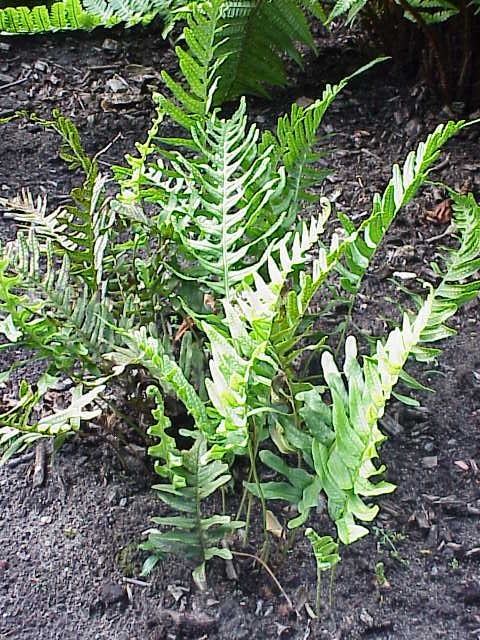
Photo: Wikimedia Commons, CC BY-SA 3.0 · source

Fern · Polypodiaceae
Common polypody
Polypodium vulgare
In other languages: Gewone eikvaren (Nederlands) · Polypode commun (Français)
The common polypody is a small, evergreen fern that grows wild in much of Europe and Asia, including Belgium. You find it on mossy walls, rocks, old tree stumps, banks and even high up on pollarded willows and oaks, where it grows as an epiphyte in the moss and humus. The leathery, dark green fronds are 10–30 cm long, deeply cut like a comb, and rise one by one along a creeping rhizome. On the underside there are two rows of large, round, orange-yellow spore clusters. Gardeners value it because it grows where almost nothing else will: in dry shade, on walls and on stumps.
Light
Partial shade or shade
tolerates little sun
Moisture
Dry to normal
no wet feet
Legal basis
Sand or loam
acid to neutral
Hardiness
Fully hardy
down to -30 °C
Size
0.3 m
tall, 0.4 m wide
| Pruning months | May–June |
|---|---|
| Height | 0.3 m |
| Native to Belgium | Yes |
| Poisonous to people and pets | Not known to be poisonous |
Identify
Common polypody: how do you recognise it?
- Habit
- Low, creeping fern 20–30 cm tall that slowly forms a loose mat 40 cm wide or more.
- Fronds
- Leathery, simple and deeply cut like a comb, 10–30 cm long; the fronds stand separately along the rhizome.
- Colour
- Matt to glossy dark green all year round. New fronds appear in late spring and early summer.
- Spores
- Large, round, orange-yellow spore clusters without a covering membrane, in two rows under the frond; ferns do not flower.
- Rhizome
- Thick, creeping and covered in brown scales; it lies just below or even on the surface.
Plants: March–May and September–October · Pruning: May–June
In your garden
Why grow it?
- Evergreen: fresh dark green fronds all winter, just when the garden is bare.
- One of the few ferns that tolerate dry shade once well established.
- Grows on walls, stumps, rocks and pollarded willows: ideal for clothing an old wall or tree stump.
- Native, it fits perfectly into a wildlife garden, where it belongs among moss and dead wood.
- Slowly forms a low, evergreen ground cover under trees and shrubs.
- Little work: cutting off some old fronds once a year is enough.
Common polypody: where does it grow best?
- Partial shade to shade; it tolerates morning or evening sun well.
- Light, well-drained, humus-rich soil: sand or loam, acid to neutral. Also on walls, stones, stumps and mossy branches.
- Dry to normally moist. Once established it tolerates drought; wet, heavy soil makes the rhizome rot.
- Very suitable for dry shade under trees, at the foot of a hedge or on a north-facing wall.
- Plant about 30 cm apart; after a few years it forms a closed mat.
- Light
- Partial shade and shade
- Soil type
- Sand or loam
- Acidity
- Acid or neutral
- Moisture
- Dry or normal
- Size
- 0.3 m tall, 0.4 m wide
- Hardiness
- Hardy (to -30 °C)
Goes well with
- Maidenhair spleenwort: A small native wall fern that grows on the same old walls and rocks.
- Barrenwort: An evergreen ground cover that also tolerates dry shade.
- Rock cranesbill: Scented leaves and pink flowers in May–June, tough in dry shade.
- Lesser periwinkle: Evergreen with small blue flowers in spring, for dry shade under trees.
- Snowdrop: White bells in February among the winter-green fern fronds.
Maintenance
Common polypody: when and how to plant it?
Plant in March–May and September–October.
- Plant from March to May or in September–October, when the soil is not frozen.
- Loosen the soil and work in leaf mould and some coarse sand so that it is light and well drained.
- Plant shallowly: lay the rhizome horizontally and only half cover it with soil. Hold it in place with a bent piece of wire or a small stone.
- On a wall or stump: push the rhizome with some moss and leaf mould into a crevice or hollow and hold it with a small stone.
- Leave about 30 cm between plants.
- Water straight away and keep the soil or moss lightly moist for the first months, until the plant has rooted.
Care
- Water
- In the first months water or mist in dry spells. After that extra water is hardly ever needed, except in a long heatwave.
- Feeding
- Not needed. A thin layer of leaf mould in spring is enough; on walls and stumps nothing at all.
- Mulching
- A thin layer of leaf mould is fine, but a thick layer of wet leaves on the rhizome can make it rot.
- Old fronds
- In late May–June cut off worn and brown fronds, when the new ones appear.
- Competition
- Keep ivy and vigorous ground covers away, as they soon smother it.
Tip: Plant it shallowly, with the rhizome half above the soil, and never in wet, heavy soil. On a mossy wall, an old stump or a pollarded willow it often does better than in a border.
Common polypody: when to prune it?
Pruning months: May–June.
When: In late May–June, when the new fronds appear. Otherwise it needs no pruning.
How:
- Cut off only the old, worn or brown fronds at the base; healthy green fronds can stay.
- Do not cut it back in March as with many other ferns: the plant would then stay bare until summer, because the new fronds come late.
- On a wall or in a tree you can simply let it be.
Propagation
- Division
- In April or September break or cut off a piece of rhizome with a few fronds and plant it shallowly in a moist, shady spot. Hold it in place with a small stone and keep it lightly moist.
- Spores
- In autumn collect ripe spores from the orange-yellow clusters and sow them on sterile, moist compost under glass. It takes patience: small ferns only appear after several months.
Common polypody: how does it get through the winter?
Hardy to −30 °C.
- Very hardy, to about −30 °C: no protection is needed in Belgium.
- The fronds stay green all winter; after hard frost they may be somewhat damaged, but new fronds arrive in summer.
- On walls, stumps and in trees it survives the winter without help.
- In a pot: use free-draining compost and stand the pot in shelter, so it is not sitting in wet soil.
Diseases and pests
- Rhizome rot: Brown, limp fronds and a soft rhizome in wet, heavy soil. Move it to a light, well-drained spot, or onto a wall or stump.
- Smothered: Ivy, grass or vigorous ground covers grow over it. Pull them away by hand.
- Dried-up fronds: In young plants during a long drought. Water or mist; established plants usually recover by themselves.
- Leaf layer too thick: A thick layer of wet autumn leaves can make the shallow rhizome rot. In winter carefully rake off the thickest layer.
Through the year
- March: Plant. Remove ivy and weeds.
- April: Plant or divide.
- May: New fronds appear. Cut off old fronds.
- June: New fronds. Cut off worn fronds. Water young plants in dry spells.
- August: Water young plants in dry spells.
- September: Plant or divide.
- October: Plant. Collect ripe spores.
- December: Evergreen fronds decorate walls and stumps.
You and this species
Did you know?
- Polypodium means ‘many feet’, after the creeping, branching rhizome with the knobs of old frond stalks.
- The rhizome tastes sweet, a little like liquorice; an old Dutch name for the plant is therefore ‘engelzoet’.
- On trees it grows as an epiphyte: it uses the tree only for support and takes no food from it.