Photo: Bouba at French Wikipedia, CC BY-SA 3.0 · source

Perennial · Primulaceae
Japanese primrose
Primula japonica
In other languages: Etageprimula (Nederlands) · Primevère du Japon (Français)
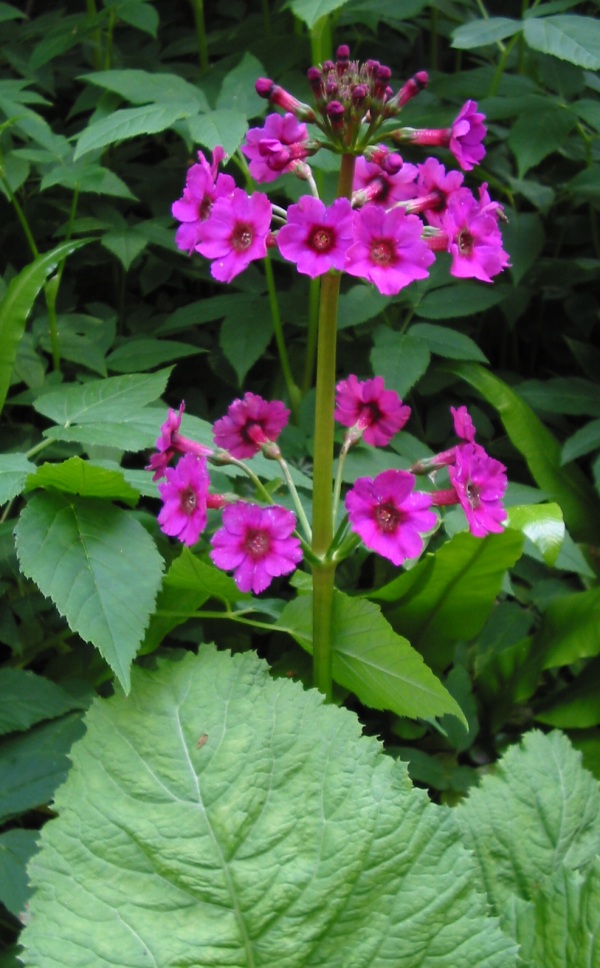
The Japanese primrose comes from Japan, where it grows in damp mountain woods and along streams. It forms a rosette of large, pale green, crinkled leaves, from which sturdy stems up to 50 cm tall rise in May and June. The flowers are arranged in tiers of whorls up the stem, like the floors of a building or the arms of a candelabra. Colours range from magenta and crimson to pink and white. Well-known cultivars include the white ‘Postford White’ and the dark red ‘Miller’s Crimson’. In wet soil beside a pond or stream it self-seeds freely and forms fine drifts after a few years.
Caution: Self-seeds freely in wet soil. Cut off the flower stems after flowering if you want to limit this.
Light
Partial shade or shade
tolerates little sun
Moisture
Moist to wet
must not dry out
Legal basis
Loam, clay or peat
acid to neutral
Hardiness
Fully hardy
down to -25 °C
Size
0.5 m
tall, 0.3 m wide
Flowering
May–June
| Height | 0.5 m |
|---|---|
| Native to Belgium | No, planted |
| Good for bees, butterflies and birds | Yes, for bees |
| Poisonous to people and pets | Not known to be poisonous |
| Flowering | May–June |
Identify
Japanese primrose: how do you recognise it?
- Habit
- Leaf rosette with upright flower stems up to 50 cm tall; a clump is about 30 cm wide.
- Leaves
- Large, up to 25 cm long, obovate, pale green and crinkled, with a finely toothed edge. Dies back in winter.
- Flower
- Flowers about 2 cm across in tiered whorls on a sturdy stem; the lowest whorl opens first.
- Colour
- Magenta, crimson, pink or white, often with a darker eye.
- Seed
- Round seed capsules in whorls; the seed falls around the plant.
- Roots
- A short rootstock with fleshy roots that must never dry out.
Flowering: May–June · Plants: March–April and September–October
In your garden
Why grow it?
- Striking flower stems with tiers of whorled flowers in May and June.
- One of the finest plants for wet soil beside a pond or stream or in a bog garden.
- Bees and bumblebees visit the flowers.
- In the right spot it self-seeds and forms broad, colourful drifts after a few years.
- Flowers in half shade and light shade, where few other plants show such bright colours.
Japanese primrose: where does it grow best?
- Half shade or light shade; in sun only if the soil stays really wet.
- Humus-rich loam, clay or peaty soil, acid to neutral.
- Moist to wet: ideal at a pond edge, along a stream or in a bog border. The crown should not sit under water, though.
- Plant 30 cm apart, preferably in groups.
- Light
- Partial shade and shade
- Soil type
- Loam, clay or peat
- Acidity
- Acid or neutral
- Moisture
- Wet
- Size
- 0.5 m tall, 0.3 m wide
- Hardiness
- Hardy (to -25 °C)
Goes well with
- Rodgersia: Large, divided leaves beside the whorls of flowers, also for wet soil.
- Hosta: Broad leaves in the same moist half shade.
- Siberian iris: Narrow leaves and blue flowers at the same time.
- Ostrich fern: Tall, fresh green fronds for a wet, shady corner.
- Marsh marigold: Yellow flowers in early spring, before the Japanese primrose blooms.
Maintenance
Japanese primrose: when and how to plant it?
Plant in March–April and September–October.
- Plant in March–April or in September–October.
- Work plenty of leaf mould or well-rotted compost into the soil so that it holds moisture.
- Dig a hole slightly larger than the root ball and set the plant at the same depth as it was in the pot.
- Leave 30 cm between plants; plant in groups of five or more for the best effect.
- Water well straight away and keep the soil moist for the first few weeks.
- Spread a layer of leaf mould around the plants, but not over the crown.
Care
- Water
- Never let it dry out. If it is not in a wet spot, water every few days in dry spells.
- Feeding
- Every spring a layer of compost or well-rotted manure: it likes rich soil.
- Mulching
- Leaf mould in spring keeps the soil cool and moist.
- Spent flowers
- Leave them if you want it to self-seed; otherwise cut them off at the base.
- Rejuvenating
- Old clumps flower less: divide them every three to four years.
Tip: Plant several colours together at the edge of a pond: after a few years they self-seed and form a colourful band.
Japanese primrose: when to prune it?
When: It is not pruned. After flowering you can cut off the faded stems; in autumn the leaves die back by themselves.
How:
- If you want seedlings, leave the stems until the seed capsules have opened.
- If you do not want seedlings, cut the stems off at the base after flowering.
- In autumn or early spring, clear away the dead leaves.
Propagation
- Seed
- Sow fresh seed in summer or autumn in a pot of moist seed compost and leave it outside: the seed germinates best after a cold period. Seedlings do not always have the colour of the parent.
- Moving seedlings
- In spring, lift the young self-sown seedlings around the plant and replant them where you want them.
- Division
- In March–April or in September, split a clump with a spade into pieces, each with roots and a bud.
Japanese primrose: how does it get through the winter?
Hardy to −25 °C.
- Hardy to about −25 °C: no protection is needed in Belgium.
- The leaves die back in autumn; in winter only a bud at ground level remains.
- Mark the spot so you do not dig the plants up by accident in spring.
- In a pot or container: keep it sheltered and the compost slightly moist.
Diseases and pests
- Drying out: Limp leaves with brown edges. Water and mulch, or move it to a wetter, shadier spot.
- Slugs: Eat young leaves in spring. Pick them off in the evening or after rain.
- Vine weevil: The grubs eat the roots and the plant wilts. Use nematodes against the grubs.
- Aphids: On stems and buds. Hose them off with a strong jet of water.
Through the year
- March: Plant. Give compost or manure. Clear away dead leaves.
- April: New rosettes. Watch for slugs.
- May: Flowering starts.
- June: Full flower. Water in dry spells.
- July: Seed capsules ripen. Leave or cut off the faded stems.
- August: Sow fresh seed in pots and stand them outside. Never let them dry out.
- September: Plant and divide.
- October: Plant. The leaves die back.
Use
Good for wildlife
- Bees
- Nectar and pollen for honeybees and wild bees.
You and this species
Did you know?
- Its Japanese name, kurinsō, means ‘nine-ring plant’ and refers to the rings on the spire of a pagoda.
- It belongs to the candelabra primulas, a group of Asian primulas whose flowers are arranged in tiers of whorls.
- Seedlings often differ in shade from the parent, so that after a few years all sorts of pinks and reds appear.