Photo: Wikimedia Commons, CC BY-SA 3.0 · source

Perennial · Ranunculaceae
Meadow buttercup
Ranunculus acris
In other languages: Scherpe boterbloem (Nederlands) · Renoncule âcre (Français)
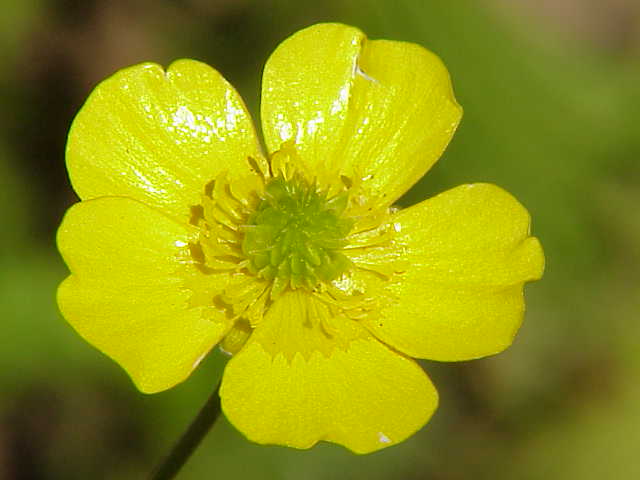
Meadow buttercup is a native perennial of damp hay meadows and pastures throughout Europe and much of Asia. From a loose rosette of deeply divided, hand-shaped leaves rise branched stems 30–60 cm tall, carrying glossy yellow, five-petalled flowers from May into July. Unlike creeping buttercup it does not make runners: it stays a neat clump. In a flower meadow it is a cheerful, easy plant that feeds many small bees, hoverflies and beetles. In borders the double form ‘Flore Pleno’ is the usual choice, with small, tight yellow pompons that do not self-seed.
Caution: All parts are poisonous, especially when the plant is fresh. The sap irritates skin and mucous membranes: wear gloves when dividing and cutting back. Children, dogs, cats, horses and grazing livestock can suffer mouth, stomach and gut problems if they eat the fresh plant. Do not plant it in or next to a horse paddock, and do not let children chew it.
Light
Sun or partial shade
preferably some sun
Moisture
Normal to wet
must not dry out
Legal basis
Loam, clay or peat
any pH
Hardiness
Fully hardy
down to -30 °C
Size
0.6 m
tall, 0.3 m wide
Flowering
May–July
| Pruning months | March and July |
|---|---|
| Height | 0.6 m |
| Native to Belgium | Yes |
| Good for bees, butterflies and birds | Yes, for bees |
| Poisonous to people and pets | Yes, take care with children and pets |
| Flowering | May–July |
Identify
Meadow buttercup: how do you recognise it?
- Habit
- Loose clump with a basal rosette and upright, branched stems 30–60 cm tall and about 30 cm wide.
- Leaves
- Deeply divided like a hand into 3–7 toothed lobes, slightly hairy. The stem leaves are smaller and narrower.
- Flower
- Glossy yellow, saucer-shaped flowers about 2 cm across with five petals, from May to July. Fully double in ‘Flore Pleno’.
- Fruit
- A small ball of flat seeds, each with a short beak.
- Roots
- A short rootstock with a bundle of fibrous roots, without runners.
Flowering: May–July · Plants: March–May and September–October · Pruning: March and July
In your garden
Why grow it?
- Flowers from May to July in glossy yellow: a classic of the flowering hay meadow.
- Native and valuable for wild bees, hoverflies and beetles, which easily reach the nectar and pollen in its open flowers.
- Grows well on moist loam, clay and peaty soil, where many other meadow flowers struggle.
- Forms a clump and does not creep: far better behaved than creeping buttercup.
- The double ‘Flore Pleno’ is a sturdy, long-flowering border plant that produces no seedlings.
Meadow buttercup: where does it grow best?
- Sun to partial shade. It flowers most freely in full sun, as long as the soil does not dry out.
- Loam, clay or peaty soil, acid, neutral or chalky: it is not fussy.
- Moist to wet soil: ideal in a damp meadow, along a ditch or at the edge of a pond. It dislikes very dry sand.
- Plant 25–30 cm apart, in groups of three to five for a good effect.
- Light
- Sun and partial shade
- Soil type
- Loam, clay or peat
- Acidity
- Not fussy
- Moisture
- Normal or wet
- Size
- 0.6 m tall, 0.3 m wide
- Hardiness
- Hardy (to -30 °C)
Goes well with
- Ragged robin: Pink, ragged flowers in the same damp meadow and in the same months.
- Ox-eye daisy: White flowers beside the glossy yellow: the classic hay meadow picture.
- Cuckooflower: Flowers a little earlier in pale lilac, on the same moist soil.
- Yellow rattle: A semi-parasite that weakens the grass, so flowers such as buttercups get more room.
- Hardy geranium: In the border, a blue or purple counterpoint to the yellow pompons of ‘Flore Pleno’.
Maintenance
Meadow buttercup: when and how to plant it?
Plant in March–May and September–October.
- Plant from March to May or in September–October, when the soil is moist but not frozen.
- Loosen the soil and remove perennial weeds such as couch grass and creeping buttercup.
- Dig a hole slightly larger than the pot and set the plant at the same depth as it was in the pot.
- Leave 25–30 cm between plants. In grassland, plant them in small groups in open patches in the turf.
- Firm the soil and water in well straight away.
- Wear gloves: the sap can irritate the skin.
Care
- Water
- Keep moist for the first weeks after planting. After that, water only in long dry spells.
- Feeding
- Not needed. In a border a thin layer of compost in March is enough. Do not feed a hay meadow, or the grass will crowd out the flowers.
- Mowing
- In grassland, mow after flowering and seed set, from July, and remove the cuttings.
- Spent flowers
- On the wild form, cut them off if you want fewer seedlings. ‘Flore Pleno’ sets no seed.
- Support
- On rich soil the stems can flop apart. Let them lean on neighbours or use a low ring.
Tip: If you want flowers without seedlings, choose ‘Flore Pleno’: it sets no seed and flowers for a long time. In grassland, mow only after seed set so that the wild form can self-seed.
Meadow buttercup: when to prune it?
Pruning months: March and July.
When: After flowering in July, and in late February–March to clear old leaves.
How:
- After flowering, cut the spent stems back to just above the rosette: you get fresh leaves and sometimes a small second flush.
- If you want the wild form to self-seed in grassland, let the seed ripen before you mow.
- In March, remove dead leaves and stems before the new growth starts.
- Put the trimmings on the compost heap, not in a field where animals graze.
Caution: Wear gloves: the fresh sap can cause redness and small blisters on the skin.
Propagation
- Division
- In March–April or September: lift the clump, pull or cut it into pieces that each have a few buds and roots, and replant at once. This is also how ‘Flore Pleno’ is propagated.
- Seed
- Wild form only: sow fresh seed in late summer or autumn in a pot of seed compost left outdoors. Germination is slow and erratic.
Meadow buttercup: how does it get through the winter?
Hardy to −30 °C.
- Fully hardy, to about −30 °C: no protection is needed in Belgium.
- In winter only a small rosette of leaves remains, or the plant dies back completely. Mark its place in the border.
- It copes well with wet winters: in the wild it grows in damp meadows.
Diseases and pests
- Powdery mildew: White powder on the leaves, mainly in dry summers. Cut off affected leaves and water in dry weather; it is usually harmless.
- Too many seedlings: The wild form self-seeds freely in damp grass and in borders. Cut off spent stems in time or choose ‘Flore Pleno’.
- Confusion with creeping buttercup: That one has long, rooting runners and is a stubborn weed. Meadow buttercup grows in a clump; look closely before you keep a seedling.
- Flopping stems: On very rich soil the stems become weak. Do not feed, and plant it close to other plants.
Through the year
- March: Clear old leaves. Plant or divide.
- April: Plant. The new rosettes start into growth.
- May: Flowering starts. Add a low support on rich soil.
- June: Full flower. Bees and hoverflies visit the flowers.
- July: Last flowers. Cut back spent stems or mow the meadow.
- August: Water in long dry spells.
- September: Divide and plant. Sow the wild form in a pot.
- October: Plant in the border or in damp grassland.
Use
Edible and useful
Not edible. All parts of these buttercups are poisonous, especially when fresh: when the plant is damaged it releases protoanemonin, an acrid compound that causes a burning feeling in the mouth, drooling, vomiting and stomach ache, and redness and small blisters on the skin. The acrid taste puts most animals off: cows and horses leave fresh buttercups standing in the field, but in hay they are harmless, because the compound breaks down as it dries. So never throw fresh mowings or trimmings into a field, run or pen, and do not give them to rabbits or guinea pigs. Do not let children chew the stems or flowers, and wear gloves when dividing and trimming. If any is swallowed, call a poison centre (in Belgium 070 245 245) or your doctor at once.
Good for wildlife
- Bees
- Nectar and pollen for honeybees and wild bees.
You and this species
Did you know?
- The shine of the petals comes from an extremely smooth top layer of cells with a thin layer of air beneath, which reflects light like a mirror. That is why a yellow glow appears when you hold a buttercup under your chin.
- Grazing cows and horses usually leave fresh buttercups alone, so in a grazed field they remain as yellow patches. Dried in hay, the plant largely loses its toxicity.
- The name ‘acris’ means sharp or bitter and refers to the burning taste of the fresh sap.