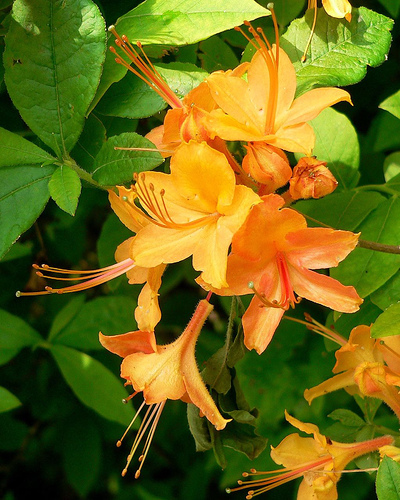
Photo: User:Arx Fortis, CC BY 2.5 · source

Shrub · Ericaceae
Flame azalea
Rhododendron calendulaceum
In other languages: Azalea (Nederlands) · Azalée (Français)
This azalea (Rhododendron calendulaceum), called flame azalea in English, grows wild in the Appalachian Mountains in the eastern United States. It is a deciduous shrub about 2.5 m tall that flowers in May–June in fiery shades of orange, yellow and red, often at the same time as the young leaves unfold. Its species name refers to the marigold (Calendula) because of those warm colours. It is fully hardy and is one of the parents of the Ghent azaleas. It needs acid, humus-rich soil and a spot in light shade, and then gives a warm, bright splash of colour in the garden for many years.
Caution: All parts are toxic: leaves, flowers and nectar. Children, cats, dogs and grazing animals such as horses, sheep and goats can fall ill if they eat it. Do not plant it in or next to a paddock and do not let children put flowers or leaves in their mouths.
Light
Sun or partial shade
preferably some sun
Moisture
Normal
no wet feet
Legal basis
Sand, loam or peat
acid
Hardiness
Fully hardy
down to -30 °C
Size
2.5 m
tall, 2 m wide
Flowering
May–June
| Pruning months | June |
|---|---|
| Height | 2.5 m |
| Native to Belgium | No, planted |
| Good for bees, butterflies and birds | Yes, for bees |
| Poisonous to people and pets | Yes, take care with children and pets |
| Flowering | May–June |
Identify
Flame azalea: how do you recognise it?
- Habit
- Open, deciduous shrub about 2.5 m tall and 2 m wide, developing a broad crown over the years.
- Foliage
- Elliptic to obovate, 4–8 cm long, finely hairy, matt green; appears around flowering time.
- Flower
- Funnel-shaped flowers about 5 cm across in clusters in May–June, orange, yellow and red, often with an orange blotch.
- Fruit
- A narrow, hairy capsule that splits open in autumn and releases very fine seed.
- Roots
- Shallow and finely branched: they dry out quickly and must not be disturbed by digging or hoeing.
Flowering: May–June · Plants: March–April and September–October · Pruning: June
In your garden
Why grow it?
- Fiery orange, yellow and red flowers in May–June, in half shade where few other shrubs flower so brightly.
- Fully hardy, to about −30 °C, and deciduous: no frost-damaged foliage.
- The flowers are visited by bees and bumblebees.
- The leaves often turn yellow to orange in autumn.
- Little work: hardly any pruning, just a mulch and some water in dry summers.
Flame azalea: where does it grow best?
- Half shade or light shade, for example under tall trees with deep roots such as oak or pine; the flowers last longer there.
- Acid soil (pH about 4.5–5.5): sand or loam rich in humus. Never use lime or chalky compost.
- Evenly moist but well drained; it dislikes both wet feet and drying out.
- Sheltered from cold east wind and from morning sun after a night frost. Allow 1.5–2 m of space.
- Light
- Sun and partial shade
- Soil type
- Sand, loam or peat
- Acidity
- Acid
- Moisture
- Normal
- Size
- 2.5 m tall, 2 m wide
- Hardiness
- Hardy (to -30 °C)
Goes well with
- Ferns: Fresh green foliage in the same moist, acid soil.
- Japanese maple: A classic partner: fine leaves and good autumn colour above the azalea.
- Pieris: An evergreen ericaceous shrub that flowers in spring.
- Hosta: Large leaves in the shade of the azalea, including on moist soil.
- Hydrangea: Flowers later in summer in the same acid, moist soil.
Maintenance
Flame azalea: when and how to plant it?
Plant in March–April and September–October.
- Plant in March–April or September–October, when the soil is neither frozen nor waterlogged.
- Dig a hole 2–3 times as wide as the root ball, but no deeper. Mix the excavated soil with leaf mould or peat-free ericaceous compost.
- Soak the root ball in a bucket of water until no more air bubbles rise, then gently tease out the roots.
- Set the root ball so its top is level with, or slightly above, the soil: never plant deeper than in the pot.
- Firm the soil and water straight away, preferably with rainwater.
- Spread a 5–8 cm layer of leaf mould, pine-needle mulch or oak leaves around the base.
Care
- Water
- In dry weather give a good watering every week, preferably rainwater: tap water often contains lime and makes the soil less acid.
- Feeding
- In April–May, an ericaceous fertiliser or organic fertiliser. Not after July.
- Mulching
- Renew the leaf mould or needle mulch every spring. Do not dig or hoe around the shrub: the roots lie just below the surface.
- Spent flowers
- You may snap off spent trusses by hand without damaging the young buds below. It is not essential.
- Avoid lime
- Do not use lime, dolomite or chalky compost nearby; the leaves would turn yellow.
Tip: Water with rainwater in dry weather and spread a layer of leaf mould or needle mulch every spring: the shallow roots like cool, moist, acid soil.
Flame azalea: when to prune it?
Pruning months: June.
When: It needs little pruning. Do it just after flowering, in June, because next year’s flower buds form in summer.
How:
- Snap or cut off spent trusses if you wish.
- Remove dead, weak and crossing branches at the base.
- Shorten overlong branches just above a side shoot to adjust the shape.
- An old, bare shrub can be cut back to 30–50 cm above the ground in March: it usually regrows, but will not flower that year.
Caution: Do not prune in late summer or autumn: you would cut off next year’s flower buds.
Propagation
- Layering
- In spring, bend a low, flexible branch down, peg it into acid, loose soil with a hook and put a stone on top. Separate it with its roots after one or two years.
- Seed
- Scatter the fine seed in January–March on moist acid seed compost without covering it, in the light at 15–20 °C. Seedlings grow slowly and do not always resemble the parent.
Flame azalea: how does it get through the winter?
Hardy to −30 °C.
- Fully hardy, to about −30 °C: no protection is needed in Flanders.
- A layer of leaves or needle mulch around the base protects the shallow roots, especially on young plants.
- In a pot the roots freeze more easily: stand the pot against a wall, wrap it in hessian and water on frost-free days.
Diseases and pests
- Chlorosis: Yellow leaves with green veins on soil that is too chalky. Acidify the soil with needle mulch and leaf mould, water with rainwater and give an ericaceous fertiliser.
- Powdery mildew: A white, powdery coating on the leaves, mainly in late summer in dry weather. Water at the base, leave space between plants and remove affected leaves.
- Vine weevil: Half-moon notches in the leaf edges in summer; the grubs eat the roots. Apply nematodes in August–September to warm, moist soil.
- Root rot: Limp, wilting leaves in summer while the soil is wet. Improve drainage or plant on a slight mound.
Through the year
- March: Plant. Ericaceous fertiliser. Renovate old shrubs if needed (no flowers that year).
- April: Plant. Top up the leaf mould or needle mulch.
- May: Flowering begins. Water with rainwater in dry weather.
- June: Flowering. After flowering, remove spent trusses and prune lightly.
- July: Water in dry weather. Watch for notched leaf edges.
- August: Water in dry weather. Apply nematodes against vine weevil grubs.
- September: Plant. Collect seed when the capsules open.
- October: Plant. Autumn colour. Top up the mulch.
- November: Rest. Fallen leaves can stay as mulch.
Use
Edible and useful
Not edible. Rhododendrons and azaleas are poisonous in all their parts, including the flowers and nectar: they contain grayanotoxins, which cause drooling, vomiting, weakness, a slow heartbeat and low blood pressure. Goats, sheep and alpacas above all, but also horses, cattle, rabbits and guinea pigs become seriously ill from them, sometimes after only a small quantity of leaves; dogs and cats are at risk too. So never throw clippings over the fence of a field or into a pen or hutch, do not give them to animals, and do not pick greens for rabbits among the shrubs; if in doubt, call your vet at once. In children who put a leaf or flower in their mouth or suck nectar from the flowers, as they do with dead-nettle, it usually goes no further than a burning mouth and nausea, but teach them not to do it. If any is swallowed, call a poison centre (in Belgium 070 245 245) or your doctor at once.
Good for wildlife
- Bees
- Nectar and pollen for honeybees and wild bees.
You and this species
Did you know?
- The species name calendulaceum refers to the marigold (Calendula), because of the orange colours of the flowers.
- Together with species such as Rhododendron luteum and R. viscosum, it formed the basis of the Ghent azaleas, bred in Ghent in the 19th century.
- In the southern Appalachians it grows wild on grassy mountain tops, where it flowers in masses in June.