Photo: Attribution information, such as the author's name, e-mail, website, or signature, that was once vis, CC BY-SA 3.0 · source

Shrub · Rosaceae
Jetbead
Rhodotypos scandens
In other languages: Rhodotypos (Nederlands) · Rhodotypos (Français)
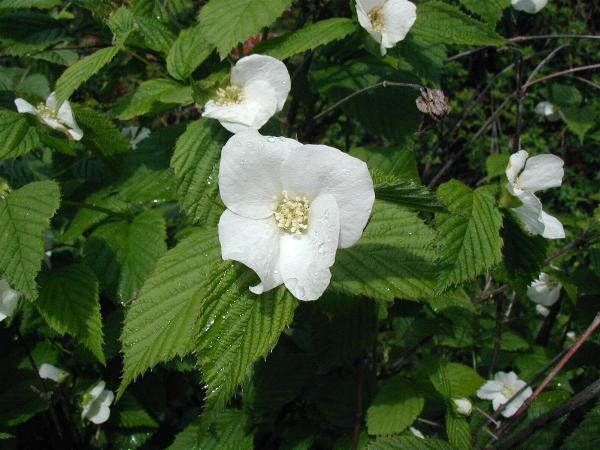
Jetbead comes originally from Japan, Korea and China and is a tough, undemanding shrub of the rose family. It forms a broad, loose bush with fresh green, deeply veined leaves and, from May to June, white flowers with four petals that recall a single rose. After flowering come shiny black fruits, usually in fours, which stay on the branches all winter. The shrub grows in sun and shade, in dry or fairly moist soil and on both chalky and acid ground. That makes it a dependable answer for difficult corners of the garden.
Caution: The fruits are poisonous. Children and pets such as dogs and cats can become ill if they eat them. The shiny black fruits look like berries: avoid planting the shrub where small children play, and cut off the fruits if necessary.
Light
Sun to shade
not fussy
Moisture
Normal
no wet feet
Legal basis
Sand, loam or clay
any pH
Hardiness
Fully hardy
down to -30 °C
Size
1.5 m
tall, 2 m wide
Flowering
May–June
| Pruning months | February–March |
|---|---|
| Height | 1.5 m |
| Native to Belgium | No, planted |
| Good for bees, butterflies and birds | Yes, for bees |
| Poisonous to people and pets | Yes, take care with children and pets |
| Flowering | May–June |
Identify
Jetbead: how do you recognise it?
- Habit
- Broad, loose shrub about 1.5 m tall and 2 m wide, with upright to arching branches.
- Leaves
- Opposite, oval, 5–10 cm, sharply double-toothed and deeply veined; fresh green, with little autumn colour.
- Flowers
- White flowers, 3–5 cm across, with four petals and many stamens, at the tips of young shoots, in May–June.
- Fruit
- Shiny black fruits, usually in fours, that hang on well into winter.
- Toughness
- Tolerates shade, drought and chalky soil, and also grows in an urban garden.
Flowering: May–June · Plants: March–April and October–November · Pruning: February–March
In your garden
Why grow it?
- Flowers from May to June with large, white, four-petalled blooms that attract bees.
- The shiny black fruits stay on all winter and add contrast to the bare garden.
- A tough shrub: it grows in sun, partial shade and shade and is not fussy about soil.
- Low maintenance: few diseases or pests and hardly any pruning.
- Good in an informal hedge or in a border with other shrubs.
Jetbead: where does it grow best?
- Sun, partial shade or shade: it flowers and fruits best in sun, but it also does well under trees.
- Almost any well-drained garden soil: sand, loam or clay, acid to chalky.
- Normally moist; once established it also tolerates drought.
- Can be planted sheltered or in the open, because it is fully hardy.
- Allow 1.5–2 m of space; in a hedge you can set plants 1 m apart.
- Light
- Sun, partial shade and shade
- Soil type
- Sand, loam or clay
- Acidity
- Not fussy
- Moisture
- Normal
- Size
- 1.5 m tall, 2 m wide
- Hardiness
- Hardy (to -30 °C)
Goes well with
- Weigela: Flowers at the same time, with pink or red blooms beside the white ones.
- Spiraea: A loose, flowering shrub that also grows in sun and on ordinary soil.
- Hydrangea: Takes over in summer and shares the partial shade.
- Hosta: Broad leaves under the shrub in a shady corner.
- Lady’s mantle: A soft, low edging that covers the base of the shrub.
Maintenance
Jetbead: when and how to plant it?
Plant in March–April and October–November.
- Plant in March–April or in October–November, when the soil is neither frozen nor waterlogged.
- Dig a hole twice as wide as the root ball and just as deep.
- Improve heavy clay or poor sand with a few spadefuls of compost.
- Set the shrub at the same depth as in its pot, fill in with soil and firm it well.
- Water in generously straight away, even if it is raining.
- Spread a layer of compost or bark around the base and keep 1.5–2 m from other plants.
Care
- Water
- In the first year give a good can of water weekly in dry spells. After that it usually manages on its own, even in dry summers.
- Feeding
- In spring give a spadeful of compost or a little organic feed. On good soil this is not really necessary.
- Mulching
- A layer of compost or bark in spring keeps weeds down and the soil moist.
- Fruits
- Leave them on: they decorate the winter. Only cut them off if small children or pets play in the garden.
- Seedlings
- Young plants may appear around the shrub. Pull them out in spring if you do not want them.
Tip: An ideal shrub for a difficult spot: it also grows in shade and on dry soil. Leave the black fruits on for winter decoration, but cut them off if small children or pets play in the garden.
Jetbead: when to prune it?
Pruning months: February–March.
When: It needs little pruning. Thin it every few years in February–March, before it comes into leaf.
How:
- Remove dead, damaged or crossing branches completely.
- Every few years take out a few of the oldest branches at the base to keep the shrub young and airy.
- If you want to keep it smaller, cut the branches back to a side shoot after flowering, in June–July. You will then lose part of the fruits.
Caution: If you prune hard in summer, you lose the fruits. Keep prunings with fruits out of reach of children and pets.
Propagation
- Softwood cuttings
- In June–July take cuttings of 10–15 cm from young shoots, remove the lower leaves and insert them in moist compost, under plastic or in a propagator. They usually root readily.
- Hardwood cuttings
- From November to February push cuttings of 20 cm of last year’s wood two-thirds into the ground in a sheltered spot. After a year most have rooted.
- Seed
- The seeds need a cold spell to germinate. Sow them in autumn in a pot and leave the pot outdoors over winter. Seedlings may differ from the parent plant.
Jetbead: how does it get through the winter?
Hardy to −30 °C.
- Fully hardy to about −30 °C: in Belgium no protection is needed.
- The black fruits stay on all winter and look good against bare branches and in hoar frost.
- Give young plants a mulch around the base in their first winter.
Diseases and pests
- Aphids: On young shoots in May–June. Rinse them off with water or let ladybirds and lacewings do the work.
- Powdery mildew: White powder on the leaves, mostly in a dry or stuffy spot. Water at the base, allow air to circulate and cut away affected shoots.
- Poor flowering: Usually too much shade or pruned too hard. Give it more light and do not prune too much after flowering.
- Self-sown seedlings: The fruits can self-seed. Pull up young plants in spring and remove the fruits if you want to limit this.
Through the year
- February: Thin out and cut away dead wood before the buds open.
- March: Thin out if needed. Plant. Give compost.
- April: The leaves unfold. Plant.
- May: Flowering begins. Bees visit.
- June: Flowering. Take softwood cuttings. If needed, lightly cut back after flowering.
- July: Water in prolonged drought. The fruits form.
- August: The fruits ripen and turn shiny black.
- October: Plant. Sow seed.
- November: Plant. Take hardwood cuttings.
- December: The black fruits decorate the bare branches.
Use
Edible and useful
Not edible. The shiny black fruits of jetbead are poisonous: like the stones and pips of many plants in the rose family, the hard seeds inside contain compounds that can release cyanide. Chewing them can cause stomach ache, vomiting and diarrhoea, and dogs and cats fall ill from them too. The fruits, usually in fours, look like berries and stay on the branches all winter, often at a child’s height. Teach children that they are not for eating, cut them off where small children play, and keep dogs and cats away from fallen fruits. If any is swallowed, call a poison centre (in Belgium 070 245 245) or your doctor at once.
Good for wildlife
- Bees
- Nectar and pollen for honeybees and wild bees.
You and this species
Did you know?
- The scientific name means roughly ‘rose-like’ (Greek rhodon, rose, and typos, form). ‘Scandens’ means climbing, although the shrub itself does not climb.
- It is the only species in its genus: Rhodotypos has no close relatives within the genus.
- Most plants in the rose family have flowers with five petals; jetbead has only four.