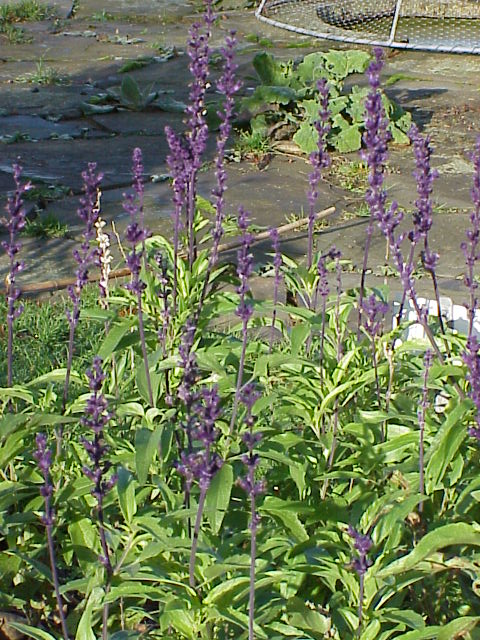
Photo: Wikimedia Commons, CC BY-SA 3.0 · source

Annual · Lamiaceae
Mealycup sage
Salvia farinacea
In other languages: Meelsalie (Nederlands) · Sauge farineuse (Français)
Mealycup sage comes from Texas, New Mexico and northern Mexico, where it grows on dry, limestone prairies and slopes. In its homeland it is a perennial, but in our climate it is not hardy and is grown as an annual. It forms an upright clump of 40–60 cm with narrow, grey-green leaves and slender spikes of small, violet-blue lipped flowers. The flower calyces and stems are covered with a white, mealy coating, which gives the plant its name. Well-known varieties are ‘Victoria’, a deep violet-blue, and ‘Strata’, with blue flowers in silvery-white calyces.
Light
Full sun
warm and bright
Moisture
Dry to normal
no wet feet
Legal basis
Sand, loam or clay
any pH
Hardiness
down to -2 °C
protect in harsh winters
Size
0.5 m
tall, 0.3 m wide
Flowering
June–October
| Height | 0.5 m |
|---|---|
| Native to Belgium | No, planted |
| Good for bees, butterflies and birds | Yes, for bees and butterflies |
| Poisonous to people and pets | Not known to be poisonous |
| Flowering | June–October |
Identify
Mealycup sage: how do you recognise it?
- Habit
- Upright, branching clump, 40–60 cm tall and 25–35 cm wide.
- Leaves
- Narrow and lance-shaped, 4–8 cm long, grey-green, with a slightly toothed edge.
- Flowers
- Small lipped flowers in slender, straight spikes of 15–20 cm, from June to October.
- Colour
- Deep violet-blue, pale blue or white; the calyces are often blue or silvery white and mealy-hairy.
- Stems
- Square, like all members of the mint family; dark blue in some varieties.
Flowering: June–October · Sowing: February–March · Plants: May
In your garden
Why grow it?
- Flowers non-stop from June until the first frost.
- Copes well with drought and heat, ideal for pots on a sunny patio.
- A magnet for bees, bumblebees and butterflies.
- Lovely as a cut flower and for drying: the spikes keep their colour.
- Its cool blue goes with almost every summer colour.
Mealycup sage: where does it grow best?
- Full sun, as warm as possible.
- Free-draining soil: sand, loam or clay with some gravel; acid, neutral or chalky.
- Dry to normally moist; it copes better with drought than with wet feet.
- Plant 25–30 cm apart; in a pot, 3 plants are enough for a 30 cm pot.
- Light
- Sun
- Soil type
- Sand, loam or clay
- Acidity
- Not fussy
- Moisture
- Dry or normal
- Size
- 0.5 m tall, 0.3 m wide
- Hardiness
- Tolerates light frost (to -2 °C)
Goes well with
Maintenance
Mealycup sage: when and how to plant it?
Plant in May.
- Sow indoors in February–March at 20–22 °C and cover the seed lightly; the seedlings grow slowly.
- Prick out the seedlings into individual pots and keep them in a bright, not too warm place.
- In May, harden the plants off for a week.
- Plant out after mid-May, when there is no more night frost, at the same depth as in the pot.
- Keep 25–30 cm between plants and water in well straight away.
- In pots, use compost mixed with some sand or perlite for good drainage.
Care
- Watering
- In the ground only in long dry spells; in pots every 2–3 days in warm weather, when the top few centimetres are dry.
- Feeding
- In pots, liquid feed for flowering plants every 2–3 weeks; in the border it is not needed.
- Spent spikes
- Cut off spent spikes above a couple of side shoots; new ones will follow.
- Picking and drying
- Cut spikes when most flowers are open and hang them upside down in a dark, dry place.
- Support
- Rarely needed; in a windy spot a few twiggy sticks can help.
Tip: Sow early indoors or buy young plants and plant out in May in a sunny spot. It copes well with drought and flowers until the frost; the spikes dry beautifully.
Mealycup sage: when to prune it?
When: No real pruning is needed. From June to October, simply cut off spent spikes.
How:
- Cut off spent spikes just above a couple of healthy leaves or side shoots.
- If the plant gets untidy in summer, shorten the longest stems by a third.
- To overwinter a plant, cut it back to 10–15 cm in October before bringing it indoors.
Propagation
- Seed
- Indoors in February–March at 20–22 °C. Germinates in 1–3 weeks. Early sowing is needed for flowers from June.
- Cuttings
- In August–September, take 8 cm cuttings from non-flowering shoots in sandy cutting compost; overwinter them frost-free in a bright place.
Mealycup sage: how does it get through the winter?
Hardy to −2 °C: protect in harsh winters.
- Not hardy: it tolerates only a few degrees of frost, to about −2 °C.
- It is usually treated as an annual and cleared after the first frost.
- A potted plant can overwinter in a bright, cool, frost-free place at 5–10 °C, with very little water.
- Easier still: take cuttings in August–September and overwinter them indoors.
Diseases and pests
- Aphids: On young shoots and flower spikes. Hose them off; ladybirds and parasitic wasps also help.
- Whitefly: Tiny white flies under the leaves, especially on plants raised indoors. Hang up yellow sticky traps and ventilate well.
- Slugs: Attack young plants after planting out. Check in the evening and pick them off.
- Root rot: The plant wilts in cold, wet soil or in a pot without drainage. Plant in a free-draining spot and never let pots stand in water.
Through the year
- February: Sow indoors at 20–22 °C.
- March: Sow indoors. Prick out seedlings.
- May: Harden off. Plant out after mid-May.
- June: Flowering starts. Cut off spent spikes.
- July: Flowering. Pick and dry. Water pots regularly.
- August: Flowering. Take cuttings.
- September: Flowering. Dry spikes for arrangements.
- October: Last flowers until the frost. Bring potted plants in to overwinter.
- November: Clear spent plants.
Use
Good for wildlife
- Bees
- Nectar and pollen for honeybees and wild bees.
- Butterflies
- Nectar for butterflies.
You and this species
Did you know?
- The name farinacea comes from the Latin ‘farina’, meal or flour, after the white coating on the calyces and stems.
- In Texas and Mexico, mealycup sage is a perennial that comes back every year; here it is too cold and wet for that.
- The genus Salvia has hundreds of species, including the common sage used in cooking.