Photo: Kurt Stüber [1], CC BY-SA 3.0 · source

Herb · Lamiaceae
Winter savory
Satureja montana
In other languages: Winterbonenkruid (Nederlands) · Sarriette des montagnes (Français)
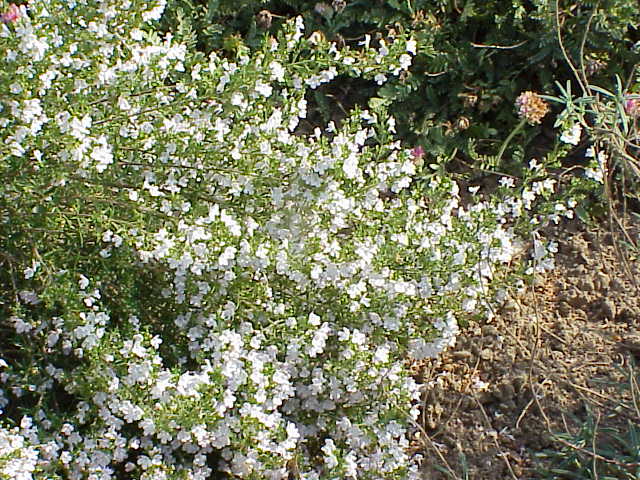
Winter savory is a low, woody-based herb from the rocky mountain slopes of southern Europe. It forms a compact little bush 20–30 cm tall with narrow, leathery, dark green leaves that smell strong and spicy. From July into September, small white to pale lilac flowers open in spikes at the shoot tips, and bees and butterflies love to visit them. Unlike annual summer savory, it is a perennial that lasts for years and keeps part of its foliage in winter. Its flavour is stronger and slightly peppery, ideal with beans, stews and pulses.
Light
Full sun
warm and bright
Moisture
Dry
tolerates drought
Legal basis
Sand, loam or clay
neutral to chalky
Hardiness
down to -15 °C
protect young plants
Size
0.3 m
tall, 0.4 m wide
Flowering
July–September
| Pruning months | April |
|---|---|
| Height | 0.3 m |
| Native to Belgium | No, planted |
| Good for bees, butterflies and birds | Yes, for bees and butterflies |
| Poisonous to people and pets | Not known to be poisonous |
| Flowering | July–September |
Identify
Winter savory: how do you recognise it?
- Habit
- A compact, rounded little bush 20–30 cm tall and 30–40 cm across, with a woody base.
- Leaves
- Narrow and lance-shaped, 1–3 cm long, leathery, glossy dark green and dotted with tiny glands full of aromatic oil.
- Flowers
- Small lipped flowers, white to pale lilac or pale pink, in loose spikes at the shoot tips, from July to September.
- Scent
- Strongly aromatic and spicy, somewhere between thyme and oregano.
- Roots
- Deep and woody; it copes well with drought but not with wet feet.
Flowering: July–September · Harvest and fruit: April–October · Sowing: March–April · Plants: April–May and September · Pruning: April
In your garden
Why grow it?
- A perennial herb: plant it once and harvest for years.
- Semi-evergreen: even in winter you can often still pick a few sprigs.
- A strong, peppery flavour for beans, peas, lentils, stews and marinades.
- A real bee and butterfly plant, flowering from July to September.
- Drought-tolerant and low-maintenance: ideal for a sunny rock garden, a herb spiral or a pot on the patio.
- Looks good as a low edging along the vegetable or herb garden.
Winter savory: where does it grow best?
- Full sun: the more sun, the stronger the flavour.
- Poor, free-draining soil: sand, loam or chalky clay lightened with grit; it is perfectly happy with lime.
- Dry; in winter especially, the soil must not stay wet.
- Allow 30–40 cm per plant; 25–30 cm as an edging.
- Also does well in a well-drained pot or container.
- Light
- Sun
- Soil type
- Sand, loam or clay
- Acidity
- Neutral or chalky
- Moisture
- Dry
- Size
- 0.3 m tall, 0.4 m wide
- Hardiness
- Hardy (to -15 °C)
Goes well with
- Thyme: The same dry, sunny spot, and a bee plant too.
- Lavender: Purple flowers and grey foliage beside the dark green.
- Sage: Another hardy kitchen herb for poor, dry soil.
- Oregano: Flowers at the same time and also draws plenty of butterflies.
- Beans: In the vegetable garden: the herb you need right at harvest time.
Maintenance
Winter savory: when and how to plant it?
Plant in April–May and September.
- Plant in April–May or in September, so it is well established before winter.
- Dig a hole slightly larger than the root ball; on heavy soil, mix in plenty of coarse sand or fine gravel.
- Set the plant at the same depth as in the pot and firm the soil.
- Leave 30–40 cm between plants.
- Water at planting, then only in prolonged dry spells. Mulch with gravel if you like, not with compost.
Care
- Watering
- Little: only in dry spells during the first year. After that it copes on its own, except in a pot.
- Feeding
- Not needed: on rich soil it grows soft and loses flavour.
- Harvesting
- Pick young tips all season. For the strongest flavour harvest just before flowering; to dry, hang bunches upside down in an airy, dark place.
- Faded flowers
- Leave them until spring and remove them when you prune.
- Renewing
- After 4–5 years it becomes woody and bare; take cuttings then and replace the old plant.
- In pots
- Use herb compost with extra grit in a pot with a drainage hole; water when the compost is dry.
Tip: For the kitchen, harvest just before flowering, when the flavour is strongest. Never cut away more than a third of the plant at once, so it stays nice and bushy.
Winter savory: when to prune it?
Pruning months: April.
When: In April, as new growth begins. Do not prune in late summer or autumn, as young shoots are then vulnerable to frost.
How:
- Cut the plant back lightly, by about a third, to keep it compact.
- Do not cut into old, bare wood: it struggles to regrow from there.
- Remove frost-damaged or dead shoots back to healthy green growth.
- Regular harvesting keeps the plant naturally bushy.
Caution: Never prune hard into old wood: a plant cut back to bare stems often fails to regrow.
Propagation
- Sowing
- In March–April, sow indoors on moist seed compost. The seed needs light to germinate: sow on the surface, press in and do not cover. Plant out the young plants in May.
- Cuttings
- From May to July, take 5–8 cm cuttings from non-flowering shoots, strip the lower leaves and insert them in sandy cutting compost. They root within a few weeks.
- Layering
- In spring or summer, peg a low branch down to the soil and cover it with a little earth; sever it after a few months.
Winter savory: how does it get through the winter?
Hardy to −15 °C: protect young plants.
- Hardy to about −15 °C: in most Belgian winters it survives without protection if the soil drains well.
- Winter wet is a greater danger than frost: make sure drainage is good.
- In severe frost you can cover it with conifer branches or horticultural fleece.
- In a pot: stand it against a sheltered wall, dry under an overhang, and wrap the pot in hessian.
Diseases and pests
- Root rot: The plant wilts and turns brown, often after a wet winter. Move it to a drier spot or a raised bed with grit.
- Bare and woody: Older plants go bare at the base. Prune lightly every spring and replace the plant with a cutting after a few years.
- Little flavour: Too little sun or too rich a soil. Move it to a sunnier spot and do not feed.
- Aphids: Sometimes on young shoots in spring. A jet of water is usually enough.
Through the year
- March: Sow indoors.
- April: Cut back lightly. Plant. Sow indoors.
- May: Plant. Plant out young plants. Take cuttings.
- June: Harvest young tips. Take cuttings.
- July: Harvest for drying, ideally just before flowering. Flowering begins.
- August: Flowering: bees and butterflies visit the flowers. Harvest.
- September: Last flowers. Plant.
- November: Avoid winter wet: move pots to a dry, sheltered spot.
- December: Rest. Cover in severe frost.
Use
Edible and useful
- Leaves (April–October)
- Winter savory is a perennial, semi-evergreen herb: you can cut sprigs from April to October, best just before flowering in July. Do not cut into the old, bare wood. It is stronger and slightly more bitter than summer savory, so use it sparingly in stews, beans, lentils, marinades and with lamb and game.
- Storing
- In July, cut a few extra sprigs and dry them in bunches, hung upside down somewhere airy and dark. Strip off the leaves and keep them in a closed jar for up to a year. As the plant keeps its leaves in winter, you can carry on picking it fresh in mild winters.
Caution: In normal kitchen amounts, winter savory is safe; never swallow the essential oil. During pregnancy do not drink large amounts of the tea. On wet, heavy soil the plant rots in winter: it wants sun and dry, poor soil.
Eating and using is at your own risk: see the terms of use.
Recipes
- Lentil stew with winter savory (Dish · 4 people · 50 min)
- Herb salt with winter savory (Dried · ± 150 g · 15 min + 1 day drying)
Good for wildlife
- Bees
- Nectar and pollen for honeybees and wild bees.
- Butterflies
- Nectar for butterflies.
You and this species
Did you know?
- In Provence it is called poivre d’âne, ‘donkey’s pepper’, and it is one of the classic herbs of Provençal cooking.
- Summer savory is a close annual relative that has to be sown every year; winter savory is a perennial that lasts for years.
- Its spicy scent comes mainly from carvacrol, the same aromatic compound found in oregano and thyme.