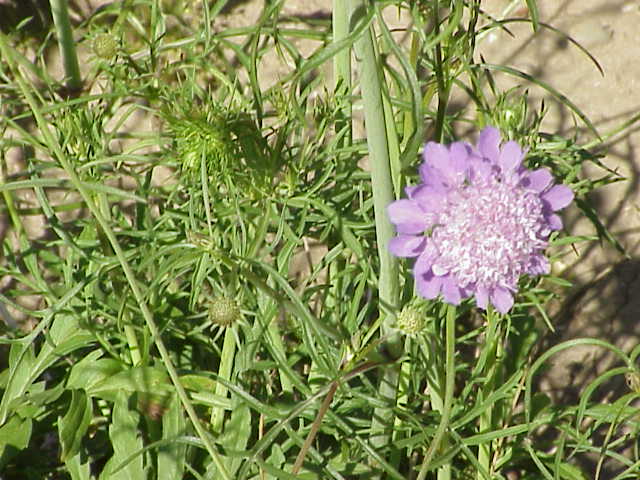
Photo: Kurt Stüber [1], CC BY-SA 3.0 · source

Perennial · Caprifoliaceae
Small scabious
Scabiosa columbaria
In other languages: Duifkruid (Nederlands) · Scabieuse colombaire (Français)
Small scabious is a native perennial of dry, chalky grassland; in Belgium it grows mainly on limestone slopes in the south of the country, and it is also found elsewhere in Europe. It is a graceful, fairly low plant with finely cut, grey-green leaves and thin stems about 50 cm tall. From June to October each stem carries a domed flower head 2–3 cm across in soft lilac, like a pincushion. Gardeners love its long flowering season and the many butterflies and bees it attracts; in a dry, sunny spot it is also very little work. Compact cultivars such as ‘Butterfly Blue’ and ‘Pink Mist’ are often sold under this name.
Light
Full sun
warm and bright
Moisture
Dry
tolerates drought
Legal basis
Sand, loam or clay
neutral to chalky
Hardiness
Fully hardy
down to -25 °C
Size
0.5 m
tall, 0.3 m wide
Flowering
June–October
| Pruning months | March and June–September |
|---|---|
| Height | 0.5 m |
| Native to Belgium | Yes |
| Good for bees, butterflies and birds | Yes, for bees and butterflies |
| Poisonous to people and pets | Not known to be poisonous |
| Flowering | June–October |
Identify
Small scabious: how do you recognise it?
- Habit
- Loose clump 30–50 cm tall and about 30 cm wide, with thin, branched flower stems.
- Leaves
- Rosette leaves lobed to cut, stem leaves finely divided; grey-green and slightly hairy.
- Flower
- Domed heads 2–3 cm across, packed with tiny tubular flowers; the outer ones are larger and form a collar.
- Colour
- Soft lilac to blue-violet; also pink in some cultivars.
- Fruit
- Round seed heads with fine bristles that remain after flowering.
Flowering: June–October · Sowing: March–May · Plants: March–May and September · Pruning: March and June–September
In your garden
Why grow it?
- Flowers for almost five months, from June to October, if you deadhead.
- A favourite with butterflies, bees and bumblebees.
- Native and drought-tolerant: ideal for a sunny rock garden, gravel garden or dry flower meadow.
- Compact and graceful: also suits the front of the border or a pot.
- The round seed heads are decorative after flowering too.
Small scabious: where does it grow best?
- Full sun: in shade it hardly flowers and flops.
- Sand, loam or chalky clay, neutral to alkaline and above all well drained.
- Dry soil: it cannot stand wet feet in winter.
- Plant 25–30 cm apart, about ten plants per m².
- Light
- Sun
- Soil type
- Sand, loam or clay
- Acidity
- Neutral or chalky
- Moisture
- Dry
- Size
- 0.5 m tall, 0.3 m wide
- Hardiness
- Hardy (to -25 °C)
Goes well with
- Wild marjoram: Native, fragrant and also loved by butterflies, for the same dry, chalky soil.
- Common knapweed: Purple flower heads in a dry flower meadow.
- Lady’s bedstraw: Fragrant yellow sprays, native and drought-tolerant.
- Catmint: A long-flowering blue edging in the sun.
- Feather grass: Fine, swaying grass around the lilac heads.
Maintenance
Small scabious: when and how to plant it?
Plant in March–May and September.
- Plant from March to May or in September, when the soil is not too wet.
- Dig a hole twice as wide as the pot. On heavy soil, mix in coarse sand or fine gravel.
- On acid soil, a handful of lime or limestone grit in the planting hole helps.
- Set the plant at the same depth as it was in the pot: the crown must not be buried.
- Water in moderately; after that only in prolonged dry spells.
- Mulch with gravel, not compost: it keeps the crown dry.
Care
- Water
- Rarely needed once established; regularly in pots.
- Feeding
- Not needed: it flowers best on poor soil.
- Deadheading
- Regularly cut faded heads back to a leaf or side bud: it will keep flowering into October.
- Seed
- Late in summer, let a few heads set seed: the plant is short-lived, but seedlings take over.
- Pots
- In a pot, use gritty compost with a layer of gravel at the bottom.
Tip: Deadhead regularly and give it a dry, sunny spot with chalky, well-drained soil: it will then flower from June into October.
Small scabious: when to prune it?
Pruning months: March and June–September.
When: From June to September, deadhead regularly. In March, clear away the old stems and dead leaves.
How:
- Cut a faded head off with its stem, back to a leaf or a new bud.
- In September, let a few heads ripen if you want seed or seedlings.
- In March, cut the old stems back to just above the leaf rosette.
Caution: Do not cut right down to the ground in autumn: the leaf rosette protects the crown in winter.
Propagation
- Seed
- Indoors in March, or outdoors in April–May. Barely cover the seed and keep it lightly moist; it germinates within a few weeks. Plant out once the seedlings are sturdy.
- Cuttings
- In April–May, take cuttings of young shoots from the base and root them in sandy cutting compost.
Small scabious: how does it get through the winter?
Hardy to −25 °C.
- Hardy to about −25 °C: no problem in Belgium, provided the soil is well drained.
- Wet winters are more dangerous than frost: in wet soil it rots away.
- In a pot: stand it under cover in winter so the compost does not become waterlogged.
Diseases and pests
- Root rot: The plant rots away in winter on wet, heavy soil. Improve drainage or plant it on a raised spot.
- Powdery mildew: White powder on the leaves in dry late summers. Not very harmful: remove affected leaves.
- Slugs: They eat young plants in spring. Pick them off in the evening.
- Short life: After a few years it weakens. Keep some seedlings or sow again.
Through the year
- March: Cut down old stems. Sow indoors. Plant.
- April: Sow outdoors. Plant. Take cuttings.
- May: Sow outdoors. Plant.
- June: Flowering begins. Deadhead.
- July: In flower. Deadhead.
- August: In flower. Deadhead.
- September: In flower. Let a few heads ripen. Plant.
- October: Last flowers. Leave the seed heads.
Use
Good for wildlife
- Bees
- Nectar and pollen for honeybees and wild bees.
- Butterflies
- Nectar for butterflies.
You and this species
Did you know?
- Columbaria comes from the Latin columba, dove; the Dutch name ‘duifkruid’, dove herb, is a literal translation.
- The name Scabiosa comes from the Latin scabies, itch: people once believed the plant helped against skin complaints.
- A flower head is made up of dozens of tiny flowers; the outer ones are larger and face outwards, so the whole looks like a single large flower.