Photo: 三上 勝生, CC BY-SA 2.1 jp · source

Climber · Schisandraceae
Chinese magnolia vine
Schisandra chinensis
In other languages: Schisandra (Nederlands) · Schisandra (Français)
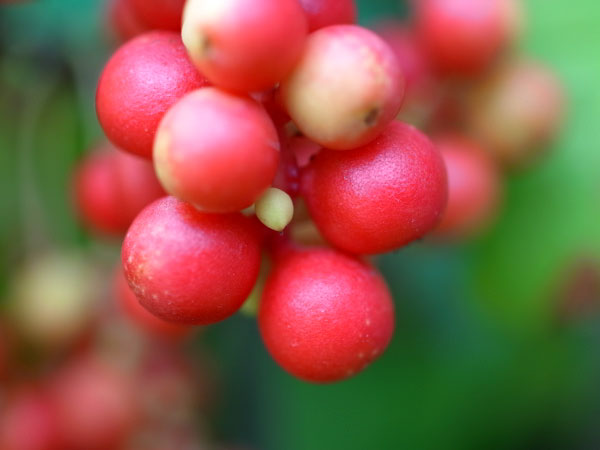
Schisandra is a vigorous, deciduous twining climber from the forests of northern China, Korea, the Russian Far East and Japan. Its stems wind their way up to about 6 m around a post, wire or tree. The leaves are oval and glossy and smell of lemon when crushed. In April–May small, waxy, creamy-white to pale pink flowers hang on long stalks, with a gentle scent. On female plants, long, hanging clusters of bright red berries follow in late summer, with an unusual flavour that is sour, sweet, salty, bitter and pungent all at once. It is fully hardy and one of the few climbers with edible fruit for partial shade.
Light
Partial shade or shade
tolerates little sun
Moisture
Normal
no wet feet
Legal basis
Sand or loam
acid to neutral
Hardiness
Fully hardy
down to -30 °C
Size
6 m
tall, 2 m wide
Flowering
April–May
| Pruning months | February–March and July |
|---|---|
| Height | 6 m |
| Native to Belgium | No, planted |
| Poisonous to people and pets | Not known to be poisonous |
| Flowering | April–May |
Identify
Chinese magnolia vine: how do you recognise it?
- Habit
- Deciduous twining climber about 6 m tall and 1.5–2 m wide. The stems twine around a support.
- Leaves
- Oval to elliptic, 5–10 cm, glossy green with a finely toothed edge; smells of lemon when crushed.
- Flowers
- Small, waxy and cup-shaped, creamy white to pale pink and gently fragrant, on long stalks in April–May. Male and female flowers usually grow on separate plants.
- Fruit
- Long, hanging clusters of small, glossy red berries, ripe in August–September.
- Roots
- Shallow and branched; they like a cool, moist root run.
Flowering: April–May · Harvest and fruit: August–September · Plants: March–April and October · Pruning: February–March and July
In your garden
Why grow it?
- An elegant climber for partial and full shade, with fragrant flowers in spring.
- Clusters of red berries in late summer, lovely to look at and good in juice, syrup or tea.
- Fully hardy, to about −30 °C.
- Takes up little ground space: ideal for a pergola, a fence or an old tree trunk.
- An unusual plant you rarely see, and the flavour of the berries surprises everyone.
Chinese magnolia vine: where does it grow best?
- Partial or light shade; ideally the roots in shade while the top gets some sun. Full midday sun scorches the leaves.
- Humus-rich, open soil: sand or loam, acid to neutral. It dislikes chalky or heavy, wet soil.
- Moderately moist: the soil must never dry out for long.
- Provide a sturdy post, wires or a pergola to twine around.
- For fruit, plant a male and a female plant 1.5–2 m apart.
- Light
- Partial shade and shade
- Soil type
- Sand or loam
- Acidity
- Acid or neutral
- Moisture
- Normal
- Size
- 6 m tall, 2 m wide
- Hardiness
- Hardy (to -30 °C)
Goes well with
- Hardy kiwi: Another hardy climber with edible fruit, which usually also needs male and female plants.
- Climbing hydrangea: A self-clinging climber for the same partial shade, with white flower heads in June.
- Ferns: A cool, green root run in the shade.
- Rhododendron: Likes the same acid, humus-rich soil.
- Hosta: Large leaves that keep the roots cool and shaded.
Maintenance
Chinese magnolia vine: when and how to plant it?
Plant in March–April and October.
- Plant in March–April or in October, when the soil is neither frozen nor waterlogged.
- Dig a generous hole and mix in plenty of leaf mould or compost.
- Set the plant at the same depth as in the pot, close to the support, and guide the stems towards it.
- Plant male and female plants 1.5–2 m apart.
- Water in well, even if it is raining.
- Apply a thick mulch of leaf mould or wood chips to keep the roots cool and moist.
Care
- Watering
- Regularly in the first year; after that in dry weather, as it cannot stand drying out.
- Feeding
- A layer of compost or leaf mould in March.
- Mulching
- A thick layer of leaf mould or wood chips over the roots every spring.
- Support
- Guide young stems around the support in spring; after that they twine by themselves.
- Harvesting
- Pick the clusters in August–September when the berries are bright red and soft.
- In the kitchen
- The berries are very sour with an unusual flavour: use them in juice, syrup, tea or jelly, or dry them. In Korea they are made into a refreshing pink drink.
Tip: Let it twine up an old tree or a post in partial shade and keep the roots cool with a thick mulch of leaf mould. Plant a male and a female plant together for berries.
Chinese magnolia vine: when to prune it?
Pruning months: February–March and July.
When: In February–March, before it comes into leaf. Pruning is not strictly necessary, but it keeps the plant in check.
How:
- Remove dead, weak and tangled stems.
- Shorten over-long side shoots to a few buds.
- Cut out old stems that hardly flower any more at the base.
- In summer, shorten shoots that reach too far.
Propagation
- Cuttings
- In June–July, take semi-ripe cuttings 10–15 cm long and insert them in moist cutting compost under plastic.
- Layering
- In spring, peg a low stem into the soil; after a year, sever it.
- Seed
- Sow fresh seed in a pot outdoors in autumn; it needs a cold spell and germinates slowly and unevenly. You will only know the sex of a seedling after several years.
Chinese magnolia vine: how does it get through the winter?
Hardy to −30 °C.
- Fully hardy, to about −30 °C: no protection is needed in Belgium.
- Young shoots can be frosted by a late night frost in April; they usually regrow.
- In a pot: stand it against a wall and keep the compost lightly moist, in winter too.
Diseases and pests
- No fruit: There is only a male or only a female plant. Plant one of the other sex nearby.
- Scorched leaves: Brown leaf edges in full sun or during drought. Shade the roots and water.
- Yellow leaves: Yellow leaves with green veins on chalky soil. Mulch with leaf mould and use rainwater.
- Slugs: Eat young shoots at the base in spring. Pick them off in the evening.
- Slow start: It grows slowly for the first few years; after that it speeds up. Patience and a moist root run.
Through the year
- February: Prune: remove dead and tangled stems, shorten side shoots.
- March: Plant. Spread compost and mulch.
- April: Plant. Flowering begins. Guide young stems around the support.
- May: Flowering; the flowers are fragrant. Water in dry weather.
- June: Water in dry weather. Top up the mulch.
- July: Take cuttings. Shorten over-long shoots.
- August: Berries turn red. Pick the first clusters.
- September: Harvest. Make juice or syrup.
- October: Plant. Sow seed outdoors.
Use
Edible and useful
- Berries (August–September)
- For berries you usually need a female and a male plant: only the female bears fruit. Pick the hanging clusters in August and September, when the berries are bright red and soft. Raw, they taste very sour and at the same time a little sweet, salty, bitter and pungent: in Chinese they are called the fruit of five flavours. Eat only a few fresh; usually you make a syrup or a cold drink, or dry them. To dry, spread the berries in a single layer on a rack in a warm, airy place, or in the oven at 40–50 °C with the door ajar, until they are hard and dark red. In Korea, dried berries are steeped overnight in cold water: that gives a refreshing pink drink.
- Storing
- Fresh berries keep for a few days in the fridge. Dried berries keep for a year in a closed jar, somewhere cool and dark. The syrup keeps for six months in the fridge.
Caution: Use schisandra in moderation, as a fruit for a drink or a dash of syrup, and not in large amounts every day: too much can upset your stomach. Not during pregnancy or breastfeeding, and not for young children. If you take medication, ask your doctor or pharmacist first, as schisandra can affect how some medicines work. Do not chew the seeds: they are bitter.
Eating and using is at your own risk: see the terms of use.
Recipes
- Schisandra syrup (Syrup · ± 500 ml · 20 min + 6 weeks)
- Cold schisandra drink (omija-cha) (Tea · 4 glasses · 10 min + 12 hrs steeping)
You and this species
Did you know?
- In Chinese the berry is called wuweizi, ‘five-flavour fruit’, because it tastes sweet, sour, salty, bitter and pungent at once.
- In Russian it is called limonnik, after the lemon scent of its leaves and stems.
- It belongs to an ancient plant family that also includes star anise.