Photo: Wikimedia Commons, Public domain · source

Houseplant · Cactaceae
Easter cactus
Schlumbergera gaertneri
In other languages: Paascactus (Nederlands) · Cactus de Pâques (Français)
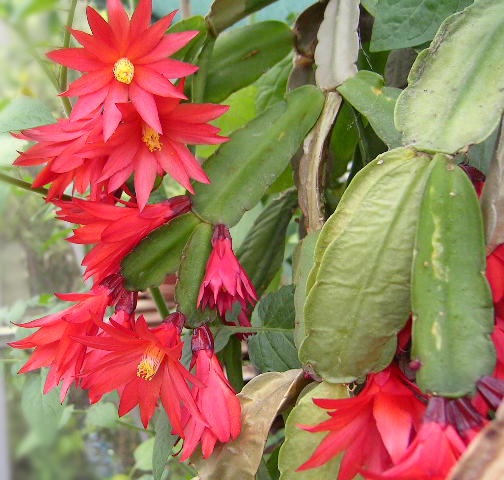
The Easter cactus comes from the mountain forests of south-eastern Brazil, where it grows as an epiphyte on trees, just like its well-known relative the Christmas cactus. It has flat, jointed stems made up of short green segments with fine bristles at their tips. In April and May star-shaped flowers in red, pink, orange, lilac or white appear at the ends of the segments. Growers like it because it flowers freely every spring and easily lives for many years. In the trade it is also sold under its older names, Hatiora gaertneri or Rhipsalidopsis gaertneri.
Light
Partial shade
no harsh midday sun
Moisture
Normal
no wet feet
Legal basis
Potting soil
Hardiness
Houseplant
min. 10 °C
Size
0.3 m
tall, 0.4 m wide
Flowering
April–May
| Pruning months | May–June |
|---|---|
| Height | 0.3 m |
| Poisonous to people and pets | Not known to be poisonous |
| Flowering | April–May |
Identify
Easter cactus: how do you recognise it?
- Habit
- Bushy and later trailing, 20–30 cm tall and up to 40 cm wide.
- Stems
- Flat, jointed segments with rounded edges and fine brown bristles at the tips; no real spines.
- Flower
- Star-shaped, symmetrical and wide open, at the tips of the segments.
- Colour
- Red, pink, orange, lilac or white.
- Roots
- Fine and fairly shallow, sensitive to wet feet.
Flowering: April–May · Plants: May–June · Pruning: May–June
In your garden
Why grow it?
- Generous flowering in April and May, with star-shaped flowers in bright colours.
- Lives for many years and flowers again every year.
- A cactus for partial shade: no fierce sun needed.
- Attractive in a hanging pot or on a high shelf, where the segments arch over.
- Easy to propagate from a few stem segments.
Easter cactus: where does it grow best?
- Bright light to partial shade out of fierce midday sun: an east- or west-facing window is ideal.
- Room temperature from March to October; cool from November to February, 10–15 °C.
- In summer it can go outside in a sheltered, partly shaded spot, from June to September; bring it in before nights drop below 10 °C.
- Choose a permanent spot: once it has buds, do not turn or move it any more.
- Light
- Bright, out of direct sun
- Potting soil
- Multi-purpose compost or airy, humus-rich compost
- Acidity
- Acid or neutral
- Watering
- Moderately
- Size
- 0.3 m tall, 0.4 m wide
- Temperature
- Minimum 10 °C
Goes well with
- Christmas cactus: Its relative that flowers in winter; together you get two flowering seasons.
- Mistletoe cactus: Also an epiphytic rainforest cactus, for the same partial shade.
- Hoya: A trailing plant with fragrant flowers in summer, after the Easter cactus.
- Peperomia: A compact foliage plant for the same bright spot out of fierce sun.
Maintenance
Easter cactus: when and how to plant it?
Plant in May–June.
- Repot in May–June, after flowering, every 2–3 years.
- Choose a pot only 2–3 cm wider than the old one, with a drainage hole: it likes to flower slightly pot-bound.
- Use an open, slightly acid mix: potting compost with a third orchid bark or perlite. Pure cactus compost is too poor and too dry.
- Set the plant at the same depth as before and firm lightly.
- Wait a few days after repotting before watering, and then water moderately.
Care
- Water
- From March to October keep the compost lightly moist, but let the surface dry out between waterings. Never leave water in the saucer.
- Rest period
- From November to February cool (10–15 °C) and fairly dry: give just enough water to keep the segments from shrivelling. This is how it sets buds.
- Feeding
- From May to August, feed for flowering houseplants at half strength every 2–3 weeks.
- Buds
- Do not turn or move the plant once it has buds, or they will drop.
- Humidity
- As an epiphyte it likes slightly humid air; do not put it above a radiator.
Tip: Keep it cool (10–15 °C) and fairly dry from November to February, and it will set buds. Do not turn or move the plant once it has buds, or they will drop.
Easter cactus: when to prune it?
Pruning months: May–June.
When: After flowering, in May–June, if you want to shape the plant or make it bushier.
How:
- Twist off overlong or lopsided stems at a joint with a gentle turn; no knife is needed.
- Remove a few segments per stem: it will branch there and give more flowers next year.
- Use the twisted-off segments as cuttings.
- Remove shrivelled or damaged segments.
Caution: Do not prune in autumn or winter: that is when the buds form at the tips of the segments.
Propagation
- Stem cuttings
- In May–June, twist off pieces of 2–3 segments, let them dry for a day and set them upright, a centimetre deep, in slightly moist cutting compost. They root in 3–4 weeks; put several together in one pot for a full plant.
Easter cactus: how does it get through the winter?
- Keep it indoors except in summer: it does not tolerate frost and suffers below 10 °C.
- From November to February cool (10–15 °C) and fairly dry: this is needed for flowering.
- Keep it in the light, for example in a cool bedroom or an unheated room that stays above 10 °C.
- From late February, gradually warmer and a little more water: the buds then swell.
Diseases and pests
- Bud drop: The buds fall because of moving, turning, draughts, drought or a sudden change in temperature. Leave the plant where it is and keep the compost lightly moist.
- No flowers: No cool, dry rest in winter. Keep it at 10–15 °C from November to February.
- Root rot: Limp, discoloured segments and wet compost. Water less and repot in an open mix; take the healthy segments as cuttings.
- Mealybug: White, woolly tufts between the segments. Remove them with a cotton bud dipped in a little alcohol.
- Red segments: Segments turning red from too much sun or cold. Move it somewhere a little shadier or warmer.
Through the year
- January: Rest: cool (10–15 °C) and fairly dry.
- February: Rest. In late February, gradually move somewhere warmer.
- March: Buds appear. A little more water. Do not turn or move it any more.
- April: Flowering. Keep the compost lightly moist.
- May: Flowering. After flowering, repot, shape and take cuttings.
- June: Repot or take cuttings. Feed. Move outside into partial shade if you like.
- July: Feed. Keep lightly moist.
- August: Last feed of the year.
- September: Bring in before nights drop below 10 °C.
- October: Water less.
- November: Start of the cool, dry rest.
- December: Rest at 10–15 °C. Very little water.
You and this species
Did you know?
- Unlike the Christmas cactus, the Easter cactus has symmetrical, star-shaped flowers and bristles at the tips of its segments: that is how you tell them apart even without flowers.
- Although it is a cactus, in the wild it does not grow in the desert, but on tree branches in humid mountain forests.
- Botanists have moved it between genera several times: Rhipsalidopsis, Hatiora and recently back to Schlumbergera, the genus of the Christmas cactus.