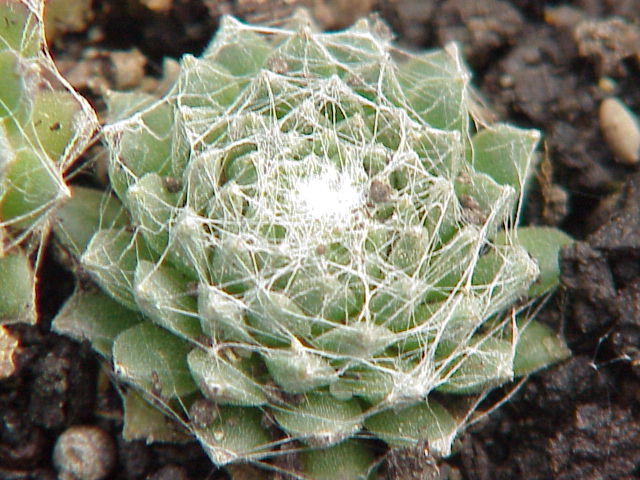
Photo: Kurt Stüber [1], CC BY-SA 3.0 · source

Perennial · Crassulaceae
Cobweb houseleek
Sempervivum arachnoideum
In other languages: Spinnenwebhuislook (Nederlands) · Joubarbe aranéeuse (Français)
The cobweb houseleek is a small succulent from the mountains of southern Europe: the Alps, the Pyrenees, the Apennines and the Carpathians. It forms tight cushions of rosettes 1–3 cm across, with the leaf tips joined by fine white hairs, as if a spider had spun a web over them. In summer, bright pinkish-red starry flowers appear on fleshy stems 5–10 cm tall, and bees visit them eagerly. It is very hardy, copes with drought and needs almost no care. Ideal for a trough, a rock garden, the top of a wall or a shallow bowl of gravel.
Light
Full sun
warm and bright
Moisture
Dry
tolerates drought
Legal basis
Sand or loam
acid to neutral
Hardiness
Fully hardy
down to -30 °C
Size
0.1 m
tall, 0.3 m wide
Flowering
June–August
| Height | 0.1 m |
|---|---|
| Native to Belgium | No, planted |
| Good for bees, butterflies and birds | Yes, for bees |
| Poisonous to people and pets | Not known to be poisonous |
| Flowering | June–August |
Identify
Cobweb houseleek: how do you recognise it?
- Habit
- Low, dense cushion of rosettes; 5–10 cm tall including the flower stems and up to 30 cm wide.
- Leaves
- Fleshy, pointed little leaves in rosettes 1–3 cm across, green to reddish, with white hairs between the tips.
- Flower
- Bright pinkish-red stars on fleshy stems, from June to August.
- Growth
- Each rosette dies after flowering, but first makes small offsets on short runners.
- Roots
- Small and shallow; they cannot stand wet feet.
Flowering: June–August · Plants: March–September
In your garden
Why grow it?
- Attractive all year: the grey-green rosettes with their white ‘cobweb’ stay put even in winter.
- Flowers from June to August with pink starry flowers that attract bees.
- Very drought tolerant: perfect for a trough, bowl, wall or green roof where little else will grow.
- Forms a dense carpet of large and small rosettes all by itself.
- Hardly any work: no pruning, no feeding and almost no watering.
Cobweb houseleek: where does it grow best?
- Full sun: the more light, the more compact the rosettes and the whiter the cobweb.
- Poor, very free-draining soil: sand or loam with plenty of grit, acid to neutral.
- Dry: in wet soil or a saucer of water, the rosettes rot away.
- Sheltered from wet winters, for example under the eaves, on a wall or in a bowl that is slightly tilted.
- Plant 10–15 cm apart; the rosettes soon grow together.
- Light
- Sun
- Soil type
- Sand or loam
- Acidity
- Acid or neutral
- Moisture
- Dry
- Size
- 0.1 m tall, 0.3 m wide
- Hardiness
- Hardy (to -30 °C)
Goes well with
- Stonecrop: Another succulent that needs just as little water and flowers later in summer.
- Creeping thyme: Fragrant cushions between the rosettes, also good for bees.
- Saxifrage: Small alpines that fill a trough nicely together with houseleeks.
- Cheddar pink: Grey foliage and scented pink flowers in the same dry, sunny spot.
- Thrift: Round cushions with pink pompoms; it also likes sun and poor soil.
Maintenance
Cobweb houseleek: when and how to plant it?
Plant in March–September.
- Plant between March and September, preferably in spring, so the roots are well anchored before winter.
- Mix potting compost or garden soil half and half with grit or coarse sand; a pot or bowl must have a drainage hole.
- Set the rosette so that its heart stays just above the soil and firm it in gently.
- Leave 10–15 cm between plants.
- Give a very little water to settle the soil, then let it dry out again.
- Spread a thin layer of fine grit around the rosettes to keep them dry and clean.
Care
- Watering
- In the garden almost never needed. In a pot only during long droughts, and only once the compost is completely dry.
- Feeding
- Not needed; fertiliser makes the rosettes soft and less colourful.
- Spent rosettes
- The rosette that flowered dies: twist or cut it out with its flower stem and fill the gap with a little grit.
- Fallen leaves
- Remove fallen leaves in autumn; under a wet layer of leaves the rosettes rot.
- Repotting
- Every 3–4 years, when the bowl is overcrowded: split the rosettes and replant them in a fresh, gritty mix.
Tip: Never leave the rosettes standing in a saucer of water: put the pot on pot feet or on gravel so the water can always drain away. A thin layer of grit keeps the heart of the rosettes dry.
Cobweb houseleek: when to prune it?
When: Cobweb houseleek needs no pruning. After flowering, simply tidy away the spent rosettes.
How:
- After flowering, cut off the dried flower stems together with the dead rosette.
- In spring, remove any dead or rotten rosettes.
- If the bowl gets too full, take out a few rosettes and plant them elsewhere.
Propagation
- Offsets
- From April to September: detach a young offset and lay it on dry, gritty compost. It roots within a few weeks, even if it has no roots yet.
- Seed
- Possible in spring, but seedlings often look unlike the parent, because houseleeks cross easily.
Cobweb houseleek: how does it get through the winter?
Hardy to −30 °C.
- Very hardy, to about −30 °C: frost is never the problem, wet soil is.
- In winter, move pots and bowls under cover or against a wall, out of the rain.
- Remove fallen leaves from the rosettes so no wet layer stays on top of them.
- No covering needed: leaves or fleece only hold moisture in.
Diseases and pests
- Rot: Rosettes turn soft, brown or black, mainly in winter. Cause: soil that is too wet. Remove rotten rosettes and replant the rest in a grittier mix.
- Vine weevil: The grubs eat the roots, after which the rosettes come loose. Mainly in pots. Repot, pick out the white grubs and, if needed, use nematodes against them.
- Birds: Blackbirds pull rosettes out while hunting for insects. Press them back in; a layer of grit helps.
- Soft, stretched rosettes: Too little light or too much fertiliser. Move the plant into full sun and stop feeding.
Through the year
- March: Remove dead or rotten rosettes. Top up the grit.
- April: Planting. Detach and replant offsets.
- May: Planting. Move pots into full sun.
- June: The first flower stems appear.
- July: Flowering. Water pots only in long dry spells.
- August: Remove spent rosettes with their stems.
- September: Last planting and replanting of offsets.
- October: Clear fallen leaves off the rosettes.
- November: Move pots and bowls out of the rain.
- December: Rest. Keep the rosettes dry.
Use
Good for wildlife
- Bees
- Nectar and pollen for honeybees and wild bees.
You and this species
Did you know?
- Each rosette flowers only once and then dies. By then it has made a ring of small offsets that take its place.
- The name Sempervivum means ‘always alive’: the plant stays green all year and survives both frost and drought.
- Charlemagne decreed in one of his ordinances that the gardener should have houseleeks growing on his house. People believed they protected against lightning.