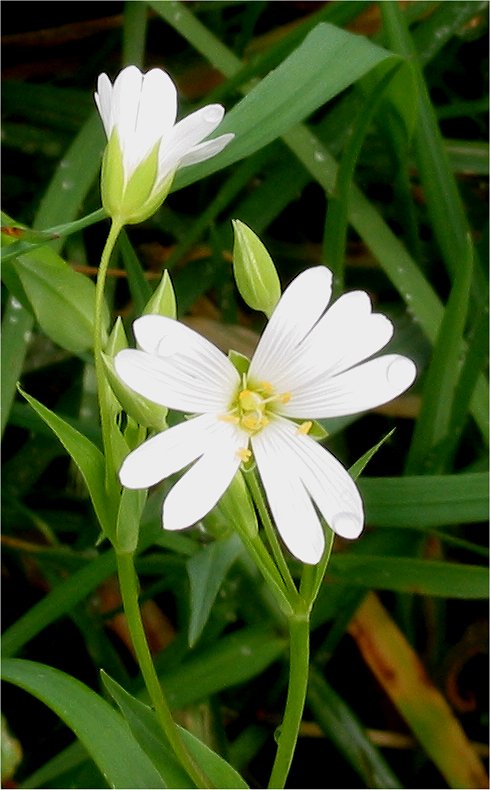
Photo: Rasbak, CC BY-SA 3.0 · source

Perennial · Caryophyllaceae
Greater stitchwort
Stellaria holostea
In other languages: Grootbloemmuur (Nederlands) · Stellaire holostée (Français)
Greater stitchwort is a native perennial of hedge banks, hedgerows, verges and woodland edges across most of Europe. From April to June it covers the foot of a hedge with bright white starry flowers 2–3 cm across, on thin, square stems 15–30 cm tall. The stems are weak and brittle: it leans on its neighbours and weaves between grasses and low shrubs. With short rhizomes it forms loose green mats. Gardeners value it as an easy, natural underplanting for partial shade that brings light early in the year and feeds bees and hoverflies.
Light
Partial shade or shade
tolerates little sun
Moisture
Normal
no wet feet
Legal basis
Sand, loam or clay
any pH
Hardiness
Fully hardy
down to -30 °C
Size
0.3 m
tall, 0.4 m wide
Flowering
April–June
| Pruning months | March and July |
|---|---|
| Height | 0.3 m |
| Native to Belgium | Yes |
| Good for bees, butterflies and birds | Yes, for bees |
| Poisonous to people and pets | Not known to be poisonous |
| Flowering | April–June |
Identify
Greater stitchwort: how do you recognise it?
- Habit
- Loose, creeping to leaning mat 15–30 cm tall and about 40 cm wide, with thin, square, brittle stems.
- Leaves
- Narrow and lance-shaped, 4–8 cm, stalkless with a rough edge, in opposite pairs; greyish green.
- Flower
- White, 2–3 cm across, with five petals split to halfway, so they seem to be ten. Flowers from April to June.
- Fruit
- A rounded capsule that splits open and scatters the seeds.
- Roots
- Short, creeping rhizomes with which it spreads gently.
Flowering: April–June · Plants: March–April and September–October · Pruning: March and July
In your garden
Why grow it?
- One of the loveliest white spring flowers of the hedge bank, from April to June.
- Brings light to partial and full shade, at the foot of a hedge or under shrubs.
- Native and useful for bees, hoverflies and other early insects.
- Weaves loosely between other plants and fills bare patches without smothering them.
- Little work: no feeding, no staking and hardly any cutting back.
Greater stitchwort: where does it grow best?
- Partial to light shade, such as at the foot of a hedge, on a woodland edge or under tall shrubs.
- Sand, loam or clay, acid to chalky; preferably with some humus from fallen leaves.
- Normally moist soil; in full sun on dry soil it shrivels in summer.
- Plant 30–40 cm apart, among other plants it can lean on.
- Light
- Partial shade and shade
- Soil type
- Sand, loam or clay
- Acidity
- Not fussy
- Moisture
- Normal
- Size
- 0.3 m tall, 0.4 m wide
- Hardiness
- Hardy (to -30 °C)
Goes well with
- Bluebell: Blue bells in April–May with the white stars: a classic hedge bank picture.
- Red campion: Pink flowers in the same partial shade and the same weeks.
- Wood anemone: Flowers a little earlier and dies down as the stitchwort takes over.
- Male fern: Fresh green fronds that keep the spot looking good after flowering.
- Garlic mustard: Small white flowers in the same hedge bottom, and a food plant of the orange-tip butterfly.
Maintenance
Greater stitchwort: when and how to plant it?
Plant in March–April and September–October.
- Plant in March–April or in September–October, when the soil is moist.
- Loosen the soil and mix in a few handfuls of leaf mould, especially under a hedge where the soil is poor and dry.
- Dig a hole slightly larger than the pot and set the plant at the same depth as in the pot.
- Leave 30–40 cm between plants, or set them in small groups among ferns and other woodland plants.
- Firm in and water well, even if it is raining.
- Spread a thin layer of fallen leaves or leaf mould around the plants as a mulch.
Care
- Water
- Water in dry spells during the first year. After that, in a shady spot, it usually looks after itself.
- Feeding
- Not needed. Leave fallen leaves in place: they are the best food.
- Mulching
- A layer of leaf mould in autumn keeps the soil under the hedge cool and moist.
- Support
- No staking needed, but place it among grasses or low plants it can lean on.
- Spread
- In spring, pull out shoots that grow over small, less vigorous plants.
Tip: Plant it at the foot of a hedge or on a woodland edge, among other plants: it leans on its neighbours and so fills bare patches. Cut it back after flowering if it becomes untidy.
Greater stitchwort: when to prune it?
Pruning months: March and July.
When: After flowering, in July, when the plant becomes untidy, and if you like in March to clear dead stems.
How:
- After flowering, cut the long, spent stems back by half or to just above the ground: fresh leaves soon grow back.
- Leave some stems until the seed is ripe if you want it to self-seed.
- In March, remove dead stems by hand or with a rake before the new shoots appear.
Propagation
- Division
- In March–April or September–October: cut off a piece of the mat with rhizomes and replant it elsewhere straight away. Water well.
- Seed
- Collect seed in June–July and sow it in autumn in a pot of seed compost left outdoors. Plant out in spring.
Greater stitchwort: how does it get through the winter?
Hardy to −30 °C.
- Fully hardy, to about −30 °C: no protection is needed in Belgium.
- Leave fallen leaves between the plants: they protect the soil and feed the soil life.
- Little of it is left in winter; new shoots appear in early spring.
Diseases and pests
- Untidy after flowering: The weak stems flop and turn yellow. Cut back after flowering; new leaves soon follow.
- Spreading too much: Among small plants it can take up too much room. Pull out shoots or cut off a piece of the mat.
- Shrivelling: In full sun or under a dry hedge it shrivels in summer. Choose a cooler spot and mulch with leaf mould.
- Flopping: It only falls flat in an open spot. Plant it among other plants and it will lean on its neighbours.
Through the year
- March: Clear dead stems. Plant or divide.
- April: Flowering starts. Bees and hoverflies on the flowers.
- May: Full flower at the foot of the hedge.
- June: Last flowers. Collect seed.
- July: Cut back spent stems for fresh leaves.
- September: Plant or divide. Sow in a pot outdoors.
- October: Plant. Add a layer of leaf mould.
- November: Leave fallen leaves between the plants.
Use
Good for wildlife
- Bees
- Nectar and pollen for honeybees and wild bees.
You and this species
Did you know?
- It has only five petals, but because each one is split to halfway, every flower appears to have ten.
- It is related to chickweed, the familiar small weed of the vegetable garden, but has much larger flowers.
- The English name stitchwort comes from an old folk belief that the plant helped against a stitch in the side.