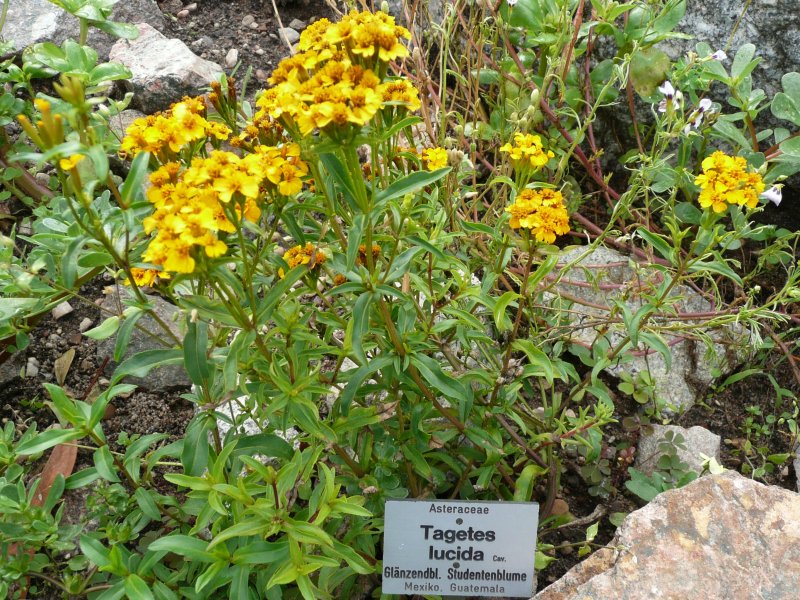
Photo: [email protected], CC BY-SA 3.0 · source

Herb · Asteraceae
Mexican tarragon
Tagetes lucida
In other languages: Mexicaanse dragon (Nederlands) · Estragon du Mexique (Français)
Mexican tarragon (Tagetes lucida) is a herb from Mexico and Central America. It forms an upright clump of narrow, glossy, toothed leaves that smell and taste strongly of aniseed, much like tarragon. It is related to the French marigold and only produces its small yellow flower heads late in the season, in September–October. It loves warmth and dry summers. In Flanders it tolerates only a light frost (about −3 °C), so grow it as an annual or overwinter it frost-free.
Light
Full sun
warm and bright
Moisture
Dry to normal
no wet feet
Legal basis
Sand or loam
any pH
Hardiness
down to -3 °C
protect in harsh winters
Size
0.6 m
tall, 0.4 m wide
Flowering
September–October
| Pruning months | April–July |
|---|---|
| Height | 0.6 m |
| Native to Belgium | No, planted |
| Good for bees, butterflies and birds | Yes, for bees |
| Poisonous to people and pets | Not known to be poisonous |
| Flowering | September–October |
Identify
Mexican tarragon: how do you recognise it?
- Habit
- Upright, branching herb 50–60 cm tall and 30–40 cm wide; in its homeland it lives for several years.
- Leaves
- Narrow, lance-shaped, 5–10 cm long with a finely toothed edge; glossy green, with a strong aniseed scent.
- Flower
- Small golden-yellow flower heads in dense clusters at the shoot tips, in September–October.
- Scent
- Sweet and aniseed-like with a hint of tarragon; strong in both leaf and flower.
- Roots
- Fibrous and shallow: it also does well in a pot or tub.
Flowering: September–October · Harvest and fruit: June–October · Sowing: March–April · Plants: May–June · Pruning: April–July
In your garden
Why grow it?
- A good substitute for tarragon: the leaves taste of aniseed and suit chicken, fish, eggs and herb butter.
- Loves sun and dry conditions, so a smart choice for a warm border, a herb garden or a pot on the patio.
- The small yellow flowers only appear in September–October, when they are a welcome source for bees.
- The whole plant smells strongly when you brush past it.
- The flowers are edible and add a sweet aniseed note to salads.
- Easy from seed: a good-sized plant in a single season.
Mexican tarragon: where does it grow best?
- Full sun and warmth: a sheltered spot by a south-facing wall or a pot on the patio.
- Well-drained soil: sand or loam, neutral to chalky; avoid heavy, wet clay.
- Dry to moderately moist: it copes with drought better than wet feet.
- Space plants 30–40 cm apart; in a pot choose a diameter of at least 25–30 cm.
- Light
- Sun
- Soil type
- Sand or loam
- Acidity
- Not fussy
- Moisture
- Dry or normal
- Size
- 0.6 m tall, 0.4 m wide
- Hardiness
- Half hardy (to -3 °C): protect it in harsh winters
Goes well with
- Basil: Likes the same warmth; together they make a herb corner for the summer kitchen.
- Rosemary: The same sunny, dry spot, with a Mediterranean scent alongside.
- Tomato: In the vegetable garden or on the patio, with flavours that go together in the kitchen.
- Dahlia: Flowers in the same late summer and brings warm colours beside the small yellow flowers.
Maintenance
Mexican tarragon: when and how to plant it?
Plant in May–June.
- Sow indoors in March–April in seed trays of seed compost; barely cover the seeds and keep them at 18–22 °C.
- Prick the seedlings out into small pots as soon as they have two true pairs of leaves.
- In May, put the young plants outside by day to harden them off to sun and wind.
- Plant them out after mid-May, when frost is no longer expected, 30–40 cm apart.
- Dig a hole as deep as the pot, firm the soil and water straight away.
Care
- Water
- Regularly at first, then sparingly: it likes dry conditions. In a pot, water weekly in warm weather.
- Feeding
- Little needed: a bit of compost at planting is enough. Too much feed gives floppy leaves with less flavour.
- Pinching out
- In June, pinch out the shoot tips for a bushy plant.
- Harvesting
- Pick or snip young shoots and leaves from June. They taste best fresh.
- In the kitchen
- Use the leaves in chicken and fish dishes, eggs, herb butter and vinegar. Add them at the end of cooking.
Tip: Add the leaves at the end of cooking: that way they keep their aniseed aroma best. Pinch out the tips for a bushy plant.
Mexican tarragon: when to prune it?
Pruning months: April–July.
When: Light pruning from May to July: pinch out the tips and harvest regularly. Cut an overwintered plant back in April.
How:
- Pinch the tips of young plants out just above a pair of leaves: this gives more side shoots.
- Harvest with a sharp knife or scissors, taking part of a shoot each time.
- Cut overwintered plants back to about 15 cm in April.
Caution: Never harvest more than a third of the plant at once, so it can keep growing.
Propagation
- Seed
- Sow indoors in March–April at 18–22 °C. The seeds germinate in about 1–2 weeks.
- Cuttings
- In August–September: take 8–10 cm cuttings from non-flowering tips and root them in moist cutting compost. Overwinter them frost-free.
Mexican tarragon: how does it get through the winter?
Hardy to −3 °C: protect in harsh winters.
- Only half hardy: it tolerates a light frost down to about −3 °C, but will not survive an ordinary Flemish winter outdoors.
- Overwintering: in October, before the first hard frosts, bring a potted plant to a light, cool spot (5–10 °C) and water it hardly at all.
- Or grow it as an annual and sow again every spring.
Diseases and pests
- Long, floppy growth: Too little light or too much feed. Move it to a sunnier spot and feed less.
- Root rot: Yellow leaves and wilting in wet soil. Make sure drainage is good and water less.
- Aphids: On young shoots. Rinse them off with water or let ladybirds clear them.
- Slugs: They strip young plants in spring. Collect them in the evening or set up a barrier.
Through the year
- March: Sow indoors at 18–22 °C.
- April: Prick out seedlings. Cut back overwintered plants.
- May: Harden off the plants, then plant out after mid-May.
- June: Pinch out the tips and start harvesting.
- July: Snip and harvest regularly. Water in dry spells, especially pots.
- August: Harvest. Take cuttings if you like.
- September: Flowering begins. Take cuttings for overwintering.
- October: Flowering. Bring a plant indoors before the first frosts.
Use
Edible and useful
- Flowers (September–October)
- The small golden flower heads only appear in September and October. They are edible and taste sweet, of aniseed: pull off the petals and scatter them over a salad, rice or a dessert.
- Leaves (June–October)
- Pick or cut young shoots and leaves from June until the first frost. The glossy leaves taste sweet, of aniseed and tarragon, and make a good substitute for tarragon. Use them with chicken, fish and eggs, in herb butter, a sauce or vinegar, and add them at the end. A few leaves are enough: the flavour is strong. The plant only tolerates light frost (down to about −3 °C): bring it indoors in October or sow again every spring.
- Storing
- Fresh is best: a bunch keeps for a few days in a glass of water or in a bag in the fridge. Dried leaves lose some of their aroma but are still useful: dry sprigs in bunches somewhere airy and dark and keep the leaves for six months in a closed jar. Or make vinegar with the fresh leaves.
Caution: Use Mexican tarragon as a kitchen herb, in small amounts: a few leaves per dish, and do not drink large amounts as tea. Not during pregnancy or breastfeeding. People allergic to the daisy family (such as chamomile or arnica) may react to it. Only use Tagetes lucida: the leaves of ordinary French and African marigolds are not a kitchen herb.
Eating and using is at your own risk: see the terms of use.
Recipes
- Mexican tarragon vinegar (Vinegar · ± 500 ml · 10 min + 2 weeks steeping)
- Chicken with Mexican tarragon and cream (Dish · 4 people · 35 min)
Good for wildlife
- Bees
- Nectar and pollen for honeybees and wild bees.
You and this species
Did you know?
- In Mexico the herb is called pericón and has been used for centuries as a seasoning and at festivals.
- It belongs to the same genus as the French marigold (Tagetes), but has a very different, sweet aroma.
- The plant flowers late: in Flanders from September until the first frost.