Photo: Wikimedia Commons, CC BY 2.5 · source

Herb · Asteraceae
Feverfew
Tanacetum parthenium
In other languages: Moederkruid (Nederlands) · Grande camomille (Français)
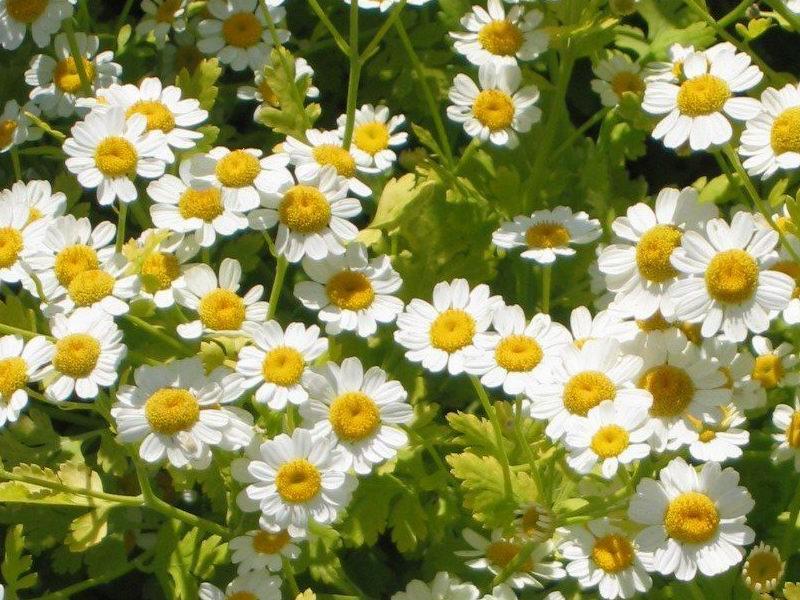
Feverfew is a short-lived perennial of the daisy family, originally from the Balkans and western Asia but naturalised throughout Europe for centuries. It forms a compact, bushy clump 40–60 cm tall, with finely cut, yellowish-green leaves that smell bitter and camphor-like. From June to September it is covered in small white daisy flowers with yellow centres. Gardeners love it because it flowers for so long, asks for little and fills every gap in the border. It is an old garden herb often seen in herb gardens. Well-known forms include ‘Aureum’, with golden-yellow leaves, and double forms with little white pompons.
Caution: Feverfew self-seeds freely and can take over a whole border or vegetable plot within a few years: remove spent flowers or weed out the seedlings while young. The leaves can irritate sensitive skin, so wear gloves. Do not let cats, dogs or horses eat it.
Light
Sun or partial shade
preferably some sun
Moisture
Dry to normal
no wet feet
Legal basis
Sand, loam or clay
any pH
Hardiness
Fully hardy
down to -20 °C
Size
0.6 m
tall, 0.4 m wide
Flowering
June–September
| Pruning months | March and July–August |
|---|---|
| Height | 0.6 m |
| Native to Belgium | No, planted |
| Good for bees, butterflies and birds | Yes, for bees |
| Poisonous to people and pets | Not known to be poisonous |
| Flowering | June–September |
Identify
Feverfew: how do you recognise it?
- Habit
- Bushy, upright clump 40–60 cm tall and 30–40 cm wide, with branched stems. Short-lived: often less attractive after two or three years.
- Leaves
- Pinnate and deeply cut, soft yellowish-green to fresh green; golden yellow in ‘Aureum’. In mild winters a leaf rosette remains.
- Flowers
- Small daisies 1.5–2 cm across with white rays and a yellow centre, in loose clusters from June to September. Double forms also exist.
- Scent
- The leaves smell strong, bitter and camphor-like when crushed.
- Roots
- Fibrous and not invasive; it spreads mainly by seed.
Flowering: June–September · Harvest and fruit: June–September · Sowing: March–May · Plants: April–May · Pruning: March and July–August
In your garden
Why grow it?
- Flowers from June to September, with dozens of small white blooms at a time.
- Easy and tough: grows in sun and partial shade, in almost any soil.
- Bees, hoverflies and other beneficial insects visit the open flowers.
- Quickly fills gaps in a young border, in the vegetable garden or between paving.
- Pretty as a filler in a small posy, and the foliage of ‘Aureum’ brightens the border all season.
- A herb-garden classic with a long history.
Feverfew: where does it grow best?
- Sun or partial shade; in full sun it flowers most freely and stays more compact.
- Almost any well-drained soil: sand, loam or clay, acid to chalky.
- Dry to moderately moist; wet feet in winter shorten its life even more.
- Plant 30–40 cm apart, in small groups among other perennials.
- Light
- Sun and partial shade
- Soil type
- Sand, loam or clay
- Acidity
- Not fussy
- Moisture
- Dry or normal
- Size
- 0.6 m tall, 0.4 m wide
- Hardiness
- Hardy (to -20 °C)
Goes well with
- Rose: Small white flowers as a loose filler between roses.
- Catmint: Blue and white along the edge of a sunny border.
- Pot marigold: Orange and white in the vegetable or herb garden.
- Lady’s mantle: Soft green and yellow next to white in partial shade.
- Lavender: A classic combination in the herb garden.
Maintenance
Feverfew: when and how to plant it?
Plant in April–May.
- Sow indoors in March on the surface: the seed needs light to germinate. Seedlings appear within two to three weeks.
- Or sow outdoors where it is to flower in April–May and thin the seedlings later.
- Plant out in April–May, after hardening off indoor-raised plants.
- Dig a hole slightly larger than the root ball; on heavy soil add some coarse sand.
- Set the plants at the same depth as in the pot, 30–40 cm apart, and firm the soil well.
- Water in well and keep moist for the first few weeks. Mulching is not needed.
Care
- Watering
- Only during long dry spells and in pots; once established it copes with a dry period.
- Feeding
- Not needed; on rich soil it becomes soft and leggy.
- Deadheading
- Remove spent flowers regularly: this extends flowering and limits self-seeding.
- Cutting back
- After the first flush in July, cut it back by half; it will regrow and flower until September.
- Renewal
- It is short-lived: leave a few seedlings each year to replace old plants.
Tip: Cut it back by half after the first flush in July: it becomes compact again, flowers once more until September and self-seeds less.
Feverfew: when to prune it?
Pruning months: March and July–August.
When: In July–August after the first flush of flowers, and in March to remove the old stems.
How:
- Remove spent flowers regularly, before the seed ripens.
- After the first flowering, cut the whole plant back by half for a new flush.
- Leave the leaf rosette in autumn; in March, cut the old, dead stems back to just above the new leaves.
- Wear gloves: the leaves can irritate sensitive skin.
Caution: If you let all the flowers set seed, you will have dozens of seedlings the following year.
Propagation
- Seed
- Indoors in March or outdoors in April–May, sown on the surface. It also self-seeds freely.
- Division
- Divide older clumps in March–April. This works, but young seedlings are often more vigorous.
- Cuttings
- In spring, take cuttings of young shoots from the base and insert them in moist cutting compost.
Feverfew: how does it get through the winter?
Hardy to −20 °C.
- Hardy to about −20 °C: no protection is needed in a normal Belgian winter.
- Wet, heavy soil in winter is a greater risk than frost.
- Leave the low leaf rosette in place over winter; it protects the crown of the plant.
- In a pot: stand it in a sheltered spot against a wall and do not let the compost become waterlogged.
Diseases and pests
- Aphids: Blackfly on the stem tips in early summer. Hose them off or pinch out the tips; ladybirds help.
- Leaf miner: Pale, winding tunnels in the leaves. Remove affected leaves; the damage is usually limited.
- Slugs: Eat young seedlings in spring. Pick them off in the evening.
- Root rot: The plant wilts and dies in wet soil. Plant in a better-drained spot and replace it with a seedling.
- Too many seedlings: Weed them out while young and easy to pull, or cut the flowers off before the seed ripens.
Through the year
- March: Sow indoors. Cut old stems back to just above the new leaves.
- April: Sow outdoors or plant out. Divide clumps.
- May: Sow outdoors. Plant. Watch for slugs and aphids.
- June: Flowering begins. Remove spent flowers.
- July: Full flower. After the first flush, cut back by half.
- August: Second flush. Weed out or keep seedlings.
- September: Last flowers. Remove flowers to limit self-seeding.
- November: Leave the leaf rosette in place for winter.
Use
Edible and useful
- Flowers (June–September)
- Feverfew is not a kitchen herb, nor a tea to make yourself: the leaves are very bitter, and it was once used as a medicinal herb, with side effects. What you can pick are the flowers, from June to September: cut stems with plenty of open flowers for a bouquet. Florists call it matricaria; the double forms have little white pompons.
- Storing
- Cut the stems in the morning and put them straight into a bucket of water; remove any leaves that would sit below the waterline. In a vase they last about a week; change the water every few days. You can also hang bunches upside down somewhere airy and dark for a dried bouquet.
Caution: Do not eat or drink feverfew. Chewing the leaves can cause mouth ulcers and a sore, swollen mouth. Not during pregnancy or breastfeeding, nor if you take blood thinners: feverfew can affect blood clotting. The leaves can irritate sensitive skin, and people allergic to the daisy family may react to them: wear gloves. Do not let cats, dogs or horses eat it.
Eating and using is at your own risk: see the terms of use.
Good for wildlife
- Bees
- Nectar and pollen for honeybees and wild bees.
You and this species
Did you know?
- The name parthenium comes from the Greek parthenos, maiden.
- ‘Aureum’, with golden-yellow leaves, was once widely used as a low edging plant in carpet bedding.
- Feverfew is related to common tansy and was formerly classed with the chrysanthemums, as Chrysanthemum parthenium.