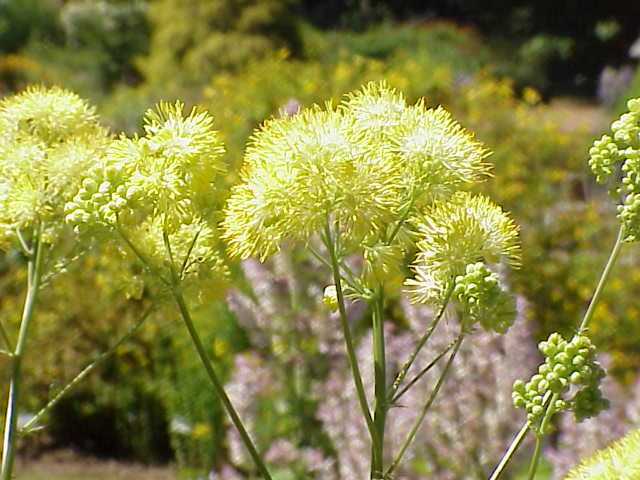
Photo: Kurt Stüber [1], CC BY-SA 3.0 · source

Perennial · Ranunculaceae
Common meadow-rue
Thalictrum flavum
In other languages: Poelruit (Nederlands) · Pigamon jaune (Français)
Common meadow-rue is a native perennial of wet meadows, riverbanks, fens and ditch sides across much of Europe. From a creeping rootstock rise sturdy stems 1–1.2 m tall with finely divided, dull green leaves that are a little reminiscent of columbine. From June to August they carry airy, upright panicles of soft yellow, lightly scented flowers that consist mainly of fluffy stamens. It brings height and a gentle colour to a bog border or pond edge without taking up much room. The form glaucum, from Spain, Portugal and North Africa, has strikingly blue-grey leaves and grows a little taller.
Caution: All parts are poisonous if eaten, as with many plants in the buttercup family. Children, cats, dogs and grazing animals such as horses and cows are at risk if they eat it. Do not plant it in or next to a grazed field, and wear gloves when cutting back and dividing.
Light
Sun or partial shade
preferably some sun
Moisture
Moist to wet
must not dry out
Legal basis
Loam, clay or peat
any pH
Hardiness
Fully hardy
down to -30 °C
Size
1.2 m
tall, 0.5 m wide
Flowering
June–August
| Pruning months | March and September |
|---|---|
| Height | 1.2 m |
| Native to Belgium | Yes |
| Good for bees, butterflies and birds | Yes, for bees |
| Poisonous to people and pets | Yes, take care with children and pets |
| Flowering | June–August |
Identify
Common meadow-rue: how do you recognise it?
- Habit
- Upright clump 1–1.2 m tall and about 50 cm wide, spreading slowly by rhizomes.
- Leaves
- Two to three times divided, with wedge-shaped leaflets lobed at the tip; dull green, blue-grey in glaucum.
- Flower
- Small flowers without true petals, with many soft yellow stamens, in dense, upright panicles from June to August. Lightly scented.
- Fruit
- Small ribbed seeds in clusters on the spent panicles.
- Roots
- A creeping, yellow rootstock with which it slowly forms a group.
Flowering: June–August · Plants: March–May and September–October · Pruning: March and September
In your garden
Why grow it?
- Soft yellow, airy flower panicles from June to August, with a light scent.
- Adds height to a wet border or pond edge, yet stays slender and takes up little ground.
- Native; bees and hoverflies collect its pollen.
- The fine, columbine-like leaves are decorative outside the flowering season too, especially on the blue-grey form glaucum.
- Grows on wet, heavy soil where many border plants struggle.
Common meadow-rue: where does it grow best?
- Sun to partial shade; in full sun it needs wet soil.
- Loam, clay or peaty soil, acid to chalky.
- Wet to very moist soil: a bog border, a ditch bank or the marsh zone of a pond, just above the water line. It tolerates some temporary water on the surface, but not permanent flooding.
- Preferably with some shelter from strong wind, as the tall stems can blow over.
- Plant 40–50 cm apart, in groups of three for a good effect.
- Light
- Sun and partial shade
- Soil type
- Loam, clay or peat
- Acidity
- Not fussy
- Moisture
- Wet
- Size
- 1.2 m tall, 0.5 m wide
- Hardiness
- Hardy (to -30 °C)
Goes well with
- Meadowsweet: Creamy, scented plumes in the same wet soil and the same months.
- Purple loosestrife: Purple spikes as a strong contrast beside the soft yellow.
- Hemp agrimony: Pink flat heads in late summer, much loved by butterflies.
- Ragged robin: Lower, pink and earlier, at the front of the pond edge.
Maintenance
Common meadow-rue: when and how to plant it?
Plant in March–May and September–October.
- Plant from March to May or in September–October, when the soil is moist.
- Dig a hole twice as wide as the pot and, on poor soil, mix in some compost.
- Set the plant at the same depth as in the pot; at a pond, the crown sits just above the water line.
- In a lined pond, plant in a large aquatic basket filled with low-nutrient aquatic soil or loam, with no potting compost or fertiliser, and stand it in the marsh zone.
- Leave 40–50 cm between plants.
- Firm in and water well. Keep wet for the first weeks.
Care
- Water
- The soil must not dry out. Outside the wet zone, water generously every week in dry summers.
- Feeding
- In a border, a layer of compost in March. Do not feed in or beside a pond, to avoid algae.
- Support
- In an open, windy spot or on rich soil, put a few canes or a ring around the clump in May.
- Spent flowers
- Leave them for seed and winter structure, or cut them off in September if you do not want seedlings.
- Mulching
- A layer of leaf mould in spring keeps the soil moist in an ordinary border.
Tip: Give it wet soil beside a ditch or pond and a little shelter from wind. For a real eye-catcher, choose the form glaucum with blue-grey leaves.
Common meadow-rue: when to prune it?
Pruning months: March and September.
When: In late February–March cut off the old stems; if you like, remove the spent panicles in September.
How:
- In March, cut all old stems down to a few centimetres above the ground, before the new shoots appear.
- If you do not want seedlings, cut off the spent panicles just above the leaves in September.
- Wear gloves and clear away the trimmings so that children and animals do not nibble them.
Caution: Do not cut into the new shoots too early in spring: they are brittle and only really grow away in April.
Propagation
- Division
- In March–April: lift the clump or cut off a piece of rootstock with buds at the edge, and replant it elsewhere at once. This also keeps the blue-grey form glaucum true.
- Seed
- Sow fresh seed in autumn in a pot of seed compost left outdoors. After the winter cold it germinates in spring.
Common meadow-rue: how does it get through the winter?
Hardy to −30 °C.
- Fully hardy, to about −30 °C: no protection is needed in Belgium.
- The parts above ground die back. Leave the stems until March for structure and for insects.
- It copes well with wet soil in winter.
Diseases and pests
- Flopping: The tall stems fall over in wind or after rain. Stake in May, feed less and plant it among other tall plants.
- Powdery mildew: White powder on the leaves in dry summers. Water in dry spells and cut off affected leaves.
- Slugs: Eat the young shoots in spring. Pick them off in the evening or spread a rough layer around the clump.
- Brown leaves: A sign of drought. Water, or move it to wetter soil.
Through the year
- March: Cut off old stems. Plant or divide.
- April: Plant. New shoots appear; watch for slugs.
- May: Add support in an open spot.
- June: Flowering starts. Bees and hoverflies on the panicles.
- July: Full flower. Water in dry spells outside the wet zone.
- August: Last flowers. The seed ripens.
- September: Cut off spent panicles if you like. Plant.
- October: Plant. Sow fresh seed in a pot outdoors.
- December: Rest. Leave the old stems standing.
Use
Edible and useful
Not edible. All parts of meadow rue (Thalictrum) are poisonous if swallowed: they contain alkaloids that cause vomiting, stomach ache and diarrhoea, as do many plants in the buttercup family. Despite the name it is not a kitchen herb and not common rue, and its fine leaves look like those of columbine or a fern: do not pick them for tea, salad or as a herb. Grazing animals such as horses, cows, sheep and goats are at risk if they eat it; common meadow rue grows wild in wet meadows. Do not plant meadow rue in or beside a field, and never throw trimmings into a field or pen. Keep young children, cats and dogs away, and wear gloves when cutting back if you have sensitive skin. If any is swallowed, call a poison centre (in Belgium 070 245 245) or your doctor at once.
Good for wildlife
- Bees
- Nectar and pollen for honeybees and wild bees.
You and this species
Did you know?
- The flowers have no true petals. The small sepals soon drop, and what you see are the many yellow stamens.
- The name meadow-rue comes from the leaves, which resemble those of the herb rue, and from the damp places where the plant grows.
- It is related to columbine, which you can see in its finely divided leaves.