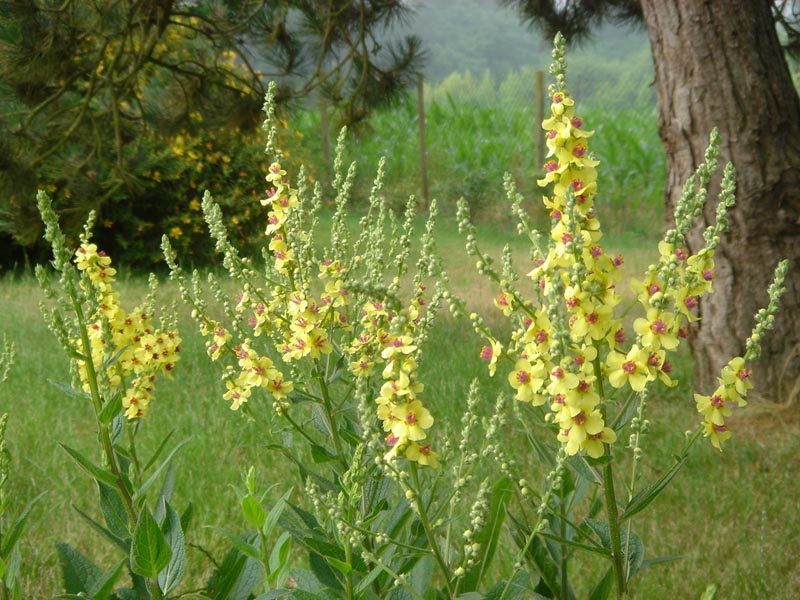
Photo: Ghislain118 http://www.fleurs-des-montagnes.net, CC BY-SA 3.0 · source

Perennial · Scrophulariaceae
Nettle-leaved mullein
Verbascum chaixii
In other languages: Toorts (Nederlands) · Molène de Chaix (Français)
This mullein comes from the mountains of southern and central Europe, where it grows on sunny slopes and at woodland edges. Unlike many mulleins, which die after two years, it is a true perennial that lasts several years. From a rosette of large, scalloped leaves, slender branched spikes about 90 cm tall rise in summer, densely set with small yellow flowers with a striking purple centre. Gardeners love its vertical accents, its long flowering season from June to August and its good drought tolerance. The cultivar ‘Album’ has white flowers, also with a purple centre.
Light
Sun or partial shade
preferably some sun
Moisture
Dry to normal
no wet feet
Legal basis
Sand, loam or clay
any pH
Hardiness
Fully hardy
down to -25 °C
Size
0.9 m
tall, 0.45 m wide
Flowering
June–August
| Pruning months | July–September |
|---|---|
| Height | 0.9 m |
| Native to Belgium | No, planted |
| Good for bees, butterflies and birds | Yes, for bees |
| Poisonous to people and pets | Not known to be poisonous |
| Flowering | June–August |
Identify
Nettle-leaved mullein: how do you recognise it?
- Habit
- A basal rosette of leaves with upright, branched flower stems 70–90 cm tall; about 45 cm wide.
- Leaves
- Large, oval, scalloped and slightly wrinkled, rather like nettle leaves; lightly hairy underneath.
- Flower
- Small, flat flowers 1.5–2 cm across, packed along slender spikes; each flower is short-lived, but new ones keep opening.
- Colour
- Soft yellow, white in ‘Album’; always with purple, woolly hairs on the stamens in the centre.
- Roots
- A deep taproot that makes it drought-tolerant but hard to move.
Flowering: June–August · Plants: March–May and September · Pruning: July–September
In your garden
Why grow it?
- Slender, vertical spikes that give structure among rounded and low plants.
- A long flowering season, from June to August, especially if you cut off faded spikes.
- Bees and bumblebees visit the flowers all summer.
- Drought-tolerant: ideal for a gravel garden or a sunny, dry border.
- Unlike many other mulleins, it stays for several years.
Nettle-leaved mullein: where does it grow best?
- Sun to light shade; it flowers best in full sun.
- Sand, loam or clay, acid to chalky, but always well drained.
- Dry to normal soil: it dislikes wet feet in winter.
- Plant 40–45 cm apart, five to six plants per m², or in small groups among other perennials.
- Light
- Sun and partial shade
- Soil type
- Sand, loam or clay
- Acidity
- Not fussy
- Moisture
- Dry or normal
- Size
- 0.9 m tall, 0.45 m wide
- Hardiness
- Hardy (to -25 °C)
Goes well with
- Woodland sage: Violet-blue spikes beside the yellow ones, for the same sunny, dry spot.
- Catmint: A low, blue cloud at the base.
- Feather grass: Fine, swaying grass that softens the stiff spikes.
- Yarrow: Flat flower heads as a contrast to the vertical spikes.
- Lavender: Fragrant grey foliage and purple flowers in a sunny, dry corner.
Maintenance
Nettle-leaved mullein: when and how to plant it?
Plant in March–May and September.
- Plant from March to May or in September, so it can root before winter.
- Dig a hole twice as wide as the pot. Lighten heavy clay with coarse sand or fine gravel.
- Set the plant at the same depth as it was in the pot: the rosette must not be buried.
- Firm the soil and water well; water again in dry spells during the first few weeks.
- If you like, mulch with gravel rather than compost: it keeps the rosette dry.
Care
- Water
- Rarely needed after the first summer. Water only in long dry spells and in pots.
- Feeding
- Not needed. In soil that is too rich the stems become floppy.
- Deadheading
- Cut the main spike back after flowering to just above a side branch: new side spikes will follow.
- Support
- Usually stands without support. In a windy spot or rich soil a cane may be needed.
- Seedlings
- Let a few spikes set seed if you want young plants: that way it stays in your garden, even when the parent plant fades after a few years.
Tip: Cut faded spikes back to just above a side branch: new side spikes will keep coming all summer. At the end, let a few self-seed so you always have young plants.
Nettle-leaved mullein: when to prune it?
Pruning months: July–September.
When: From July to September, keep cutting off the faded spikes. After the last flowers, in September, cut the stems back to the rosette.
How:
- Cut a faded spike off just above a side spike or a leaf.
- After the last flowers, cut all flower stems back to the leaf rosette.
- Leave the rosette over winter: next year’s flowers grow from it.
- If you want seedlings, let one or two spikes ripen.
Caution: Do not cut away the leaf rosette itself: next year’s spikes grow from it.
Propagation
- Root cuttings
- From December to February, cut off a piece of thick root, divide it into pieces about 5 cm long and insert them upright, top end up, in a pot of sandy cutting compost. They sprout in spring.
- Seedlings
- On bare, poor soil it often self-seeds. Move the seedlings while young, in spring or September, before the taproot is too deep.
Nettle-leaved mullein: how does it get through the winter?
Hardy to −25 °C.
- Hardy to about −25 °C: no problem in Belgium in well-drained soil.
- In winter, wet soil is more dangerous than frost: the rosette and roots then rot.
- In a pot: make sure there is a drainage hole, use gritty compost and stand the pot under cover or against a wall in winter.
Diseases and pests
- Caterpillars: Striking whitish-green caterpillars with yellow and black spots, of the mullein moth, strip the leaves in May–July. Pick them off.
- Root rot: The rosette suddenly collapses and rots in winter or after heavy rain: the soil is too wet. Replant in well-drained soil, perhaps slightly raised.
- Powdery mildew: White powder on the leaves in warm, dry weather. Not very harmful: remove affected leaves.
- Short life: After a few years the plant disappears. Keep some seedlings or take root cuttings to keep it going.
Through the year
- January: Take root cuttings during a frost-free spell.
- March: Clear dead leaves around the rosette. Plant.
- April: Plant. Move seedlings.
- May: Plant. Watch out for caterpillars.
- June: Flowering begins.
- July: In flower. Cut off faded spikes for new side spikes.
- August: In flower. Cut off faded spikes.
- September: Cut the stems back to the rosette. Plant.
- November: Rest. Make sure water does not stand around the rosette.
Use
Good for wildlife
- Bees
- Nectar and pollen for honeybees and wild bees.
You and this species
Did you know?
- The species name honours Dominique Chaix, an 18th-century French priest and botanist.
- The purple centre of the flower is made up of fine purple hairs on the stamens.
- Dried stems of large mulleins were once dipped in wax or tallow and used as torches: the Dutch name for mullein, ‘toorts’, means torch.