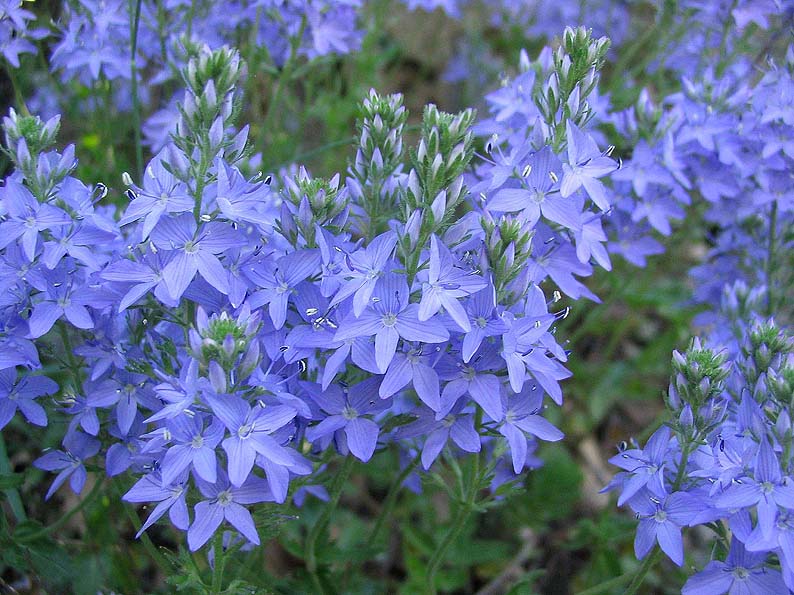
Photo: Wikimedia Commons, CC BY-SA 3.0 · source

Perennial · Plantaginaceae
Large speedwell
Veronica austriaca subsp. teucrium
In other languages: Brede ereprijs (Nederlands) · Véronique germandrée (Français)
The large speedwell grows naturally on dry, sunny grassland and slopes in southern and central Europe and western Asia. It is a low, loose clump with opposite, toothed leaves and dense, upright spikes full of intensely blue flowers from May to July. The garden cultivars ‘Royal Blue’ and ‘Crater Lake Blue’, which stay more compact and flower a deeper blue than the species, are well known. It is very hardy, likes dry, sunny soil and attracts bees and other insects. Its low growth makes it a pretty ground cover and edging plant.
Light
Full sun
warm and bright
Moisture
Dry
tolerates drought
Legal basis
Sand or loam
neutral to chalky
Hardiness
Fully hardy
down to -30 °C
Size
0.3 m
tall, 0.4 m wide
Flowering
May–July
| Pruning months | March and July |
|---|---|
| Height | 0.3 m |
| Native to Belgium | No, planted |
| Good for bees, butterflies and birds | Yes, for bees |
| Poisonous to people and pets | Not known to be poisonous |
| Flowering | May–July |
Identify
Large speedwell: how do you recognise it?
- Habit
- Low perennial 20–40 cm tall and 40 cm wide, forming a loose clump of upright to trailing stems.
- Leaves
- Opposite, oval to lance-shaped, 2–5 cm, toothed, matt green and slightly hairy.
- Flowers
- Small four-lobed flowers in dense spikes 5–10 cm long, from May to July.
- Colour
- Intense blue, often deeper in the cultivars than in the species.
- Roots
- A fibrous root system with creeping runners that slowly widen the clump.
Flowering: May–July · Plants: March–May and September–October · Pruning: March and July
In your garden
Why grow it?
- Intensely blue flowers from May to July, a rare colour in the sunny border.
- Drought-tolerant and suited to poor, chalky or sandy soil.
- Compact, low growth: ideal at the front of a border, in a rock garden or along a path.
- Bees and other insects visit the flowers.
- Little work: cutting back after flowering is the only real maintenance.
Large speedwell: where does it grow best?
- Full sun; it also flowers in light partial shade, but less freely.
- Well-drained soil: sand or loam, neutral to chalky.
- Dry to normal soil; it dislikes wet feet, especially in winter.
- Allow 40 cm per plant, or 25–30 cm for a dense edging.
- Light
- Sun
- Soil type
- Sand or loam
- Acidity
- Neutral or chalky
- Moisture
- Dry
- Size
- 0.3 m tall, 0.4 m wide
- Hardiness
- Hardy (to -30 °C)
Goes well with
- Yarrow: Flat heads in yellow or white against the blue spikes.
- Catmint: Blue-purple flowers and grey foliage, drought-tolerant.
- Stonecrop: Fleshy leaves and late flowers in the same dry sun.
- Sheep’s fescue: Fine blue-grey tufts as a calm backdrop.
Maintenance
Large speedwell: when and how to plant it?
Plant in March–May and September–October.
- Plant in March–May or in September–October, when the soil is neither frozen nor waterlogged.
- Dig a hole as wide as the root ball; on heavy clay, mix coarse sand or grit into the soil.
- Set the plant at the same depth as in its pot and firm the soil well.
- Space plants 30–40 cm apart.
- Water in straight away; in the first year water again in dry weather.
Care
- Water
- Rarely needed once established; water only during long dry spells in the first year.
- Feeding
- Not needed: on poor soil it stays compact and flowers freely.
- Mulching
- A thin layer of grit or fine stone chippings keeps the base dry and weeds down.
- Spent flowers
- Cut the spikes back after flowering; this keeps the clump compact and sometimes gives a second flush.
- Dividing
- Divide the clump every 3–4 years when the centre goes bare.
Tip: Cut back after flowering: the plant stays compact and regrows freshly. Plant it in full sun on well-drained soil.
Large speedwell: when to prune it?
Pruning months: March and July.
When: After flowering in July, with a tidy-up in March.
How:
- After flowering, cut the faded spikes and long stems back to about 10 cm above the ground.
- The plant then regrows freshly and stays compact; a second, smaller flowering sometimes follows.
- In March, remove dead foliage and dried stems.
Propagation
- Division
- In spring or in September: cut the clump with a spade into pieces with roots and shoots, and replant straight away.
- Cuttings
- In May–June take cuttings of 6–8 cm from non-flowering shoots in moist cutting compost; they root within a few weeks.
- Seed
- Sow seed of the species outdoors in spring; cultivars do not come true from seed, so increase them by division or cuttings instead.
Large speedwell: how does it get through the winter?
Hardy to −30 °C.
- Fully hardy, to about −30 °C: no protection is needed in Flanders.
- Wet winters on heavy clay are the main risk: provide good drainage and it will survive easily.
- In a pot: use soil with plenty of coarse sand and do not stand the pot in a wet corner.
Diseases and pests
- Powdery mildew: White powder on the leaves in damp, muggy weather. Allow space, cut back after flowering and remove affected leaves.
- Root rot: Limp, brown clumps in wet soil, especially in winter. Plant in a dry spot or improve the drainage.
- Bare clump: The centre opens up after a few years. Divide the clump in spring and replant the young pieces.
- Aphids: On young shoots and buds. Rinse them off with water; ladybirds usually clear them up quickly.
Through the year
- March: Tidy dead stems. Plant. Divide.
- April: Plant. Apply mulch.
- May: Flowering begins. Take cuttings.
- June: Full flower. Take cuttings.
- July: Cut back faded spikes.
- August: Water in dry weather. Possible second flowering.
- September: Plant or divide.
- October: Plant.
- November: Rest.
- December: Rest.
Use
Good for wildlife
- Bees
- Nectar and pollen for honeybees and wild bees.
You and this species
Did you know?
- Speedwell flowers have only two stamens, a striking feature of the genus Veronica.
- A single little flower lasts only briefly, but the spike stays in bloom for weeks because new flowers keep opening.
- The species name teucrium refers to the resemblance to germander (Teucrium), as the French name also shows.