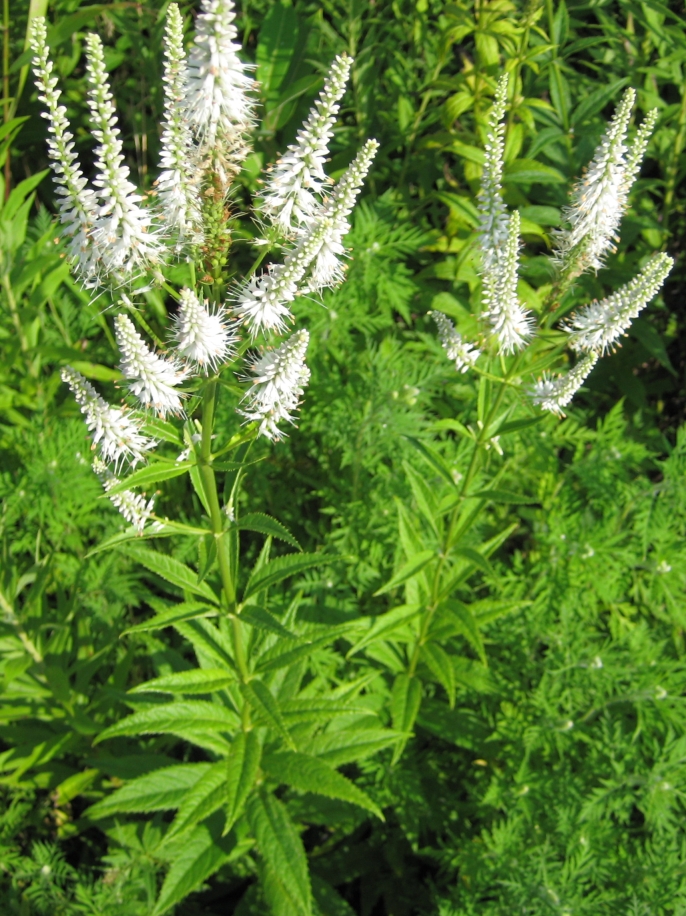
Photo: Crazytwoknobs, CC BY 3.0 · source

Perennial · Plantaginaceae
Culver's root
Veronicastrum virginicum
In other languages: Veronicastrum (Nederlands) · Véronique de Virginie (Français)
Culver’s root comes from eastern North America, where it grows in moist prairies, grasslands and woodland edges. It is a stately perennial with stiff, upright stems up to 1.6 m tall, around which the narrow leaves are arranged in whorls, like tiers. From July to September the tops carry branched, candle-shaped spikes in white, pink or lilac, like tall candelabras. Gardeners value it because it stands firm without support, attracts plenty of bees and butterflies and gives structure even in winter. Well-known cultivars are white ‘Album’, lilac-pink ‘Fascination’ and lavender-blue ‘Lavendelturm’.
Light
Sun or partial shade
preferably some sun
Moisture
Normal to wet
must not dry out
Legal basis
Loam, clay or peat
acid to neutral
Hardiness
Fully hardy
down to -30 °C
Size
1.6 m
tall, 0.6 m wide
Flowering
July–September
| Pruning months | March |
|---|---|
| Height | 1.6 m |
| Native to Belgium | No, planted |
| Good for bees, butterflies and birds | Yes, for bees and butterflies |
| Poisonous to people and pets | Not known to be poisonous |
| Flowering | July–September |
Identify
Culver's root: how do you recognise it?
- Habit
- Upright clump 1.2–1.6 m tall and about 60 cm wide, with stiff, unbranched stems.
- Leaves
- Narrow and lance-shaped, 7–15 cm, toothed, in whorls of three to seven around the stem; dark green.
- Flower
- Slender, candle-shaped spikes 10–25 cm long with hundreds of tiny tubular flowers; the main spike is surrounded by smaller side spikes, like a candelabra.
- Colour
- White, pink, lilac or lavender-blue, depending on the cultivar.
- Roots
- A tough, fibrous rhizome that slowly forms a wider clump; it does not spread aggressively.
Flowering: July–September · Plants: March–May and September–October · Pruning: March
In your garden
Why grow it?
- Tall, vertical spikes that give the border structure in late summer.
- A magnet for bees, bumblebees and butterflies from July to September.
- Stands firm without support, even after a downpour.
- The dark seed stems stay upright all winter and look stunning when frosted.
- Long-lived and low-maintenance: it rarely needs dividing.
- Fits perfectly in a naturalistic border with grasses and other prairie plants.
Culver's root: where does it grow best?
- Sun to partial shade; the stems are sturdiest in full sun.
- Loam, clay or peaty soil rich in humus, acid to neutral.
- Normal to moist soil that does not dry out in summer.
- Plant 50–60 cm apart, three plants per m², or in groups of three to five for more impact.
- Light
- Sun and partial shade
- Soil type
- Loam, clay or peat
- Acidity
- Acid or neutral
- Moisture
- Normal or wet
- Size
- 1.6 m tall, 0.6 m wide
- Hardiness
- Hardy (to -30 °C)
Goes well with
- Purple coneflower: Pink daisy flowers beside the vertical spikes.
- Joe Pye weed: Large pink flower heads at the same height.
- Switchgrass: An airy ornamental grass with lovely autumn colour.
- Great burnet: Dark red bobbles swaying between the spikes.
- Bee balm: Whorls of red or pink flowers, also popular with bees.
Maintenance
Culver's root: when and how to plant it?
Plant in March–May and September–October.
- Plant from March to May or in September–October, when the soil is not frozen or waterlogged.
- Dig a hole twice as wide as the pot and mix in a few spadefuls of compost.
- Set the plant at the same depth as it was in the pot and firm the soil well.
- Water in thoroughly, and again in dry spells during the first year.
- Mulch with compost or leaf mould to keep the soil moist.
Care
- Water
- Regularly in the first year. After that only in long dry spells: it wants soil that does not dry out.
- Feeding
- A layer of compost in spring. Too much fertiliser gives floppy stems.
- Mulching
- A layer of compost or leaf mould in March keeps the soil moist.
- Support
- Usually not needed. In too much shade or too rich a soil it may lean.
- Patience
- A young plant needs two to three years to reach full height. Leave it undisturbed.
Tip: Leave the stems standing all winter and only cut them down in late February: the dark candelabras give the winter garden structure.
Culver's root: when to prune it?
Pruning months: March.
When: Leave the stems standing all winter and cut them down in late February or March, before the new shoots appear.
How:
- Cut all stems back to just above the ground.
- Do not wait too long: the new shoots appear in April and are easily damaged.
- There is no need to deadhead: the seed stems are what makes it attractive in winter.
Propagation
- Division
- In March–April, lift a clump and split it with a sharp spade into pieces with a few buds each. The rhizome is tough: cut through it with a knife if necessary.
- Cuttings
- In May–June, take 8–10 cm cuttings from young shoots, remove the lower leaves and insert them in moist cutting compost under plastic. They root within a few weeks.
Culver's root: how does it get through the winter?
Hardy to −30 °C.
- Fully hardy, to about −30 °C: no protection is needed in Belgium.
- Leave the stems standing: when frosted, the dark spikes are a winter feature.
- In a large pot: stand it in a sheltered spot against a wall and do not let the compost dry out.
Diseases and pests
- Powdery mildew: White powder on the leaves in dry late summers. Water, leave space around the plant and remove affected leaves.
- Slugs: They eat the young shoots in April–May. Pick them off in the evening.
- Leaning stems: Too much shade or too rich a soil. Choose a sunnier spot and feed less.
- Brown leaves: A sign of drought. Water and mulch.
Through the year
- March: Cut down old stems. Add compost. Plant.
- April: Plant or divide. Watch out for slugs.
- May: Plant. Take cuttings.
- June: Take cuttings. Water in dry spells.
- July: Flowering begins.
- August: Full bloom. Water in dry spells.
- September: Last flowers. Plant.
- October: Plant. Leave the stems standing.
- December: The seed stems decorate the winter garden.
Use
Good for wildlife
- Bees
- Nectar and pollen for honeybees and wild bees.
- Butterflies
- Nectar for butterflies.
You and this species
Did you know?
- Veronicastrum means ‘resembling Veronica’, the speedwell: the suffix -astrum indicates an incomplete resemblance.
- The cultivar ‘Fascination’ owes its name to fasciation: its tips sometimes grow fused and flattened, like a fan.
- Because the leaves grow in whorls around the stem, the plant has a striking tiered shape even without flowers.