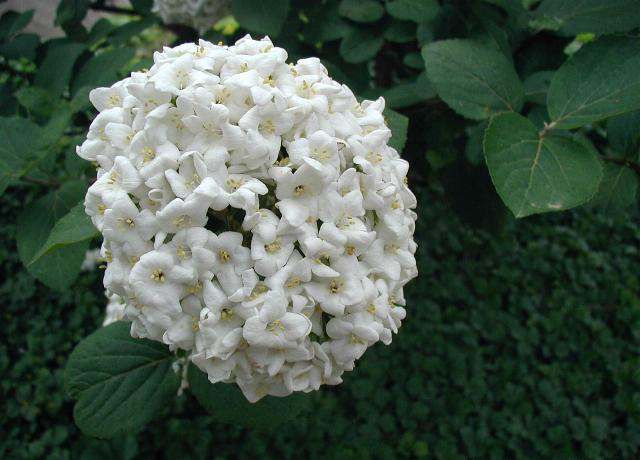
Photo: Sten at da.wikipedia, CC BY-SA 3.0 · source

Shrub · Viburnaceae
Fragrant snowball
Viburnum × carlcephalum
In other languages: Sneeuwbal (Nederlands) · Viorne (Français)
Viburnum × carlcephalum, the fragrant snowball, is a hybrid between the Korean spice viburnum and the Chinese snowball. It is a wide, loose, deciduous shrub that over the years reaches 2.5 m high and wide. In April and May it opens large, rounded flower heads of 10–15 cm: the buds are pink, the open flowers white. They have a heavy, sweet scent that drifts through the garden and attracts bees. In autumn the broad, downy leaves often turn red to orange. Fully hardy and easy in the garden.
Light
Sun or partial shade
preferably some sun
Moisture
Normal
no wet feet
Legal basis
Sand, loam or clay
any pH
Hardiness
Fully hardy
down to -25 °C
Size
2.5 m
tall, 2.5 m wide
Flowering
April–May
| Pruning months | May–June |
|---|---|
| Height | 2.5 m |
| Native to Belgium | No, planted |
| Good for bees, butterflies and birds | Yes, for bees |
| Poisonous to people and pets | Not known to be poisonous |
| Flowering | April–May |
Identify
Fragrant snowball: how do you recognise it?
- Habit
- Wide, loose, deciduous shrub up to about 2.5 m high and wide, with upright, branching stems.
- Leaves
- Broadly oval, 6–12 cm, dull green and softly hairy; red to orange in autumn.
- Flowers
- Rounded heads of 10–15 cm, pink buds, white open flowers, in April and May, strongly scented.
- Scent
- Sweet and heavy, especially in late morning and evening on warm days.
- Roots
- Fibrous and fairly shallow: the plant likes moist, humus-rich soil.
Flowering: April–May · Plants: March–April and October–November · Pruning: May–June
In your garden
Why grow it?
- Large, rounded flower heads in April–May, first pink and then white.
- A heavy, sweet scent that can be smelt far across the garden.
- Attracts bees in spring, when little else is in flower.
- Often fine autumn colour in red and orange.
- Fully hardy, happy in sun and half shade, and needs little pruning.
Fragrant snowball: where does it grow best?
- Sun to half shade; in sun it flowers best and has the finest autumn colour.
- Humus-rich, moisture-retentive but well-drained soil: sand, loam or clay, acid to chalky.
- Evenly moist to normal; water during long dry spells.
- Sheltered from strong wind, as the flower heads can be damaged in a stormy spring.
- Allow 2–2.5 m per plant and put it where you can enjoy the scent, near a patio or path.
- Light
- Sun and partial shade
- Soil type
- Sand, loam or clay
- Acidity
- Not fussy
- Moisture
- Normal
- Size
- 2.5 m tall, 2.5 m wide
- Hardiness
- Hardy (to -25 °C)
Goes well with
- Hosta: Large leaves at the base, in the same half shade.
- Rhododendron: Flowers at the same time and adds to the display on acid soil.
- Hydrangea: Takes over once the snowball has finished flowering.
- Lady’s mantle: A soft, yellow edge at the front of the border.
- Tulip: Late tulips in April–May around the base of the shrub.
Maintenance
Fragrant snowball: when and how to plant it?
Plant in March–April and October–November.
- Plant in March–April or in October–November, when the soil is neither frozen nor waterlogged.
- Dig a hole twice as wide as the root ball and mix in a few spadefuls of compost.
- Set the plant at the same depth as in its pot and firm the soil well.
- Leave 2–2.5 m between plants, or 1.5 m for an informal hedge.
- Water in thoroughly, even if it is raining.
- Lay a mulch of leaf mould or bark around the base, without covering the stem.
Care
- Water
- In the first year weekly during dry weather. Afterwards water generously at the base in very dry summers.
- Feeding
- In March or April compost or organic fertiliser for flowering shrubs.
- Mulching
- A layer of leaf mould or bark in spring keeps the soil cool and moist.
- Spent flowers
- No need to cut them off; after flowering you can remove them during the tidy-up trim.
- Tidying
- In summer, after flowering, remove dead and crossing branches.
Tip: Plant it near a patio or path, so you can enjoy its heavy scent in April–May. Prune only after flowering and only the oldest branches, or you will lose flowers the following year.
Fragrant snowball: when to prune it?
Pruning months: May–June.
When: Straight after flowering, in May–June, and only if needed.
How:
- Cut a few of the oldest or most crowded branches to the base to keep the shrub open and light.
- Remove dead, weak and crossing branches.
- Shorten overlong branches to a side shoot or bud, so the natural, loose shape is kept.
Caution: Do not prune in winter or in spring before flowering: the flower buds are already on last year’s wood and you would cut off the flowers.
Propagation
- Softwood or semi-ripe cuttings
- In June–July take cuttings of 8–10 cm from non-flowering shoots, strip the lower leaves and insert in moist compost under plastic. Rooting gives variable results.
- Layering
- In spring bend a low branch to the ground and peg it down; you can separate it after a year.
Fragrant snowball: how does it get through the winter?
Hardy to −25 °C.
- Fully hardy, to about −25 °C: no protection is needed, even in hard Belgian winters.
- Deciduous: in winter the bare, wide shrub gives calm structure to the garden.
- Young plants get a mulch around the base in their first winter.
Diseases and pests
- Viburnum leaf beetle: In May–June the larvae eat the leaves down to a lace of veins. Pick off larvae and beetles, cut off affected shoots and encourage natural enemies.
- Powdery mildew: White powder on the leaves, especially in dry weather and with too little space. Keep the shrub airy, water at the base and remove affected leaves.
- Aphids: On young shoots in May. Ladybirds usually deal with them; otherwise rinse off with water.
- Few flowers: Too much shade, pruned too hard before flowering or too much nitrogen. More sun, prune after flowering and do not overfeed.
Through the year
- March: Planting. Apply compost or fertiliser. Mulch.
- April: Flowering begins. Planting.
- May: Full flower, heavy scent and bees. Trim after flowering. Watch for leaf beetles.
- June: Tidy-up trim if needed. Pick off leaf beetle larvae.
- July: Water in dry weather.
- October: Planting. Autumn colour in red and orange.
- November: Planting. Bare, calm shrub.
Use
Good for wildlife
- Bees
- Nectar and pollen for honeybees and wild bees.
You and this species
Did you know?
- The hybrid dates from 1932 and came from the nursery of the British nurseryman Burkwood; it is a cross between the Korean spice viburnum (Viburnum carlesii) and the Chinese snowball (Viburnum macrocephalum).
- The name carlcephalum is a contraction of the names of the two parents, carlesii and macrocephalum.
- The pink buds opening to white give the flower heads a two-tone effect in April.