Photo: Joseph Dalton Hooker (1817-1911), Public domain · source

Shrub · Sapindaceae
Yellowhorn
Xanthoceras sorbifolium
In other languages: Xanthoceras (Nederlands) · Xanthocéras à feuilles de sorbier (Français)
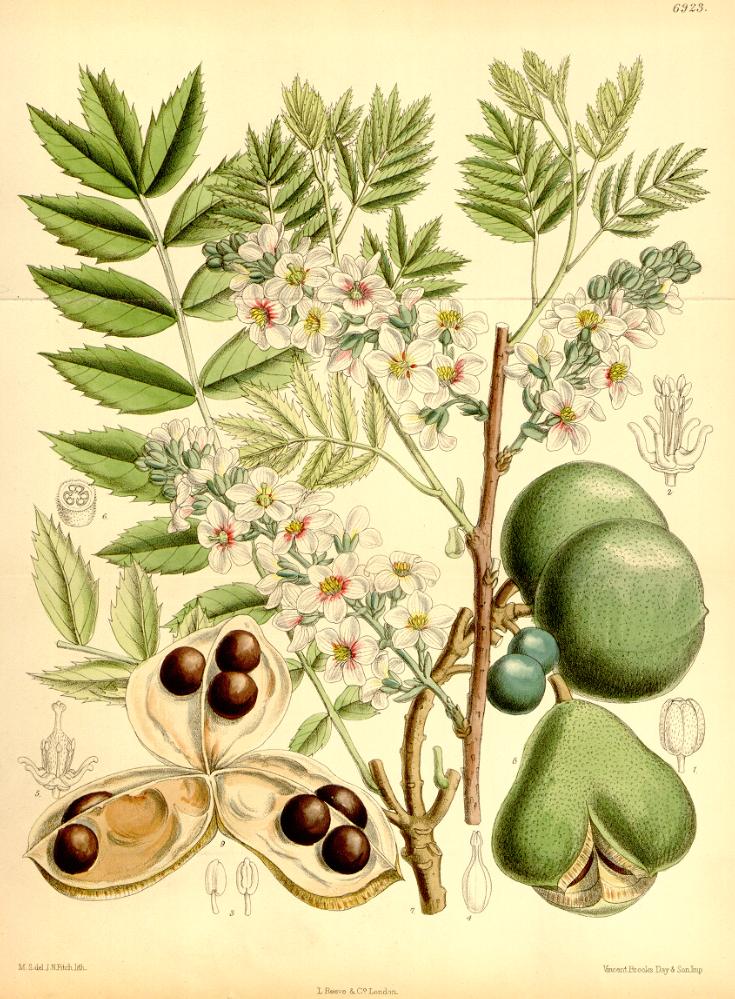
Yellowhorn comes from northern China, where it grows in dry, sunny regions. It is a small tree or large shrub with pinnate leaves that resemble those of a rowan, hence the species name sorbifolium. In May it carries upright clusters of white flowers with a centre that is first yellow and later turns red. In warm summers large, pear-shaped fruits follow, holding dark, edible seeds. It is hardy to about −30 °C, but a late spring frost can damage the flowers.
Light
Full sun
warm and bright
Moisture
Dry to normal
no wet feet
Legal basis
Sand, loam or clay
any pH
Hardiness
Fully hardy
down to -30 °C
Size
4 m
tall, 3 m wide
Flowering
May
| Pruning months | June |
|---|---|
| Height | 4 m |
| Native to Belgium | No, planted |
| Good for bees, butterflies and birds | Yes, for bees |
| Poisonous to people and pets | Not known to be poisonous |
| Flowering | May |
Identify
Yellowhorn: how do you recognise it?
- Habit
- Small tree or large shrub, 3–4 m high and 2.5–3 m wide, often multi-stemmed, with an open crown.
- Leaves
- Pinnate, 15–30 cm long, with 9–17 narrow, toothed leaflets; dark green. Falls in autumn.
- Flowers
- Upright clusters of 15–25 cm with white flowers of 2–3 cm, with a centre that is first yellow and later turns red. In May.
- Fruit
- Leathery, pear-shaped capsules of about 5–6 cm that split into three valves, with round, dark seeds of about 1 cm.
- Roots
- Deep taproot: it transplants badly.
Flowering: May · Harvest and fruit: September · Plants: March–April and October–November · Pruning: June
In your garden
Why grow it?
- Lovely flowering in May: white flower clusters with a red centre.
- Elegant, divided foliage that resembles rowan, also attractive as a specimen.
- Tolerates drought once established and grows well on poor, dry soil in sun.
- Bees visit the flowers.
- Edible seeds: in warm summers you can harvest them.
Yellowhorn: where does it grow best?
- Full sun and warmth; in shade it hardly flowers.
- Sandy, loamy or clay soil, acid to chalky, as long as it is well drained.
- Dry to normal: it tolerates drought once established, but not wet feet.
- Sheltered from late spring frost and strong wind; a warm spot with a wall or hedge behind it is ideal.
- Allow 3 m of space and choose the final spot carefully, because the taproot means it transplants badly.
- Light
- Sun
- Soil type
- Sand, loam or clay
- Acidity
- Not fussy
- Moisture
- Dry or normal
- Size
- 4 m tall, 3 m wide
- Hardiness
- Hardy (to -30 °C)
Goes well with
- Lavender: Likes the same sun and dry soil.
- Ornamental grasses: Airy plumes beneath the tree in the sun.
- Smoke bush: Warm-coloured foliage beside the fresh green.
- Coneflower: Flowers later in summer, when the tree has finished.
Maintenance
Yellowhorn: when and how to plant it?
Plant in March–April and October–November.
- Plant in March–April or in October–November, when the soil is neither frozen nor too wet. Choose a young potted plant, as older plants establish poorly.
- Dig a deep hole, twice as wide as the root ball, and loosen the bottom so the taproot can grow down.
- Do not add too much compost: poor, well-drained soil is fine.
- Set the plant at the same depth as in its pot and firm the soil.
- Water thoroughly straight away and weekly in dry weather in the first year.
- Spread a 5 cm layer of mulch around the base and, if needed, stake a young tree to keep it upright.
Care
- Water
- In the first year, weekly in dry weather so that it roots deeply. After that it usually fends for itself; water in long hot spells.
- Feeding
- Little: a bit of compost or organic fertiliser in spring.
- Mulching
- A layer of mulch keeps the soil around young plants moist and protects the roots in winter.
- Fruit
- Whether it sets fruit depends on the summer. Do not count on it every year; in warm summers you can harvest the seeds when the fruits split open.
Tip: Plant it young where it can stay and then leave it alone: because of the taproot it transplants badly. A sheltered, sunny spot protects the flowers from late frost.
Yellowhorn: when to prune it?
Pruning months: June.
When: After flowering, in June. It needs little pruning; you can remove dead wood at any time.
How:
- Remove dead, damaged or crossing branches.
- Shorten branches that are too long back to a side branch to keep a nice, open crown.
- Train a young plant over the first years into one or a few strong stems.
Caution: It flowers on last year’s wood: prune before flowering and you lose flowers.
Propagation
- Seed
- Sow fresh seed in autumn in deep pots (because of the taproot) and let them overwinter outdoors, or store it cool and moist and sow in March. Soak hard seeds in lukewarm water for a day first. Seedlings only flower after a few years.
- Root cuttings
- In winter, set pieces of root 5–8 cm long, as thick as a pencil, upright in sandy soil. In spring they may shoot.
Yellowhorn: how does it get through the winter?
Hardy to −30 °C.
- Hardy to about −30 °C: in Belgium the tree itself needs no winter protection.
- Young shoots can be damaged by an early autumn frost or a late spring frost; a sheltered spot helps.
- Give young plants a layer of mulch around the base for the first winters.
Diseases and pests
- Late frost: Flowers or young shoots turn brown after a night frost in April–May. Choose a sheltered spot and cover small plants with fleece when frost is forecast.
- Few fruits: Normal in cool summers: seed set depends on warmth. A sunny, warm spot helps.
- Poor establishment after transplanting: Because of the taproot, transplanting often fails. Plant young and do not move it afterwards.
- Root rot: Yellowing and decline on wet, compacted soil. Make sure the spot drains well, if necessary on a slight mound.
Through the year
- March: Plant. Remove dead wood.
- April: Plant. Apply mulch.
- May: Flowering: white clusters with a red centre. Cover young plants if there is a night frost.
- June: Prune lightly after flowering. Water in dry weather.
- July: Water in dry weather.
- September: After a warm summer the fruits ripen and split open: harvest the seeds.
- October: Plant. Sow seed in deep pots.
- November: Plant. Give young plants a layer of mulch.
Use
Edible and useful
- Seeds (September)
- Do not count on seeds every year: the fruits mainly set after a warm summer, and a late frost can destroy the flowers in May. In September the leathery, pear-shaped fruits split open into three parts, revealing round, dark seeds of about 1 cm. Gather them then, or take them from the open fruits. Only eat ripe seeds: dark brown to black, hard and plump; throw away pale, soft or shrivelled seeds. Under the hard seed coat is a white kernel with a mild, nutty taste. Only eat it roasted, as a nibble with drinks or scattered over a salad or soup, and in moderation: a small handful at a time.
- Storing
- Leave the seeds in their coats to dry for a week somewhere airy, then keep them in a paper bag in a cool, dry place: that way they keep for a few months. Keep roasted kernels in a closed jar and eat them within a week or two; they go rancid if left too long.
Caution: Only eat the kernel of ripe seeds, and only roasted: the fruit, the leaves and the seed coat are not eaten. Eat them in moderation and only try a few the first time: little is known about larger amounts, and as with nuts and seeds, some people may be allergic to them. Throw away seeds that are mouldy, bitter or rancid. If in doubt, leave them out. Do not confuse them with the seeds of related trees such as horse chestnut: those are poisonous.
Eating and using is at your own risk: see the terms of use.
Recipes
- Roasted yellowhorn seeds (Other · 1 small bowl · 30 min)
Good for wildlife
- Bees
- Nectar and pollen for honeybees and wild bees.
You and this species
Did you know?
- The name Xanthoceras comes from Greek: xanthos means ‘yellow’ and keras ‘horn’, after the yellow, horn-shaped projections in the flower.
- In China it is grown on a large scale for its seeds, from which oil is pressed.
- It belongs to the soapberry family (Sapindaceae), like horse chestnut, maple and lychee.