Side by side
Bamboo or Himalayan honeysuckle? How to tell them apart
Phyllostachys · Leycesteria formosa
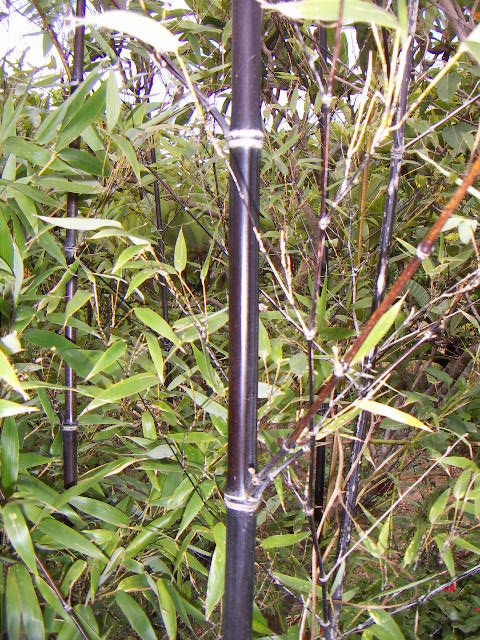
How to tell them apart – bamboo: true grass stems with nodes and long, narrow leaves; Himalayan honeysuckle: shrub with hollow, green, bamboo-like stems and hanging chains of small white flowers between claret bracts, followed by purplish-black berries.


How do you recognise them?
- Bamboo
- Evergreen, woody grass canes with nodes and narrow, lance-shaped leaves.
- Compared with Himalayan honeysuckle: true grass stems with nodes and long, narrow leaves.
- Himalayan honeysuckle
- Shrub with hollow, green, bamboo-like stems and hanging chains of small white flowers between claret bracts, followed by purplish-black berries.
| Bamboo | Himalayan honeysuckle | |
|---|---|---|
| Leaves | Narrowly lance-shaped, 5–15 cm, in fans on thin side shoots. | Opposite, 5–15 cm, oval with a long pointed tip, untoothed or slightly toothed. |
| Flowering | Flowers rarely, sometimes only after decades. | Hanging chains (5–10 cm) of small, white, funnel-shaped flowers between conspicuous claret bracts, from July to September (July–September). |
| Fruit | – | Purplish-black berries between the red bracts in late summer. |
| Bark | Hollow canes with distinct nodes; in Phyllostachys a groove above each side branch. | Hollow, blue-green stems with a waxy bloom, green even in winter. |
| Shape and height | Shrub, 3–8 m | Shrub, 1.5–2 m |
| Site | Sun or partial shade, any garden soil, normal | Sun or partial shade, any garden soil, normal |
| Native to Belgium | No, planted | No, planted |
| Good for bees, butterflies and birds | Little | – |
| Poisonous to people and pets | Not known to be poisonous | Not known to be poisonous |
| Pruning months | March–April | March–April |
What does it mean for your garden?
- Choose what suits your soil, your light and the space you have: see the growing conditions in the table.
Read on
- Plant profile: Bamboo
- Plant profile: Himalayan honeysuckle
- Bamboo: when and how to prune
- Himalayan honeysuckle: when and how to prune
- Identification key
Also looks like
This comparison is compiled from the Bladwijzer species pages.