Side by side
Bilberry or bog bilberry? How to tell them apart
Vaccinium myrtillus · Vaccinium uliginosum
How to tell them apart – bilberry: green, angled twigs, toothed pale green leaves and berries with purple flesh; bog bilberry: bluish-green, untoothed leaves, round brown twigs and berries with white flesh.
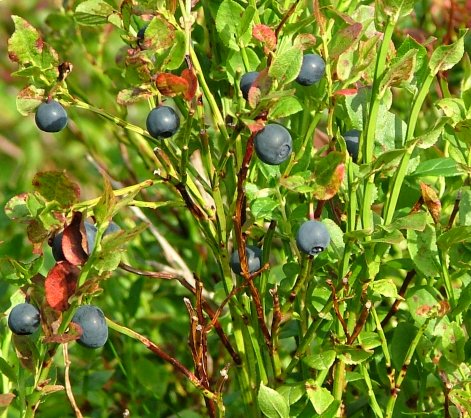


How do you recognise them?
- Bilberry
- Dwarf shrub with green, sharply angled twigs, finely toothed pale green leaves and bluish-black berries with a waxy bloom.
- Compared with bog bilberry: green, angled twigs, toothed pale green leaves and berries with purple flesh.
- Bog bilberry
- Dwarf shrub of raised bogs with bluish-green, untoothed leaves and blue berries with a waxy bloom and white flesh.
- Compared with bilberry: bluish-green, untoothed leaves, round brown twigs and berries with white flesh.
| Bilberry | Bog bilberry | |
|---|---|---|
| Leaves | Alternate, ovate, 1–3 cm, finely toothed and bright pale green; shed in autumn after turning red. | Alternate, obovate, 1–3 cm, untoothed, bluish-green with clearly visible net veins; deciduous. |
| Flowering | Greenish to pink, globe-shaped bells (5 mm), usually single in the leaf axils, April–June (April–May). | White to pink, urn-shaped bells (5 mm), 1–4 together, May–June (May–June). |
| Fruit | Bluish-black berries with a waxy bloom (5–10 mm) and purple flesh that stains tongue and fingers, July–August. | Blue berries with a waxy bloom (6–10 mm) and white flesh, July–September; edible but bland. |
| Bark | Green, sharply angled twigs that stay green in winter, growing from creeping underground runners. | Round, brown twigs (neither green nor angled). |
| Shape and height | Dwarf shrub, 20–50 cm | Dwarf shrub, 20–60 cm |
| Site | Sun or partial shade, acid soil, normal | Full sun, acid soil, moist to wet |
| Native to Belgium | Yes | Yes |
| Good for bees, butterflies and birds | – | – |
| Poisonous to people and pets | Not known to be poisonous | Not known to be poisonous |
| Pruning months | March–April | March–April |
What does it mean for your garden?
- Both are native and good for wildlife: choose what suits your soil, your light and the space you have.
Read on
- Plant profile: Bilberry
- Plant profile: Bog bilberry
- Bilberry: when and how to prune
- Bog bilberry: when and how to prune
- Identification key
Also looks like
Identify by feature
This comparison is compiled from the Bladwijzer species pages.