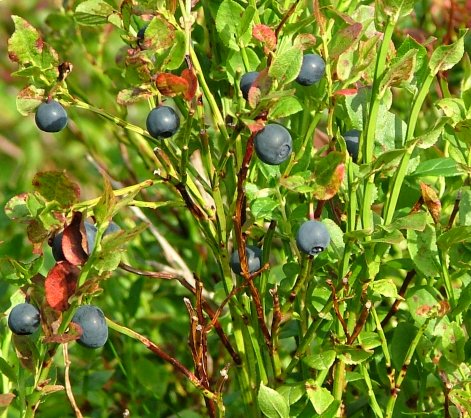
Photo: Banangraut, CC BY-SA 3.0 · source

Dwarf shrub · Heather family (Ericaceae)
Bilberry
Vaccinium myrtillus · also: Whortleberry, Blaeberry
Bilberry is a native dwarf shrub of 20–50 cm from woods and heaths on acid soil. You can recognise it by its green, sharply angled twigs and finely toothed, pale green leaves, which turn red in autumn and then fall. In July–August the small, bluish-black berries with purple flesh ripen: smaller but tastier than the cultivated blueberry. In the garden it works as ground cover under pines and oaks, on acid, humus-rich soil; on chalk or heavy clay it fails.
Caution: If you pick wild bilberries in the countryside, only do so where it is allowed, and in moderation. Wash the berries thoroughly or eat them cooked: this reduces the (small) risk of eggs of the fox tapeworm, which can end up on low-growing fruit via fox droppings.
Light
Sun or partial shade
preferably some sun
Moisture
Normal
no wet feet
Legal basis
Acid soil
acid
Hardiness
Throughout Belgium
no protection needed
Size
20–50 cm
tall
Flowering
April–May
| Pruning months | March–April |
|---|---|
| Height | 20–50 cm |
| Native to Belgium | Yes |
| Poisonous to people and pets | Not known to be poisonous |
| Flowering | April–May |
Identify
Bilberry: how do you recognise it?
- Habit
- Dwarf shrub of 20–50 cm that forms a carpet with creeping underground runners.
- Leaf
- Alternate, ovate, 1–3 cm, finely toothed and bright pale green; shed in autumn after turning red.
- Twigs
- Green, sharply angled twigs that stay green in winter, growing from creeping underground runners.
- Flower
- Greenish to pink, globe-shaped bells (5 mm), usually single in the leaf axils, April–June.
- Fruit
- Bluish-black berries with a waxy bloom (5–10 mm) and purple flesh that stains tongue and fingers, July–August.
- Difference from highbush blueberry
- The cultivated highbush blueberry is a larger shrub (1–2 m) with berries in clusters and white flesh.
- Difference from bog bilberry
- Bog bilberry has bluish-green, untoothed leaves, round brown twigs and berries with white flesh.
Flowering: April–May · Harvest and fruit: July–August · Pruning: March–April
Identify by feature: Red autumn colour · Blue berries
Looks like it, but isn’t
- Highbush blueberry Vaccinium corymbosum: a larger shrub (1–2 m) with berries in clusters and white flesh. Difference from highbush blueberry
- Bog bilberry Vaccinium uliginosum: bluish-green, untoothed leaves, round brown twigs and berries with white flesh. Difference from bog bilberry
In your garden
Why grow it?
- Wild bilberries in July–August: smaller but tastier than cultivated blueberries.
- Greenish to pink bells in spring for bumblebees; berries for birds, foxes and badgers.
- A native ground cover for the acid soil under pines and oaks.
- Red autumn colour, and green twigs in winter.
Bilberry: where does it grow best?
- Partial shade to sun: it feels at home under light trees such as pines, birches and oaks; in full sun the soil must stay moist.
- Acid, humus-rich soil (pH 4–5.5) that stays moderately moist; no lime, no heavy clay and no wet feet.
- On chalky or heavy soil it will not grow: choose the cultivated highbush blueberry in a container of ericaceous compost instead.
- Allow about 60 cm width per plant; it spreads slowly.
- Light
- Sun or partial shade
- Legal basis
- Acid soil
- Moisture
- Normal
- Size
- 0.5 m tall, 0.6 m wide
- Hardiness
- Throughout Belgium, no protection needed
Goes well with
- Scots pine: An open pine wood with bilberry as undergrowth is a typical sight on acid sandy soil.
- Sessile oak: Grows naturally with bilberry in oak woods on acid soil.
- Cowberry: An evergreen relative with red berries, for the same acid soil.
- Common honeysuckle: Climbs in the same acid oak and pine woods, and is fragrant in the evening.
Good and bad companions
Goes well with
- Suits the woodland edge or the light shade of: english oak, sessile oak, pin oak, turkey oak
- Like acid soil, just like this plant: heather, rhododendron, japanese skimmia, raspberry, highbush blueberry, witch hazel, broom, gorse
Maintenance
Bilberry: when and how to plant it?
- Plant pot-grown plants from a nursery in spring or autumn; don’t dig up plants in the woods.
- Work acid leaf mould or needle litter and some pine bark into the planting soil; no lime and no ordinary garden manure.
- Space the plants 30–40 cm apart, at the same depth as in the pot, and water in with rainwater.
- Be patient: it establishes slowly and gives few berries in the first years.
Care
- Watering
- Keep the soil moist with rainwater for the first two years; after that only in long dry spells.
- Feeding
- Not needed: a yearly layer of needle litter or acid leaf mould is enough.
- Mulching
- A layer of pine needles, oak leaves or pine bark keeps the soil acid and cool.
- Harvesting
- Pick the berries in July–August when they are fully bluish-black; a berry comb speeds things up.
Tip: If you want lots of berries in an ordinary garden, choose the cultivated highbush blueberry; the wild bilberry is mainly planted as an attractive, native ground cover. If you are still after berries, give it a light spot.
Bilberry: when to prune it?
Pruning months: March–April.
When: In March–April, if needed.
How:
- No pruning needed.
- Old, straggly plants can be cut down short: they regrow from the rhizomes.
Caution: After such rejuvenation there will be few berries for a couple of years: so don’t cut the whole carpet at once, but one part at a time.
Propagation
- Division
- In spring, cut out a piece of the carpet with rhizomes and replant it straight away, with some acid soil around the roots.
- Sowing
- Squeeze the seeds from ripe berries, sow them on ericaceous seed compost and keep them moist; it takes a few years to get a decent plant.
Bilberry: how does it get through the winter?
Hardy throughout Belgium: no protection needed.
- Fully hardy.
- Bare in winter, but the green, angled twigs keep the carpet green.
Diseases and pests
- Lime and tap water: Yellow leaves with green veins and sickly plants. Water with rainwater and mulch with needle litter.
- Drying out: Dried-up, brown twigs after a dry summer, especially in full sun. Mulch and give rainwater in dry spells.
- Few berries: Young plants, deep shade or a carpet that has just been cut back bear little fruit. Wait a few years and give a little more light.
- Birds: Blackbirds and other birds take the ripe berries. A net helps if you want to harvest yourself.
Through the year
- March: Prune if needed: cut old, straggly parts down short; planting.
- April: Last month for pruning; mulch with needle litter; flowering begins.
- May: Flowering: bells for bumblebees.
- July: The harvest begins; a net against birds.
- August: Harvest; give rainwater in dry spells.
- October: Red autumn colour; planting possible.
- November: Leave oak leaves or needles as mulch.
Use
What can you use it for?
- Food and drink
- Wild bilberries fresh, in tarts or in jam; smaller but tastier than cultivated blueberries.
- For wildlife
- Flowers for bumblebees; berries for birds, foxes and badgers.
- Garden and landscape
- Ground cover under pines and oaks on acid soil.
Edible and useful
- Berries (July–August)
- Pick the berries in July and August, on a dry day, when they are entirely blue-black with a white bloom and come away at a light touch. Pick them by hand, one at a time, and leave the little bushes intact: a berry comb also tears off twigs and young berries. Use a sturdy tub or jar and do not fill it too high, so the berries are not crushed. Picking is slow: allow well over an hour for half a kilo. Leave plenty of berries for the birds, foxes and badgers.
- Storing
- Unwashed, wild bilberries keep for a few days in the fridge in an open container. To freeze them, rinse them briefly, let them dry thoroughly and open-freeze them on a tray; then tip them into a bag so they do not stick together and stay good for a year. Jam keeps for a year in sterilised jars; dried bilberries and liqueur keep for months.
Caution: Bilberries are easy to recognise, but poisonous black berries also grow in woods. Do not confuse them with deadly nightshade (Atropa belladonna), a poisonous plant up to 1.5 m tall with large, glossy black berries sitting in a star-shaped calyx, or with herb Paris (Paris quadrifolia), a poisonous plant with four leaves in a cross and a single blue-black berry. The bilberry is a low bush of 20–50 cm with green, angular twigs, and each berry has a little crown at the tip. Never eat berries you do not know. Wild bilberries grow close to the ground: there is a small risk of fox tapeworm eggs, so wash them thoroughly or heat them (boil or bake) before eating. In many nature reserves and protected heathland you may not pick or leave the paths: do not pick there, only where it is allowed or on your own land. Do not pick beside busy roads or on sprayed ground, and never eat anything you have not identified with certainty.
Eating and using is at your own risk: see the terms of use.
Recipes
- Bilberry jam (Jam · ± 5 jars of 250 ml · 45 min)
- Bilberry liqueur (Liqueur · ± 1 litre · 20 min + 4 weeks steeping + 2 months maturing)
- Bilberry muffins (Dish · 12 muffins · 40 min)
- Dried bilberries (Dried · ± 100 g dried berries · 20 min + 8–12 hours drying)
You and this species
Did you know?
- The story that British pilots in the Second World War saw better at night thanks to bilberry jam is a myth: research found no effect on night vision.
- Unlike the cultivated blueberry, the wild bilberry is purple inside: this one does give you a blue mouth.
- The twigs stay green in winter: that way you can recognise the plant even without leaves.