Side by side
Highbush blueberry or bilberry? How to tell them apart
Vaccinium corymbosum · Vaccinium myrtillus
You can tell a highbush blueberry by its upright shrub of 1–2 m with berries in clusters and pale green to white flesh; a bilberry is a dwarf shrub of 20–50 cm with green, sharply angled twigs and small blue-black berries with purple flesh.
Cut a berry in half: white to pale green inside on the highbush blueberry, purple and staining on the bilberry. Look at the height: the highbush blueberry is a multi-stemmed shrub up to 2 m, the bilberry a low carpet of 20–50 cm. Its twigs are green and angled, those of the highbush blueberry green to red and warty.
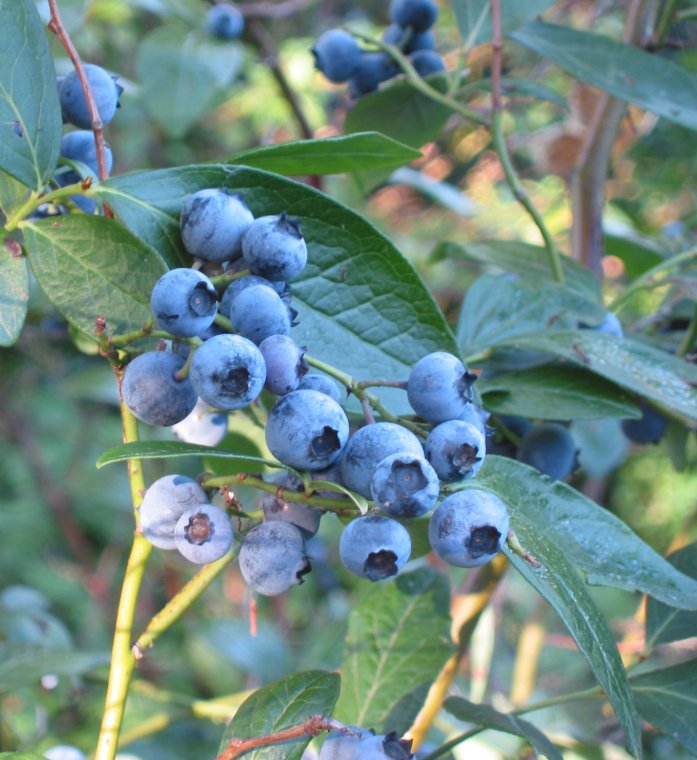
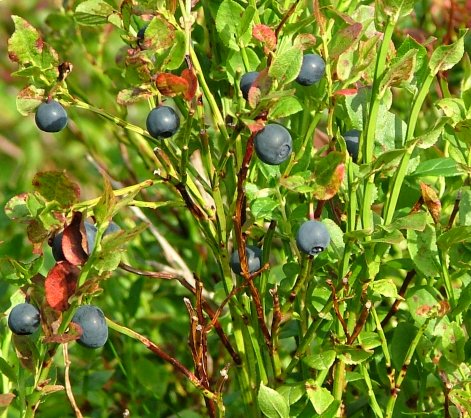


| Highbush blueberry | Bilberry | |
|---|---|---|
| Leaves | Alternate, oval, 3–8 cm, untoothed or finely toothed; glorious red autumn colour. | Alternate, ovate, 1–3 cm, finely toothed and bright pale green; shed in autumn after turning red. |
| Flowering | White to pink bells in clusters, April–May (April–May). | Greenish to pink, globe-shaped bells (5 mm), usually single in the leaf axils, April–June (April–May). |
| Fruit | Blue berries with a waxy bloom in July–August. | Bluish-black berries with a waxy bloom (5–10 mm) and purple flesh that stains tongue and fingers, July–August. |
| Bark | Green to red twigs with small warts. | Green, sharply angled twigs that stay green in winter, growing from creeping underground runners. |
| Shape and height | Shrub, 1–2 m | Dwarf shrub, 20–50 cm |
| Site | Full sun, acid soil, moist to wet | Sun or partial shade, acid soil, normal |
| Native to Belgium | No, naturalised | Yes |
| Good for bees, butterflies and birds | Yes, for bees and birds | – |
| Poisonous to people and pets | Not known to be poisonous | Not known to be poisonous |
| Pruning months | January–March | March–April |
The best feature in each season
- Spring
- Both flower with little bells: the highbush blueberry in April–May with white to pink bells in clusters, the bilberry in April–June with greenish to pink bells, usually single in the leaf axils.
- Summer
- Highbush blueberries ripen from July to September, large and in clusters; bilberries in July–August, small (5–10 mm), single and with purple flesh that stains your tongue and fingers.
- Autumn
- Both turn red: the highbush blueberry a fiery red, the bilberry red before it drops its leaves.
- Winter
- The green, sharply angled twigs of the bilberry stay green and recognisable in winter; the highbush blueberry has taller, green to red, warty twigs.
Where do they grow?
The bilberry is native and grows in woods and on heathland on acidic soil, often under pines and oaks. The highbush blueberry comes from North America and is grown here in gardens and on fruit farms.
Which one for your garden?
- Both need acidic soil, the highbush blueberry a pH of 4–5.5: in ordinary garden soil, grow it in a raised bed or large pot of ericaceous compost, and water with rainwater. It flowers for bumblebees and bees and gives the large berries you buy in the shops.
- The bilberry works as ground cover under pines and oaks on acidic, humus-rich soil; on chalk or heavy clay it will not grow. If you pick wild bilberries, only do so where it is allowed, and wash them well or eat them cooked.
Did you know? Wild bilberries stain your tongue, fingers and clothes purple, cultivated blueberries do not: so you can tell straight away which one you are eating.
Read on
- Plant profile: Highbush blueberry
- Plant profile: Bilberry
- Highbush blueberry: when and how to prune
- Bilberry: when and how to prune
- Identification key