Side by side
European larch or Japanese larch? How to tell them apart
Larix decidua · Larix kaempferi
You can tell a European larch by its yellowish twigs and little cones with straight scales; a Japanese larch has reddish-brown, bloomy twigs and round cones with scales turned outwards, like little rosettes.
Both are conifers that lose their needles in autumn. Look at the little cones: egg-shaped with straight scales on the European larch, almost round with curled-back scale edges on the Japanese larch. The twigs of the Japanese larch are strikingly reddish brown.

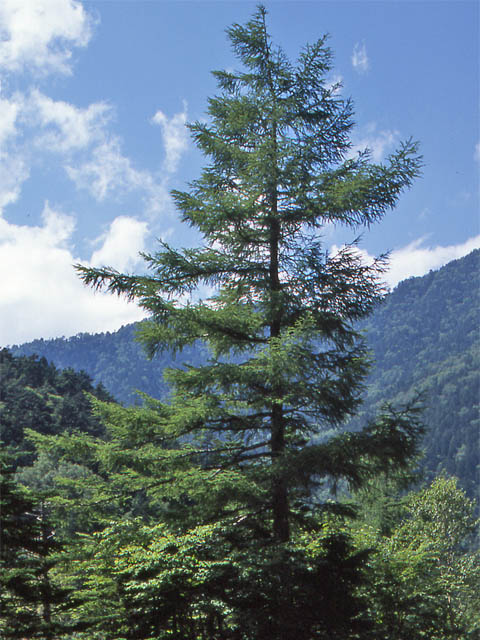


| European larch | Japanese larch | |
|---|---|---|
| Needles | Needles 2–4 cm, soft and bright light green; in tufts of 20–40 on short spurs, single on young shoots. | Needles 2–4 cm, slightly bluer green than in European larch, in tufts; they fall in autumn. |
| Flowering | – | – |
| Cones and seeds | Upright cones 2–4 cm with straight or slightly incurved scales; they stay on the tree for years. | Almost round cones 2–3 cm; the scale edges are turned outwards (rosette shape). |
| Bark | Grey-brown; on older trees thick and cracked into scales, red-brown in the fissures. | Red-brown to grey, in narrow flakes. |
| Shape and height | Conifer, 25–40 m | Conifer, 25–35 m |
| Site | Full sun, any garden soil, normal | Full sun, any garden soil, normal |
| Native to Belgium | No, naturalised | No, naturalised |
| Good for bees, butterflies and birds | Yes, for birds | Yes, for birds |
| Poisonous to people and pets | Not known to be poisonous | Not known to be poisonous |
| Pruning months | July–August and November–February | July–August and November–February |
The best feature in each season
- Spring
- In April the new needles appear in tufts: bright fresh green on the European larch, slightly more bluish green on the Japanese larch.
- Summer
- The crown of the Japanese larch is denser and broader, with bluer needles; the European larch has an open, airy crown.
- Autumn
- Both turn golden yellow and drop their needles. The little cones stay on the branches for years on both: take one in your hand and look at the edges of the scales.
- Winter
- Without needles the twigs are the best feature: yellowish to straw-coloured on the European larch, reddish brown and bloomy on the Japanese larch. The old cones hang on for years.
Where do they grow?
The European larch comes from the Alps and the Carpathians, the Japanese larch from Japan. Both are planted here in woods and parks and have naturalised in places. The Japanese larch and the hybrid larch, a cross between the two, grow faster and are the most planted in forestry.
Which one for your garden?
- Both reach 25–40 m and are too big for an ordinary garden. In a large garden or a park they bring light and the turn of the seasons, and birds such as the siskin eat their seeds.
- For a small garden there are dwarf and weeping forms, mainly of the Japanese larch. Prune little: small corrections are done in summer or winter.
Did you know? Along with the swamp cypress and the dawn redwood, larches are among the few conifers that stand completely bare in winter.
Read on
- Plant profile: European larch
- Plant profile: Japanese larch
- European larch: when and how to prune
- Japanese larch: when and how to prune
- Identification key: the question that separates them