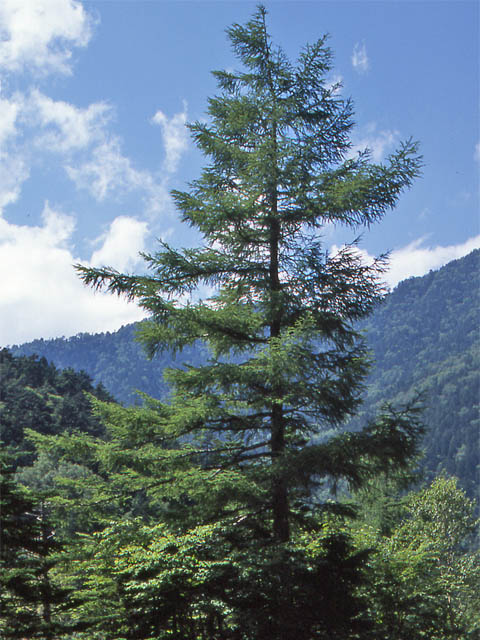
Photo: Inti-sol, CC BY-SA 3.0 · source

Conifer · Pine family (Pinaceae)
Japanese larch
Larix kaempferi
The Japanese larch looks very much like the European larch: it too has soft needles in tufts that turn yellow and fall in autumn. You recognise it by its red-brown, bloomy twigs, its slightly bluer needles and its round little cones with turned-back scales, which look like tiny roses. It grows faster than the European larch and is therefore widely used in forestry. At 25–35 m it is too big for an ordinary garden, but there are dwarf and weeping forms that fit even into a small garden.
Light
Full sun
warm and bright
Moisture
Normal
no wet feet
Legal basis
Any garden soil
any pH
Hardiness
Throughout Belgium
no protection needed
Size
25–35 m
tall
| Pruning months | July–August and November–February |
|---|---|
| Height | 25–35 m |
| Native to Belgium | No, naturalised |
| Good for bees, butterflies and birds | Yes, for birds |
| Poisonous to people and pets | Not known to be poisonous |
Identify
Japanese larch: how do you recognise it?
- Habit
- Tree of 25–35 m with a broad, conical crown about 8 m wide and fairly horizontal branches.
- Needles
- 2–4 cm, slightly bluer green than in European larch, in tufts; they fall in autumn.
- Twigs
- Red-brown and often with a bluish bloom.
- Bark
- Red-brown to grey, in narrow flakes.
- Cones
- Almost round, 2–3 cm; the scale edges are turned outwards (rosette shape).
- Difference from European larch
- European larch has yellowish twigs and cone scales without turned-back edges. Hybrid larch (Larix × marschlinsii), a cross between the two, shows intermediate forms.
Pruning: July–August and November–February
Identify by feature: Needles that fall · Needles in bundles
Looks like it, but isn’t
- European larch Larix decidua: yellowish twigs and cone scales without turned-back edges. Difference from European larch
- Hybrid larch (Larix × marschlinsii): a cross between the two, widely planted, with intermediate forms.
In your garden
Why grow it?
- Fast growth and an open, light crown that allows plenty of undergrowth.
- Fresh blue-green in spring, golden yellow in autumn.
- Red-brown twigs that add colour in winter.
- Dwarf and weeping forms suit small gardens too.
Japanese larch: where does it grow best?
- Full sun; like other larches it can’t tolerate shade.
- Almost any free-draining soil, preferably fairly moist: it likes a damp, maritime climate and struggles in prolonged drought.
- Less susceptible to larch canker than European larch.
- Allow for 25–35 m in height and a crown of about 8 m; in a small garden choose a dwarf or weeping form.
- Light
- Full sun
- Legal basis
- Any garden soil
- Moisture
- Normal
- Size
- 30 m tall, 8 m wide
- Hardiness
- Throughout Belgium, no protection needed
Goes well with
- Japanese maple: A small tree with red autumn colour, next to a dwarf or weeping form of Japanese larch.
- Rhododendron: Evergreen and flowering in May: green when the larch is bare.
- Winter heath: Flowers pink or white in winter, at the foot of a bare dwarf form.
- Silver birch: White trunks and yellow autumn leaves next to a large larch.
Good and bad companions
Goes well with
- Tolerate the shade under this tree: oregon grape, rhododendron, oleaster, japanese skimmia, garden privet, camellia, laurustinus, box-leaved honeysuckle
Maintenance
Japanese larch: when and how to plant it?
- Plant while it is leafless, from November to February.
- A pot-grown dwarf or weeping form can also be planted in spring, but not in frost or drought.
- Weeping forms are grafted onto a stem: use a sturdy stake and tie the trunk loosely.
- Protect young trees from deer and rabbits.
- Water after planting and in dry summers.
Care
- Watering
- In dry spells during the first few years, and later too in hot, dry summers.
- Feeding
- Not needed for a tree; a dwarf form in a pot gets a little compost in spring.
- Dwarf forms
- In a pot or rock garden the soil dries out quickly: water regularly in summer.
- Bare in winter
- In November all the needles fall: that is normal.
Tip: Want a larch in a small garden? Choose a weeping form such as ‘Stiff Weeping’ or a dwarf form such as ‘Blue Dwarf’: they stay small and colour just as beautifully in autumn.
Japanese larch: when to prune it?
Pruning months: July–August and November–February.
When: Dead, diseased and broken branches can be removed at any time of year. If pruning is needed, do it in winter (November–February) or in summer (July–August).
How:
- Prune as for European larch: lightly, leaving the leader intact.
- On a weeping form, cut out shoots that grow upright or trail along the ground.
- Remove wild shoots from below the graft union of a grafted form straight away.
Caution: Don’t prune in spring while the needles are emerging.
Propagation
- Sowing
- In winter, let ripe cones open somewhere warm and sow the seeds in March–April in a tray.
- Grafting
- Dwarf and weeping forms are grafted; that is a job for the nursery.
Japanese larch: how does it get through the winter?
Hardy throughout Belgium: no protection needed.
- Fully hardy.
- In winter it is bare; the red-brown twigs then add colour.
Diseases and pests
- Drought: Brown needles and early needle drop in long, dry summers. Water young trees and mulch the soil.
- Larch case-bearer: Whitened, withered needle tips in spring. A healthy tree recovers on its own.
- Woolly aphid: White, woolly tufts on the needles; usually harmless.
- Phytophthora ramorum: Dying shoots, blackened needles and resin bleeding on the trunk. In Britain this disease has affected many larch woods. If you suspect it, get an expert to take a look.
Through the year
- January: Formative pruning during dormancy; plant in mild weather.
- February: Last month for winter pruning and planting.
- March: New needles emerge: don’t prune.
- June: Water in dry spells.
- July: Summer pruning; trim weeping forms.
- August: Summer pruning still possible; water in dry summers.
- October: Golden yellow autumn colour.
- November: Needles fall; planting season and winter pruning.
- December: Winter pruning possible; protect young trees from browsing.
Use
What can you use it for?
- Wood
- Fast-growing forestry timber for cladding, posts and beams.
- Garden and landscape
- Also available in dwarf forms for small gardens.
Good for wildlife
- Birds
- Berries, seeds or insects as food, or a place to nest.
You and this species
Did you know?
- Grows faster than European larch and is therefore widely used in forestry.
- With their outward-curling scales, the little cones look like tiny wooden roses.
- Hybrid larch arose around 1900 in Scotland, at Dunkeld, where European and Japanese larches grew side by side.
- The name kaempferi honours Engelbert Kaempfer, a German physician who worked for the Dutch East India Company on Dejima in Japan in the late 17th century and described its plants.
- In the wild it grows only in the mountains of central Honshu, Japan’s largest island.